


CUET · MATHS · PYQ PAPER 2023
If \(A=\left[\begin{array}{ccc}1 & -2 & 3 \\ -4 & 2 & 4\end{array}\right]\) and \(B=\left[\begin{array}{cc}1 & -2 \\ 3 & -4 \\ 2 & 4\end{array}\right]\) then product \(A B\) is :
- A Not possible
- B \(\left[\begin{array}{ccc}1 & -6 & 6 \\ 8 & -8 & 16\end{array}\right]\)
- C \(\left[\begin{array}{c}9 \\ 19 \\ 15\end{array}\right]\)
- D \(\left[\begin{array}{cc}1 & 18 \\ 10 & 16\end{array}\right]\)
Answer & Solution
Correct Answer
(D) \(\left[\begin{array}{cc}1 & 18 \\ 10 & 16\end{array}\right]\)
Step-by-step Solution
Detailed explanation
\(A B = \left[\begin{array}{cc} (1)(1)+(-2)(3)+(3)(2) & (1)(-2)+(-2)(-4)+(3)(4) \\ (-4)(1)+(2)(3)+(4)(2) & (-4)(-2)+(2)(-4)+(4)(4) \end{array}\right]\) \(A B = \left[\begin{array}{cc} 1-6+6 & -2+8+12 \\ -4+6+8 & 8-8+16 \end{array}\right]\)…
See the Complete Solution
Get step-by-step explanations for this and 2.5 Lakh+ more JEE, NEET & CET questions.
- Unlock all solutions
- Practice the full chapter
- Track accuracy across PYQs
4.8 rated on Google Play · 14,000+ reviews
More questions from MATHS
- The value of the determinant \(\left|\begin{array}{ccc}85 & 15 & 30 \\ 1 & 3 & 4 \\ 17 & 3 & 6\end{array}\right|\) is:CUET 2023 Easy
- Match \(List - I\) with \(List - II\)
\(List - I\) \(List - II\) (A) \(\frac{d}{d x}\left(\sin x^2\right)\) (I) \(\frac{1}{5}\) (B) \(\frac{d}{d x}\left(e^{\sin x}\right)\) (II) 0 (C) \(f(x)=\tan ^{-1} x\) then \(f^{\prime}(2)\) (III) \(2 x \cos x^2\) (D) If \(y=3 \cos x-2 \sin x\), then \(\frac{d^2 y}{d x^2}+y\) (IV) \(e^{\sin x} \cos x\) CUET 2023 Medium - If \(\theta\) is the angle between the vectors \(2\hat{i} - 2\hat{j} + 4\hat{k}\) and \(3\hat{i} + \hat{j} + 2\hat{k}\), then value of \(\sin \theta\) is:CUET 2023 Easy
- If the area of the triangle with vertices \(A(1,3), B(2,0), C(k, 2 k)\) is \(\frac{k^2}{2}\) sq. units, then the value(s) of \(k\) is/are:CUET 2023 Hard
- Area of the region bounded by the curve \(y=\cos (x)\) and x -axis between \(x=0\) and \(x=\pi\) is :CUET 2023 Easy
- The value of the determinant \(\left|\begin{array}{ccc}a \cos \theta & b \sin \theta & 0 \\ -b \sin \theta & a \cos \theta & 0 \\ 0 & 0 & c\end{array}\right|\) is :CUET 2023 Easy
More PYQs from CUET
- Observe the given figure and answer the following questions:
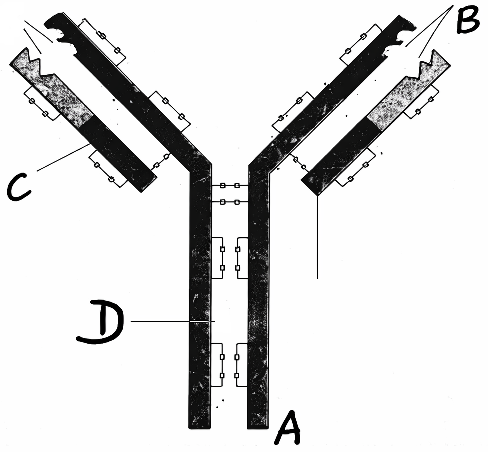
Antibody is represented as:CUET 2023 Medium - When an insect feeds on the Bt plant, the insect dies due to the conversion of inactive protein to active protein in:CUET 2024 Hard
- The electric field in a copper wire of cross-sectional area \( 4 \, mm^2 \) carrying a current of 1 A and having electrical conductivity of \( 6.25 \times 10^7 \, Sm^{-1} \) isCUET 2025 Easy
- Read the passage carefully and answer the following questions
There are mainly four series of the transition metals, \(3 d\) series ( \(S c\) to Zn), \(4 d\) series (Y to Cd), 5d series (La and Hf to Hg) and 6d series which has \(A c\) and elements from Rf to Cn. The two series of the inner transition metals; \(4 f\) (Ce to Lu) and \(5 f\) (Th to Lr) are known as lanthanoids and actinoids respectively. Their chemical properties are transitional between those of \(s\) and p-block elements. The transition metals (with the exception of Zn, Cd and Hg) are very hard and have low volatility. Their melting and boiling points are high. Transition metals have incomplete d subshell either in neutral atom or in their ions. With partly filled d orbitals these elements exhibit certain characteristic properties such as display of a variety of oxidation states, formation of coloured ions and entering into complex formation with a variety of ligands. The transition metals and their compounds are known for their catalytic activity.
In series Sc to Zn, the lowest enthalpy of atomization is shown byCUET 2025 Hard - Match List I with List II
LIST I LIST II A. Homology I. Darwin's finches B. Analogy II. Single step large mutation C. Adaptive radiation III. Convergent Evolution D. Saltation IV. Divergent Evolution
Choose the correct answer from the options given below:CUET 2023 Hard - Which of the following statements is/are true?
(A) \(B^T A B\) is a skew-symmetric matrix if \(A\) is symmetric matrix
(B) \(B^T A B\) is a symmetric matrix if \(A\) is symmetric matrix
(C) \(B^T A B\) is a symmetric matrix if \(A\) is skew-symmetric matrix
(D) \(B^T A B\) is a skew-symmetric matrix if \(B\) is skew-symmetric matrix
(E) \(B^T A B\) is a symmetric matrix if \(B\) is symmetric matrix
Choose the correct answer from the options given below :CUET 2025 Medium