


CUET · MATHS · PYQ PAPER 2023
Given relation \(R =\{(x, y): y=x+5, x<4, x, y \in N\}\). Where N is a set of natural numbers then :
- A \(R\) is an equivalence relation.
- B \(R\) is transitive but neither reflexive nor symmetric.
- C \(R\) is reflexive but neither symmetric nor transitive.
- D \(R\) is symmetric \(\backslash \&\) transitive but not reflexive.
Answer & Solution
Correct Answer
(B) \(R\) is transitive but neither reflexive nor symmetric.
Step-by-step Solution
Detailed explanation
\(x \in N, x \(R = \{(1, 6), (2, 7), (3, 8)\}\) Reflexivity: \((1, 1) \notin R\) (as \(1 \ne 1+5\)). Not reflexive. Symmetry: \((1, 6) \in R\) but \((6, 1) \notin R\) (as \(1 \ne 6+5\)). Not symmetric. Transitivity: No \((x, y) \in R\) and…
See the Complete Solution
Get step-by-step explanations for this and 2.5 Lakh+ more JEE, NEET & CET questions.
- Unlock all solutions
- Practice the full chapter
- Track accuracy across PYQs
4.8 rated on Google Play · 14,000+ reviews
More questions from MATHS
- Match List - I with List - II. Evaluate the integrals.
\(List - I\) \(List - II\) (A) \(\int_0^{\pi / 2} \frac{\sin x-\cos x}{1+\sin x \cos x} d x\) \((I)\) \(2 \pi\) (B) \(\int_0^{1 / 2} \frac{d x}{\sqrt{x-x^2}}\) \((II)\) \(\frac{\pi}{4}\) (C) \(\int_{-\pi}^\pi x \sin x d x\) \((III)\) \(0\) (D) \(\int_0^1 \frac{1}{1+x^2} d x\) \((IV)\) \(\frac{\pi}{2}\) CUET 2023 Easy - If \(\hat{a}, \hat{b}\) and \(\hat{c}\) are three units vectors and \(\hat{a}+\hat{b}+\hat{c}=\overrightarrow{0}\), then the angle between \(\hat{a}\) and ( \(-\hat{b}\) ) isCUET 2025 Hard
- If \(A=\left[\begin{array}{ccc}2 & -1 & -2 \\ 0 & 2 & -1 \\ 3 & -5 & 0\end{array}\right]\), then the value of \(\operatorname{det}(\operatorname{adj}(2 A))\) is :CUET 2025 Hard
- The number of all possible matrices of order \(2 \times 3\) with entries \(-1\) or \(1\) is:CUET 2025 Medium
- Number of solutions of the equation \(\left|\begin{array}{ccc}-1 & 0 & \sin \theta \\ \sin \theta & -1 & 0 \\ 0 & \sin \theta & -1\end{array}\right|=0\) in \((0, \pi)\) is:CUET 2023 Medium
- Solution of the inequality \(\frac{2 x+3}{4 x-5} \geq 0\) isCUET 2025 Medium
More PYQs from CUET
- The corner points of the feasible region determined by the following system of linear inequalities \(2 x+y \leq 10, x+3 y \leq 15, x, y \geq 0\) are \((0,0),(5,0),(3,4)\) and \((0,5)\). Let \(z=p x+q y\) where \(p\) and \(q>0\). The condition on \(p\) and \(q\) so that the maximum of \(z\) occurs at both \((3,4)\) and \((0,5)\) is :CUET 2023 Medium
- Observe the given figures and answer the question
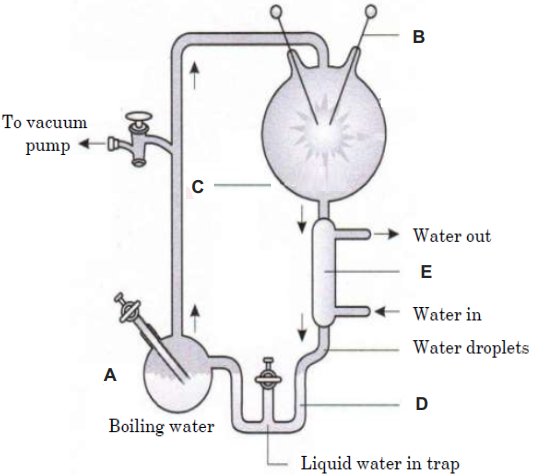
The conditions created by Miller in his experiment were:CUET 2023 Medium - Which one of the following regions will have the least number of bird species?CUET 2025 Medium
- Which of the following statements is INCORRECT about Genetic Engineering Approval Committee?CUET 2023 Medium
- The peak value of current in an ideal inductor of \((2/\pi) \text{ H}\) inductance connected to a 200 V, 50 Hz ac supply will beCUET 2025 Medium
- If \(y=\frac{1}{1+x^{b-a}+x^{a-a}}+\frac{1}{1+x^{a-b}+x^{a-b}}+\frac{1}{1+x^{a-c}+x^{b-c}}\) then \(\frac{d^2 y}{d x^2}\) is:CUET 2025 Easy