


CUET · MATHS · PYQ PAPER 2025
Consider an LPP: Maximise \(Z=50 x+15 y\) subjected to constraints
\(\begin{array}{l}x+y \leq 60 \\5 x+y \leq 100 \\x, y \geq 0\end{array}\)
If the maximum value of \(Z\) occurs at \(x=a\) and \(y=\beta\), then the value of \(a+\beta\) is :
- A 10
- B 60
- C 50
- D 40
Answer & Solution
Correct Answer
(B) 60
Step-by-step Solution
Detailed explanation
Intersection of constraints \(x+y=60\) and \(5x+y=100\): \((5x+y)-(x+y) = 100-60 \implies 4x=40 \implies x=10\) \(10+y=60 \implies y=50\) Corner points of the feasible region are \((0,0), (20,0), (10,50), (0,60)\). Evaluate \(Z=50x+15y\) at each point:…
See the Complete Solution
Get step-by-step explanations for this and 2.5 Lakh+ more JEE, NEET & CET questions.
- Unlock all solutions
- Practice the full chapter
- Track accuracy across PYQs
4.8 rated on Google Play · 14,000+ reviews
More questions from MATHS
- If the matrix \(\left[\begin{array}{ccc}-3 & x-y & 5 \\ 1 & 0 & z \\ x+y & 4 & 7\end{array}\right]\) is symmetric, then the correct option of the following, is :CUET 2023 Medium
- If \(x=a \cos \alpha+b \sin \alpha\) and \(y=a \sin \alpha-b \cos \alpha\), then \(\left(x \frac{d y}{d x}-y^2 \frac{d^2 y}{d x^2}\right)\) is equal to :CUET 2025 Easy
- The area (in sq. units) of a triangle formed by vertices \(O, A\), and \(B\) where \(\overrightarrow{O A}=\hat{i}+2 \hat{j}+3 \hat{k}\) and \(\overrightarrow{O B}=-3 \hat{i}-2 \hat{j}+\hat{k}\) isCUET 2025 Easy
- If \(A=\left[\begin{array}{cc}1 & 0 \\ -1 & 7\end{array}\right]\) and \(A^2-8 A+K I=O\), then the value of \(K\) is:CUET 2023 Easy
- A Linear Programming Problem (LPP) consists of which of the following components?
(A) Decision variables
(B) The graphical compliment
(C) The objective function
(D) The linear constraints
Choose the correct answer from the options given below :CUET 2025 Easy - The general solution of the differential equation \(\frac{d y}{d x}+y \tan x=\sec x\)CUET 2025 Medium
More PYQs from CUET
- The sum of order and degree of the differential equation \(y=x \frac{d y}{d x}+2 \sqrt{1+\left(\frac{d y}{d x}\right)^2}\) isCUET 2025 Hard
- Match List-I with List-II
Choose the correct answer from the options given below :Differential equation Degree (A) \(\frac{d^2 y}{d x^2}+\sqrt{\frac{d y}{d x}}-y=0\) (I) 6 (B) \(\sqrt{\frac{d^3 y}{d x^3}}-\sqrt[12]{\frac{d^2 y}{d x^2}}=0\) (II) not defined (C) \(\left(\frac{d^2 y}{d x^2}\right)^2+\frac{d y}{d x}+e^{\frac{d y}{d x}}=x^2\) (III) 3 (D) \(\sqrt[3]{\frac{d y}{d x}}-\frac{d^2 y}{d x^2}=e^x\) (IV) 2 CUET 2025 Hard - The value of the integral \(I=\int_0^1 \frac{1}{\sqrt{1+3 \sqrt{x}}} d x\) is:CUET 2025 Hard
- In Bohr's atomic model, the radius of the first orbit is \( r_o \). The radius of the third orbit will be :CUET 2023 Hard
- Gause's 'Competitive Exclusion Principle' states that -CUET 2025 Easy
- Match List-I (Name) with List-II (Structure)
Choose the correct answer from the options given below:List-I (Name) List-II (Structure) (A) Cinnamaldehyde (I) 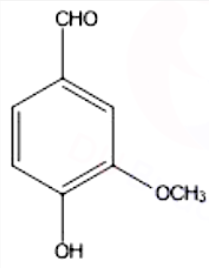
(B) Vanillin (II) 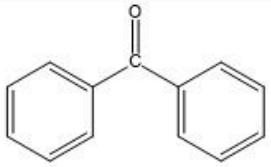
(C) Salicylaldehyde (III) 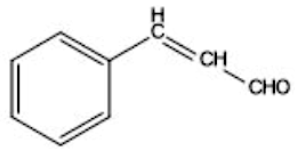
(D) Benzophenone (IV) 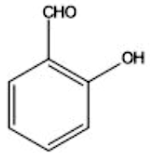 CUET 2025 Easy