


CUET · MATHS · PYQ PAPER 2025
A manufacturing unit makes two models, 'classic' and 'supreme' of the scooter.
Each piece of the classic model requires 9 labour hours for assembling and 1 labour hour for finishing.
Each piece of supreme model requires 12 labour hours for assembling and 3 labour hour for finishing.
Maximum labour hours available for assembling and finishing are 180 and 30 respectively.
Profit is Rs. 10000 on each classic piece and Rs. 15000 on each supreme piece.
Which option describes the LPP to maximize profit Z (where x and y are classic and supreme pieces)?
- A Max \(Z=10 x+15 y\), subject to \(3 x+4 y \le\) \(180, x+3 y \le\) \(30, x \ge 0, y \ge 0\).
- B \(\operatorname{Max} Z=10000 x+15000 y\), subject to \(9 x+y \le\) \(180,12 x+3 y \le \) \(30, x \ge\) \(0, y \ge 0\).
- C \(\operatorname{Max} Z=10000 x+15000 y\), subject to \(3 x+4 y \ge 180\), \(12 x+3 y \ge\) \(30, x \ge 0, y \ge 0\).
- D \(\operatorname{Max} Z=10000 x+15000 y\), subject to \(3 x+4 y \le\) \(60, x+3 y \le\) \(30, x \ge 0, y \ge 0\).
Answer & Solution
Correct Answer
(D) \(\operatorname{Max} Z=10000 x+15000 y\), subject to \(3 x+4 y \le\) \(60, x+3 y \le\) \(30, x \ge 0, y \ge 0\).
Step-by-step Solution
Detailed explanation
Maximize Profit: \(Z = 10000x + 15000y\) Subject to: Assembling hours: \(9x + 12y \le 180 \Rightarrow 3x + 4y \le 60\) Finishing hours: \(x + 3y \le 30\) Non-negativity: \(x \ge 0, y \ge 0\)
See the Complete Solution
Get step-by-step explanations for this and 2.5 Lakh+ more JEE, NEET & CET questions.
- Unlock all solutions
- Practice the full chapter
- Track accuracy across PYQs
4.8 rated on Google Play · 14,000+ reviews
More questions from MATHS
- The graph given below represents which of the following function?
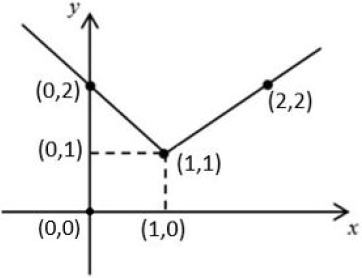 CUET 2025 Medium
 - Which constraint correctly represents the situation "Mixture of x and y must be at least 8 units"?CUET 2023 Medium
- For the matrix \(A=\left[\begin{array}{ccc}2 & -1 & -1 \\ 0 & 2 & 3 \\ 1 & -2 & 1\end{array}\right]\), which of the following statements are correct?
(A) The order of the matrix is 3 × 3
(B) |A| = 21
(C) |adj A| = 225
(D) A is skew symmetric matrix
Choose the correct answer from the options given below:CUET 2025 Easy - For a random variable \(X, E(X)=3\) and \(E\left(X^2\right)=11\), then variance of \(X\) is :CUET 2023 Medium
- The integral \(I=\int \frac{e^x}{1-e^{2 x}} d x\) is equal to :CUET 2023 Easy
- Given two independent events A and B such that P(A) = 0.3 and P(B) = 0.6,
Match the following:List - I List - II (A) P(A and B) (I) 0.28 (B) P(A and not B) (II) 0.72 (C) P(A or B) (III) 0.12 (D) P(neither A nor B) (Iv) 0.18 CUET 2023 Medium
More PYQs from CUET
- How many minimum number of times must a man toss a fair coin so that the probability of having at least one head is more than \(90 \%\) ?CUET 2025 Easy
- In a LPP:
If two corner points yield the same maximum value of the objective function of an LPP then :
(A) the LPP has unique solution
(B) the LPP has 2 solutions
(C) the LPP has 3 solutions
(D) the LPP has infinite many solutions
Choose the correct answer from the options given below :CUET 2023 Medium - Identify the correct sequence of events during menstrual cycle in human.
(A) Next cycle begins
(B) Secretory phase
(C) Follicular phase
(D) Menstruation
Choose the correct answer from the options given below:CUET 2025 Easy - The approximate volume of a cube of side a meters on increasing the side by 4% is:CUET 2023 Easy
- The most suitable substrates for preparation of following alcohol is
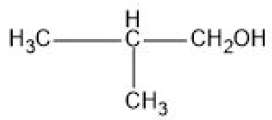 CUET 2025 Medium
 - Let \(\Delta=\left|\begin{array}{ccc}x & 2 & x \\ x^2 & x & 6 \\ x & x & 6\end{array}\right|=p x^4+q x^3+r x^2+s x+t\), then the value of \(5 p+4 q+3 r+2 s+t\) is equal to :CUET 2023 Easy