


CUET · CHEMISTRY · PYQ PAPER 2023
Which one of the following will exhibit maximum paramagnetic character?
- A \(\left[ Fe \left( H _2 O \right)_6\right]^{2+}\)
- B \(\left[ Cr \left( H _2 O \right)_6\right]^{2+}\)
- C \(\left[ Co \left( H _2 O \right)_6\right]^{2+}\)
- D \(\left[ Mn \left( H _2 O \right)_6\right]^{2+}\)
Answer & Solution
Correct Answer
(D) \(\left[ Mn \left( H _2 O \right)_6\right]^{2+}\)
Step-by-step Solution
Detailed explanation
\(\left[ Fe \left( H _2 O \right)_6\right]^{2+}\): \(Fe^{2+} \Rightarrow 3d^6 \Rightarrow n = 4\) \(\left[ Cr \left( H _2 O \right)_6\right]^{2+}\): \(Cr^{2+} \Rightarrow 3d^4 \Rightarrow n = 4\) \(\left[ Co \left( H _2 O \right)_6\right]^{2+}\):…
See the Complete Solution
Get step-by-step explanations for this and 2.5 Lakh+ more JEE, NEET & CET questions.
- Unlock all solutions
- Practice the full chapter
- Track accuracy across PYQs
4.8 rated on Google Play · 14,000+ reviews
More questions from CHEMISTRY
- Match List-I and List-II
List-I List-II A. Tranquilizers I. Ofloxacin B. Antibiotics II. Chlorodiazepoxide C. Antacids III. Seldane D. Antihistamines IV. Cimetidine
Choose the correct answer from the options given below:CUET 2023 Medium - Read the passage given below and answer the question.
The transition elements which give the greatest number of oxidation states occur in or near the middle of the series. Manganese, for example, exhibits all the oxidation states from +2 to +7. The lesser number of oxidation states at extreme ends stems from either too few electrons to lose or share (Sc, Ti) on too many d-electrons (hence fewer orbitals available in which to share electrons with others) for higher valence (Cu, Zn). Thus early in the series scandium (II) is virtually unknown and titanium (IV) is more stable than Ti (III) or Ti (II). At the other end, the only oxidation state of zinc is +2 (no d electrons are involved). The maximum oxidation states of reasonable stability correspond in value to the sum of the s- and d-electrons upto manganese (\(TiO_2, VVO^+, CrVIO_4^{2-}, MnVIIO_4\)) followed by a rather abrupt decrease in stability of higher oxidation states, so that the typical species to follow are \(Fe^{II,III}, Co^{II,III}, Ni^{II}, Cu^{I,II}, Zn^{II}\).
The variability of oxidation states, a characteristic of transition elements, arises out of incomplete filling of d-orbitaIs in such a way that their oxidation states differ from each other by unity, e.g. \(V ^{I I}, V^{I I I}, V^{I V}, V^V\). This is in contrast with the variability of oxidation states of non transition elements where oxidation states normally differ by a unit of two.
An interesting feature in the variability of oxidation states of the d-block elements is noticed among the groups (groups 4 through 10). Although in the p-block, the lower oxidation states are favoured by the heavier members (due to inert pair effect), the opposite is true in the groups of dblock. For example, in group 6, Mo(VI) and W(VI) are found to be more stable than \(Cr ( VI )\). The \(Cr ( VI )\) in the form of dichromate in acidic medium is a strong oxidising agent, whereas \(MoO _3\) and \(WO _3\) are not.
Low oxidation states are found when a complex compound has ligands capable of \(\pi\)-acceptor character in addition to the \(\sigma\)-bonding. For example, in \(Ni ( CO )_4\) and \(Fe ( CO )_5\), the oxidation state of nickel and iron is zero.
Highest oxidation state shown by 'Mn' is :CUET 2023 Hard - Match List-I With List-II
Choose the correct answer from the options below:LIST – I (Transition metal ion) LIST – II (Property) (A) \(Mn ^{3+}\) (I) \(3 d^6\), green (B) \(Fe ^{2+}\) (II) \(3 d^4\), violet (C) \(Ti ^{4+}\) (III) \(3 d^0\), colourless (D) \(V ^{2+}\) (IV) \(3 d^3\), violet CUET 2025 Easy - Which of the following compounds can be prepared by Sandmeyer's reaction?
(A) Chlorobenzene
(B) Bromobenzene
(C) Cyanobenzene
(D) Fluorobenzene
Choose the correct answer from the options given below:CUET 2025 Medium - Given below are reduction potentials :
(A) \(E _{ Cu ^{2+} / Cu }^0=0.34 V\)
(B) \(E _{ Sn ^{2+} / Sn }^0=-0.14 V\)
(C) \(E _{ Zn ^{2+} / Zn }^0=-0.76 V\)
(D) \(E _{ K ^{+} / K }^0=-2.93 V\)
The strongest reducing agent from the above is :CUET 2023 Easy - The decreasing order of reducing power of the given species as per their standard reduction potentials is :
A. \(- 2.36\)
B. \(+0.54\)
C. \(+1.23\)
D. \(-0.74\)
E. \(+ 1.81\)
Choose the correct answer from the options given below :CUET 2023 Hard
More PYQs from CUET
- Sickle cell anaemia is :CUET 2023 Medium
- The rate of change of volume of a sphere with respect to its surface area, when radius is 4 cm, is equal toCUET 2025 Medium
- If \(3\left[\begin{array}{cc}x & y \\ z & w\end{array}\right]=\left[\begin{array}{cc}x & 6 \\ -1 & 2 w\end{array}\right]+\left[\begin{array}{cc}4 & x+y \\ z+w & 3\end{array}\right]\), then the values of \(x, y, z\) and \(w\) areCUET 2025 Hard
- The constraints of the given shaded feasible region below of an L.P.P., for non-negative variable constraints \(x\) and \(y\) are
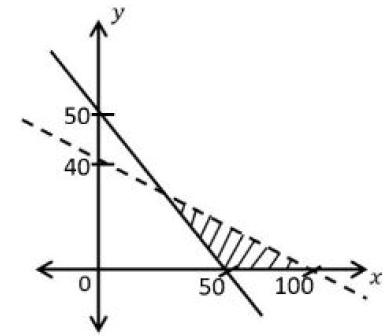 CUET 2025 Easy
 - The maximum value of \((\sin x)(\cos x)\) is :CUET 2023 Medium
- The karyotype in klinefelter's syndrome is:CUET 2023 Hard