


CUET · CHEMISTRY · PYQ PAPER 2025
Which of the following sugars will not reduce Fehling's reagent?
- A Maltose
- B Sucrose
- C Lactose
- D Fructose
Answer & Solution
Correct Answer
(B) Sucrose
Step-by-step Solution
Detailed explanation
Sucrose
See the Complete Solution
Get step-by-step explanations for this and 2.5 Lakh+ more JEE, NEET & CET questions.
- Unlock all solutions
- Practice the full chapter
- Track accuracy across PYQs
4.8 rated on Google Play · 14,000+ reviews
More questions from CHEMISTRY
- Read the passage carefully and answer the questions
Biomolecules are the organic compounds present as an essential constituents of living organisms in different cells.The molecules are generally termed as macromolecules, which are carbohydrates, enzymes, nucleic acids, amino acids and proteins etc. Carbohydrates are classified as sugars and non-sugars include sucrose, glucose, fructose, starch and cellulose. Enzymes are coordinated with various chemical reactions in nucleic acid. Nucleic acids are found in living organisms made up of proteins and natural polymers. Two types that are generally found in biological systems are DNA and RNA nucleic acid. Amino acids are bifunctional groups of carboxyl and amino groups. Proteins are a class of biologically important compounds. They are crucial to virtually all processes in living systems. Some of them are hormones, which serve as chemical messengers that coordinatecertain biochemical activities.
Glucose when treated with Bromine water formsCUET 2025 Medium - Benzene ring in phenol is expected to give the characteristic substitution or replacement reactions i.e. halogenation, nitration, sulphonation, alkylation etc. In these reactions, the attacking reagent is electrophile. The phenolic group activates the ortho and para positions in the ring due to conjugation. Disubstitution reactions are quite fast as the electron density in the ring has increased considerably. Phenols do not respond to nucleophilic substitution reactions as it is influenced by phenolic group.
Victor Meyer test gives following observations. Match List I with List II:List-I List-II A. Blood red colouration I. Tertiary alcohol B. Blue colouration II. Phenols C. Colourless solution III. Primary alcohol D. Violet colouration with \(\text{FeCl}_3\) IV. Secondary alcohol
Choose the correct answer from the options given below:CUET 2023 Easy - Lack of Vitamin B1 causes:CUET 2025 Medium
- The correct SI unit of molar conductivity is:CUET 2025 Medium
- In the following statements the in correct statement is :CUET 2023 Easy
- Formaldehyde undergoes the Cannizzaro reaction because:
(A) It has alpha-hydrogen atom.
(B) It does not have alpha-hydrogen atom.
(C) It does not undergo self-oxidation and reduction on heating with concentrated alkali.
(D) It undergoes self-oxidation and reduction on heating with concentrated alkali.
Choose the correct answer from the options given below :CUET 2024 Medium
More PYQs from CUET
- The minimum value of \(Z = 3x + 2y\) subjected to the constraints \(2x + y ≥ 7, x + 2y ≥ 8 x, y ≥ 0\) is:CUET 2025 Medium
- The integrating factor of the differential equation \(x \frac{d y}{d x}-y=2 x^2\) is :CUET 2023 Easy
- A mark placed on the surface of a sphere is viewed through glass from a position directly opposite. If the diameter of the sphere is 10 cm and refractive index of glass is 1.5, the image would be atCUET 2023 Hard
- Identify the correct statement(s) from the following Resistivity (\( \rho \)) versus Temperature (T) graphs :
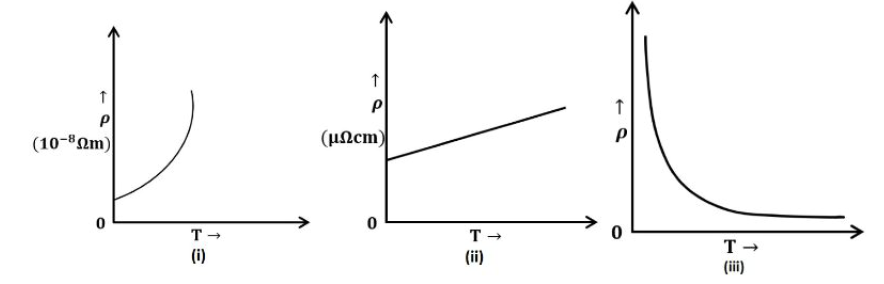
(A) Graph (i), shows \(\rho\) versus \(T\) variation for Copper
(B) Graph (ii), shows \(\rho\) versus \(T\) variation for Silicon
(C) Graph (iii), shows \(\rho\) versus \(T\) variation for semiconductor
(D) Graph (iii), shows \(\rho\) versus T variation for Nichrome
Choose the correct answer from the options given below :CUET 2025 Hard - Arrange the following radiations in the decreasing order of their energy
(A) Microwaves
(B) \( \gamma \)- rays
(C) AM radio waves (D) Infrared waves
Choose the correct answer from the options given below:CUET 2025 Hard - If \(\hat{i}, \hat{j}\) and \(\hat{k}\) are unit vectors along the co-ordinate axes OX, OY and OZ respectively, then
(A) \(\hat{i} \times \hat{j}=\hat{k}\)
(B) \(\hat{k} \times \hat{i}=-\hat{j}\)
(C) \(\hat{j} \cdot \hat{j}=1\)
(D) \(\hat{j} \cdot \hat{k}=0\)
Choose the \{correct} answer from the options given below:CUET 2025 Easy