


CUET · CHEMISTRY · PYQ PAPER 2023
Which of the following is not correct about the order of a reaction?
- A The order of a reaction is the sum of the powers of molar concentration of the reactants in the rate law expression.
- B The order of reaction is always equal to the sum of the stoichiometric coefficient of reactants in the balanced chemical equation of a reaction.
- C The order of a reaction can be a fractional number.
- D Order of a reaction is experimentally determined quantity.
Answer & Solution
Correct Answer
(B) The order of reaction is always equal to the sum of the stoichiometric coefficient of reactants in the balanced chemical equation of a reaction.
Step-by-step Solution
Detailed explanation
The order of reaction is always equal to the sum of the stoichiometric coefficient of reactants in the balanced chemical equation of a reaction.
See the Complete Solution
Get step-by-step explanations for this and 2.5 Lakh+ more JEE, NEET & CET questions.
- Unlock all solutions
- Practice the full chapter
- Track accuracy across PYQs
4.8 rated on Google Play · 14,000+ reviews
More questions from CHEMISTRY
-
List-I List-II (A) Tollen's reagent (I) Rochelle salt (B) Jones reagent (II) Conc. HCl and \(ZnCl _2\) (C) Lucas reagent (III) Ammoniacal silver nitrate (D) Fehling solution (IV) Chromium trioxide-sulfuric acid
Choose the correct match:CUET 2024 Medium - Match List I with List II.
Choose the correct answer from the options given below :List-I List-II A. \(KMnO _4\) I. Orange B. \(K _2 Cr _2 O _7\) II. Green C. \(K _2 CrO _4\) III. Yellow D. \(K _2 MnO _4\) IV. Purple CUET 2023 Easy - Read the passage carefully and answer the Questions:
Amines are classified as primary \(\left(1^{\circ}\right)\), secondary \(\left(2^{\circ}\right)\) and tertiary \(\left(3^{\circ}\right)\) depending upon the number of hydrogen atoms replaced by alkyl or aryl groups in ammonia molecules. Aliphatic amines are a stronger bases due to \(+I\) effect of an alkyl groups. Intermolecular hydrogen bonding in primary and secondary amines affects the boiling points of amines. The intermolecular association is more in primary amines than in secondary amines as there are more number of hydrogen atoms available for hydrogen bond formation. Nitro compounds are reduced to amines by passing hydrogen gas in the presence of finely divided nickel, palladium or platinum and also by reduction with metals in an acidic medium. Gabriel synthesis is used for the preparation of primary amines. Primary amines react with nitrous acid to give unstable diazonium-salts which can be used to synthesize a variety of compounds.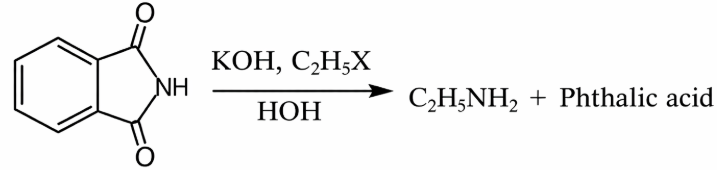
The reaction is an example of:CUET 2023 Hard - Which of the following statements are true?
(A) Decomposition of gaseous ammonia on a hot platinum surface is a zero order reaction.
(B) The rate of a reaction increases with the passage of time.
(C) A catalyst does not change the equillibrium of a reaction.
(D) The molecularity of a reaction can be zero, fraction and negative.
Choose the correct answer from the options given below:CUET 2025 Hard - Benzene ring in phenol is expected to give the characteristic substitution or replacement reactions i.e. halogenation, nitration, sulphonation, alkylation etc. In these reactions, the attacking reagent is electrophile. The phenolic group activates the ortho and para positions in the ring due to conjugation. Disubstitution reactions are quite fast as the electron density in the ring has increased considerably. Phenols do not respond to nucleophilic substitution reactions as it is influenced by phenolic group.
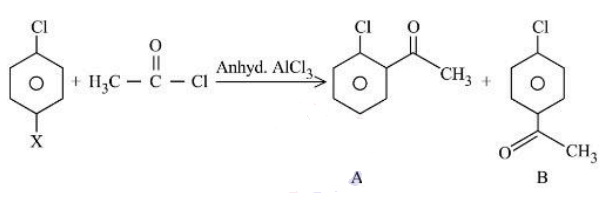
Minor product in above reaction is:CUET 2023 Hard - Answer the question on the basis of passage given below :
Aldehydes and ketones represent two essential classes of organic compounds which are extensively used in the synthesis of a wide variety of other organic molecules.
Due to the inherent polarity of the central carbonyl group, these substances readily undergo nucleophilic addition reactions.Broadly speaking, these addition reactions can be categorized into two types:
one in which simple addition of the nucleophilic reagent occurs across the \(> C = O\) bond, and the second type where the initial addition is subsequently followed by the elimination of a water molecule.
A variety of ammonia derivatives, including hydroxylamine, hydrazine, phenylhydraaine, 2, 4-dinitroplhenylhdrazine, and semicarbazide, all belong to this second category of reactions.
These specific derivatives are fundamentally used for the identification and definitive characterization of aldehydes and ketones. Significantly, both types of nucleophilic addition reactions are strongly influenced by both steric and electronic factors.
As a general rule, aliphatic aldehydes exhibit higher reactivity compared to aromatic aldehydes.
The aliphatic aldehydes demonstrate the ability to reduce both Fehling's solution and Tollen's reagent, whereas aromatic aldehydes are limited to reducing only Tollen's reagent.
In a similar manner to aldehydes, aromatic ketones are observed to be less reactive than aliphatic ketones towards all nucleophilic addition reactions.
In a separate context, phenols and carboxylic acids both exhibit acidic properties in nature.
Both classes of compounds readily dissolve in NaOH solution and cause blue litmus to turn red.
However, carboxylic acids stand out as much stronger acids than phenols and thus can decompose sodium bicarbonate \(\left( NaHCO _3\right)\) with the distinct evolution of \(CO _2\) gas, a reaction which phenols do not undergo.
It is important to note that both electron- donating and electron- withdrawing substituents significantly influence the acid strength of both aliphatic as well as aromatic carboxylic acids.
Furthermore, unlike all other common aliphatic acids, formic acid uniquely possesses reducing properties and simultaneously does not display the typical reactions characteristic of the alkyl group.
Carboxylic acid do not give the characteristic reaction of carbonyl group because:CUET 2023 Medium
More PYQs from CUET
- If \(e^x+e^y=e^{x+y}\), then \(\frac{d y}{d x}\) equalsCUET 2025 Easy
- Read the passage carefully and answer the Questions:
According to Valence Bond theory, the metal atom or ion under the influence of ligands can use its ( \(n-1\) )d, \(n s, n p\) or \(n s, n p, n d\) orbitals for hybridisation to yield a set of equivalent orbitals of definite geometry such as octahedral, tetrahedral, square planar and so on. These hybridised orbitals are allowed to overlap with ligand orbitals that can donate electron pairs for bonding. While the VB theory, to a larger extent, explains the formation, structures and magnetic behaviour of coordination compounds, it suffers from the many shortcomings. The Crystal field theory (CFT) is an electrostatic model which considers the metal-ligand bond to be ionic arising purely from electrostatic interactions between the metal ion and the ligand. The five \(d\) orbitals in an isolated gaseous metal atom/ion have same energy, i.e., they are degenerate. This degeneracy is maintained if a spherically symmetrical field of negative charges surrounds the metal atom/lon. However, when this negative field is due to ligands in a complex, it becomes asymmetrical and the degeneracy of the \(d\) orbitals is lifted. It results in splitting of the \(d\) orbitals. The pattern of splitting depends upon the nature of the crystal field.
Which of the following is not true about the limitations of VBT:CUET 2023 Medium - The point estimate of the population standard deviation for the random sample \(5,8,10,7,10,14\) is :CUET 2025 Medium
- Question 4 (IUPAC Name of Freon 12):
The correct IUPAC name of Freon 12 isCUET 2025 Hard - Match List-I with List-II
Choose the correct answer from the options given below :List - I List - II (A) \(\sin ^{-1}(-1)\) (I) \(\frac{5 \pi}{6}\) (B) \(\cot ^{-1}(-1)\) (II) \(-\frac{\pi}{2}\) (C) \(\sec ^{-1}\left(-\frac{2}{\sqrt{3}}\right)\) (III) \(\frac{\pi}{4}\) (D) \(\tan ^{-1}(1)\) (IV) \(\frac{3 \pi}{4}\) CUET 2025 Hard - Match List-l with List-ll
Choose the correct answer from the options given below:List-l (Rate expression) List-II (Overall order of reaction) (A) \(r=k[A]^{0.2}[B]^{0.3}[C]\) (I) \(\frac{3}{10}\) (B) \(r=k[A]^{0.2}[B]^{-0.3}[C]\) (II) 1 (C) \(r=k[A][B]^{0.8}[C]^{-1}\) (III) \(3 / 2\) (D)\(r=k[A]^{0.2}[B]^{0.3}[C]^{0.5}\) (IV) \(9 / 10\) CUET 2025 Hard