


CUET · CHEMISTRY · PYQ PAPER 2025
When we consider a balanced chemical equation of an elementary reaction which statement is applicable on it?
(A) Molecularity can never be zero
(B) Order is less than molecularity
(C) Order is equal to molecularity
(D) Order is greater than the molecularity
Choose the correct answer from the options given below:
- A (A), (B) and (D) only
- B (A), (B) and (C) only
- C (A) and (C) only
- D (B), (C) and (D) only
Answer & Solution
Correct Answer
(C) (A) and (C) only
Step-by-step Solution
Detailed explanation
(A) Molecularity can never be zero (Correct) (C) Order is equal to molecularity (Correct) (A) and (C) only
See the Complete Solution
Get step-by-step explanations for this and 2.5 Lakh+ more JEE, NEET & CET questions.
- Unlock all solutions
- Practice the full chapter
- Track accuracy across PYQs
4.8 rated on Google Play · 14,000+ reviews
More questions from CHEMISTRY
- Read the following passage given below and answer the question.
Aldehydes and ketones undergo nucleophilic addition reactions. A nucleophile attacks the electrophilic carbon atom of polar carbonyl group from perpendicular to plane of \(sp^2\) hybridised orbitals of carbonyl carbon. The hybridisation of carbon changes from \(sp^2\) to \(sp^3\) and a tetrahedral alkoxide intermediate is formed. This captures \(H^+\) to give neutral product. In carboxylic acids, carbonyl carbon is less electrophilic than carbonyl carbon in aldehydes and ketones.How will you convert acetaldehyde to lactic acid ?CUET 2023 Medium - Read the passage carefully and answer
When a metal is placed in a solution of its ions, the metal can lose electron and can go in the solution as ion or the metal ion in the solution can take electron from the electrode and get deposited as metal. Thus, the electrode acquires either positive or negative charge with respect to the solution leading to the development of a potential difference between the metal electrode and the solution. This potential difference is called the electrode potential of the metal. The electrode potential of a metal is a measure of relative tendency to undergo oxidation (loss of electron) or reduction (gain of electron). When the concentration of the ions in the solution is unity, the electrode potential is called standard electrode potential. The magni of potential depends upon the nature of electrode, concentration of ions in solution and the temperature. In a galvanic cell, the electrode at which oxidation occurs is known as anodic half-cell and the electrode at which reduction occurs is known as cathodic half cell. The emf of the cell in terms of standard reduction potential is given by \(E_{\text {cell }}^{\circ}=E_{\text {cathode }}^{\circ}-E_{\text {anode. }}^{\circ}\).The standard free energy change of the redox reaction taking place in the cell is related to \(E_{\text {cell }}^{\circ}\) by \(\Delta G^{\circ}=-n F E^{\circ}\). A redox reaction would occur spontaneously if the free energy change is negative. The equilibrium constant of the reaction is related to the standard free energy change by \(\Delta G^{\circ}=-R T \ln K\).
The equillibrium constant of a feasible cell reaction isCUET 2025 Hard - Read the passage carefully and answer the questions based on the passage:
Alcohols are versatile compounds as they can act as both nucleophile and electrophile. They undergo reactions based on cleavage of O-H and C-O bonds. The cleavage of O-H bond reflects the acidic character of alcohols. However they are weaker acids than water, phenol and carboxylic acids. Alkoxide ion formed by loss of proton from the OH group of alcohols reacts with water to form the corresponding conjugate acid - base pair. They act as Bronsted base due to presence of unshared electron pairs on oxygen.Both alcohols and phenol react with carboxylic acids, acid chlorides and anhydrides to form esters. The introduction of acetyl group in alcohols or phenol is known as acetylation. Alcohols react with hydrogen halides to form alkyl halides which form the basis of Lucas test. They also undergo acid catalyzed dehydration to form alkenes. Alcohols can be easily oxidized with variety of oxidizing agents. The nature of the product depends on the type of oxidizing agent and the nature of alcohol.
Which of the following gives the correct sequential steps for dehydration of alcohol?CUET 2025 Hard - Haloalkanes can be represented by the formulaCUET 2025 Easy
- Calculate the oxidation number of cobalt in
\(\mathrm{K}\left[\mathrm{Co}(\mathrm{CO})_4\right]\)CUET 2025 Hard - Calculate the magnetic moment (spin-only) of a trivalent ion in aqueous solution if its atomic number is 22 .CUET 2025 Hard
More PYQs from CUET
- Observe the figure and answer the following:
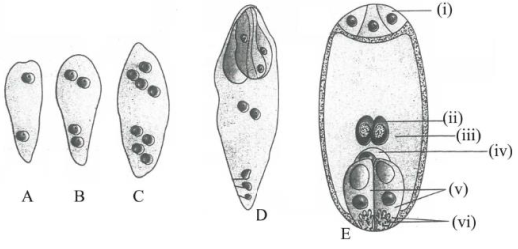
The given diagram represents stages (A-E) of development of the embryo sac in angiosperms. Which of the following correctly identifies the structure labelled (ii), (iii), (iv), (v), and (vi) in figure E?CUET 2023 Easy - Match the complexes given in List-I with oxidation state and the type of complexes given in List-II
Choose the correct answer from the options given below:List-I (Complex) List-II (Oxidation state and type of complex) (A) \(\left[ Co \left( NH _3\right)_6\right]^{3+}\) (I) +2 and Inner orbital complex (B) \(\left[ CoF _6\right]^{3-}\) (II) +2 and Outer orbital complex (C) \(\left[ NiCl _4\right]^{2-}\) (III) +3 and Outer orbital complex (D) \(\left[ Ni ( CN )_4\right]^{2-}\) (IV) +3 and Inner orbital complex CUET 2025 Hard - Which of the following statement is correct about catalyst?CUET 2023 Hard
- If \(\left|\begin{array}{ccc}x-2 & 1 & 2 \\ 1 & 2 x & 1 \\ -1 & 1 & 1\end{array}\right|=3\) then the values of x are:CUET 2023 Medium
- A long solenoid is formed by winding 40 turns/cm. The current required to produce a magnetic field of 22 mT inside the solenoid will be (Take \( \mu_0 = 4\pi \times 10^{-7} \, Tm A^{-1} \))CUET 2025 Medium
- If both the number of turns and length of an inductor are tripled, keeping other factors constant, the self inductance of the inductor will be:CUET 2025 Easy