


CUET · CHEMISTRY · PYQ PAPER 2025
When 1 mol of CrCl\(_3\) \(\cdot\) 6H\(_2\)\(O\) is treated with excess AgNO\(_3\), 3 mol of AgCl are obtained.
The conductivity of the solution will correspond to:
- A 1:1 electrolyte
- B 1:2 electrolyte
- C 2:1 electrolyte
- D 1:3 electrolyte
Answer & Solution
Correct Answer
(D) 1:3 electrolyte
Step-by-step Solution
Detailed explanation
\( \text{CrCl}_3 \cdot 6\text{H}_2\text{O} \) reacts with excess \( \text{AgNO}_3 \) to yield \( 3 \text{ mol} \) of \( \text{AgCl} \). This implies that all three chloride ions are outside the coordination sphere, so the complex is \( \text{[Cr(H}_2\text{O)}_6\text{]Cl}_3 \).…
See the Complete Solution
Get step-by-step explanations for this and 2.5 Lakh+ more JEE, NEET & CET questions.
- Unlock all solutions
- Practice the full chapter
- Track accuracy across PYQs
4.8 rated on Google Play · 14,000+ reviews
More questions from CHEMISTRY
- The properties which depend on the number of solute particles irrespective of their nature relative to the total number of particles in the solution are called colligative properties. These are relative lowering of vapour pressure of the solvent, depression of freesing point of the solvent, elevation of boiling point of the solvent and osmotic pressure of the solution. All of these properties help in calculating the observed molar mass of the solute.
Determination of osmotic pressure is considered best for the determination of molecular mass of the solute.
The binary liquid mixtures which show negative deviation from Raoult's law are :
(A) n-hexane and n-heptone
(B) phenol and acetone
(C) ethanol and acetone
(D) chloroform and acetone
(E) benzene and toluene
Choose the correct answer from the options given below :CUET 2023 Easy - Answer the question on basis of passage given below :
Alcohols and phenol are formed when a hydrogen atom in a hydrocarbon, aliphatic and aromatic respectively, is replaced by -OH group. The substitution of a hydrogen atom in a hydrocarbon by an alkoxy or aryloxy group forms ethers.
Alcohols and phenol consist of two part, an alkyl/aryl group and a hydroxyl group. The properties of alcohols and phenols are primarily due to the hydroxyl group. The nature of alkyl and aryl groups simply modify these properties. Alcohol react both as nucleophiles and electrophiles whereas in phenols, the reactions that take place on the aromatic ring are electrophilic subtitution reactions.
Few compounds are given below (A to D). Arrange them in the increasing
order of their boiling points.
(A) Pentan-1-ol
(B) n-Butane
(C) Pentan-1-al
(D) Ethoxyethane
Choose the correct answer from the options given below :CUET 2023 Hard - The IUPAC name of the following compound is
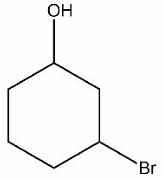 CUET 2025 Medium
 - Which of the following reactions are given by Phenols?
(A) Nitration
(B) Halogenation
(C) Oxidation
(D) Acetylation
Choose the correct answer from the options given above:CUET 2023 Medium - Which of the following statement is incorrect about fructose?CUET 2023 Hard
- The amount of radioactive substance left after \(75\) hours,
when \(100\) g of it is taken initially, will be:
(Half-life of the radioactive substance is \(15\) hours)CUET 2023 Medium
More PYQs from CUET
- Read the passage carefully and answer the questions
The resistance ( \(R\) ) of an object is given by the expression \(R=\rho \frac{l}{A}\).
The inverse of \(R\) is called conductance and the inverse of \(\rho\) is called conductivity or specific conductance represented by \(\kappa\).
The conductivity depends upon the nature of the material (insulator, semiconductor or conductor) and the temperature of the substance.
Similarly, the conductance due to the ions present in the solution (ionic conductance) depends upon the nature of the electrolyte, size of ions, the nature of the solvent and the temperature.
Molar conductivity ( \(\Lambda_m\) ) of a solution at a given concentration is the conductance of volume \(V\) containing one mole of electrolyte kept between two electrodes of area \(A\) and unit distance apart. It is given by the expression \(\Lambda_m=\kappa V\).
Molar conductivity increases with decrease in concentration and when concentration approaches zero, it is called limiting molar conductivity.
The decrease is linear for a strong electrolyte. However, for a weak electrolyte the change is gradual at higher concentrations and sharp near zero concentration.
Using limiting molar conductivity values of strong electrolytes we can calculate the limiting molar conductivity of weak electrolytes using Kohlrausch law of independent migration of ions.
From molar conductivity and limiting molar conductivity we can determine the degree of dissociation \(\left(\frac{\Lambda_m}{\Lambda_m^0}\right)\) and the ionization constant of a weak acid.
Which of the following is an insulator?CUET 2025 Easy - If \(\vec{a}\) and \(\vec{b}\) are two unit vectors and \(\vec{a}+\vec{b}\) is also a unit vector, the magnitude of \(\vec{a}-\vec{b}\) isCUET 2025 Hard
- Bag A contains 2 unbiased and 3 biased coins whereas Bag B contains 3 unbiased and 2 biased coins. A bag is selected at random and 2 coins are taken out simultaneously. The probailty, that both coins are unbiased is :CUET 2025 Hard
- In the interval [-5, -3], the function f(x) = (x + 1)(x - 3) is:CUET 2023 Medium
- If the points (-1,-1,2), (2, m, 5) and (3, 11, 6) are collinear, then m equalsCUET 2025 Medium
- Which of the following is a transducer?CUET 2023 Easy