


CUET · CHEMISTRY · PYQ PAPER 2023
Werner was the first to describe the bonding features in coordination compounds. But his theory could not answer basic questions like :
(i) Why only certain elements possess the remarkable property of forming coordination compounds ?
(ii) Why the bonds in coordination compounds have directional properties ?
(iii) Why coordination compounds have characteristics magnetic and optical properties ?
Many approaches have been put forth to explain the nature of bonding in coordination compounds vix. Valence Bond Theory (VBT), Crystal Field Theory (CFT), Ligand Field Theory (LFT) and Molecular Orbital Theory (MOT).
We shall focus our attention on elementary treatment of the application of VBT and CFT to coordination compounds.
According to this theory, the metal atom or ion under the influence of ligands can use its ( \(n -1\) )d, ns np or ns, np, nd orbitals for hybridisation to yield a set of equivalent orbitals of definite geometry such as octahedral, tetrahedral, square planar and so on.
These hybridised orbitals are allowed to overlap with ligand orbitals that can donate electron pairs for bonding.
Predict the type of hybridisation state in \(\left[ CoF _6\right]^{3-}\)
- A \(s p^3\)
- B \(d s p^2\)
- C \(s p^3 d^2\)
- D \(d^2 s p^3\)
Answer & Solution
Correct Answer
(C) \(s p^3 d^2\)
Step-by-step Solution
Detailed explanation
\(Co\) oxidation state: \(x + 6(-1) = -3 \Rightarrow x = +3\) \(Co \ ([Ar]3d^7 4s^2)\), so \(Co^{3+} \ ([Ar]3d^6)\) \(F^-\) is a weak field ligand, so no electron pairing occurs. Orbitals for 6 ligands: \(4s^1 4p^3 4d^2\) Hybridisation: \(sp^3d^2\)
See the Complete Solution
Get step-by-step explanations for this and 2.5 Lakh+ more JEE, NEET & CET questions.
- Unlock all solutions
- Practice the full chapter
- Track accuracy across PYQs
4.8 rated on Google Play · 14,000+ reviews
More questions from CHEMISTRY
- Arrange the following compounds in the increasing order of their boiling points:
A. \(\text{CH}_3\text{CH}_2\text{CH}_2\text{COOH}\)
B. \(\text{CH}_3\text{CH}_2\text{CH}_2\text{CH}_2\text{OH}\)
C. \(\text{CH}_3\text{CH}_2\text{OCH}_2\text{CH}_3\)
D. \(\text{CH}_3\text{CH}_2\text{CH}_2\text{CH}_3\)
E. \(\text{CH}_3\text{CH}_2\text{CH}_2\text{CHO}\)
Choose the correct answer from the options given below:"CUET 2023 Medium - Magnetic moment of \(\text{Co}^{2+}\) will beCUET 2023 Easy
- The reagents involved in the following conversion are
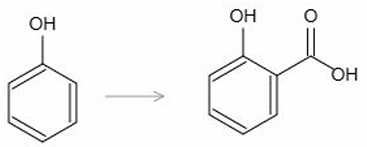 CUET 2025 Hard
 - Which one of the following is the weakest oxidizing agent?CUET 2025 Easy
- Identify the name of the amino acid representing the following structure
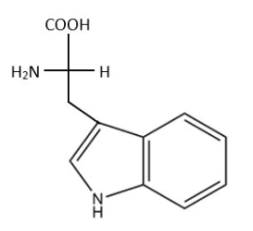 CUET 2025 Easy
 - Which of the following vitamin is water soluble ?CUET 2023 Medium
More PYQs from CUET
- Number of unpaired electrons in the square planar [Pt(CN)4]2- are :CUET 2025 Hard
- The coil of a moving coil galvanometer is wound over a metallic frameCUET 2025 Easy
- Transfer of pollen grains from anther of one flower to the stigma of a flower of different plant is called as:CUET 2023 Hard
- The remainder, when \(5^{60}\) is divided by 7 , is :CUET 2025 Medium
- It is observed that only 25% of a given radioactive sample is left undecayed after 16 days. What is the decay constant of the sample in \(\text{day}^{-1}\)?CUET 2025 Easy
- In uniform electric field \( \vec{E} = 3 \times 10^3\hat{i} \text{ N/C} \), a square loop of side 10 cm is placed such that plane of square loop is parallel to the yz plane. The flux linked with the square loop will be:CUET 2023 Hard