


CUET · CHEMISTRY · PYQ PAPER 2023
The transition element having least number of unpaired electrons, is:
- A \(\text{Fe}\)
- B \(\text{Cr}\)
- C \(\text{Zn}\)
- D \(\text{Sc}\)
Answer & Solution
Correct Answer
(C) \(\text{Zn}\)
Step-by-step Solution
Detailed explanation
\(\text{Zn}\) electronic configuration: \([Ar] 3d^{10} 4s^2\) Number of unpaired electrons = \(0\)
See the Complete Solution
Get step-by-step explanations for this and 2.5 Lakh+ more JEE, NEET & CET questions.
- Unlock all solutions
- Practice the full chapter
- Track accuracy across PYQs
4.8 rated on Google Play · 14,000+ reviews
More questions from CHEMISTRY
- Which of the following reactions are given by Phenols?
(A) Nitration
(B) Halogenation
(C) Oxidation
(D) Acetylation
Choose the correct answer from the options given above:CUET 2025 Medium - The properties which depend on the number of solute particles irrespective of their nature relative to the total number of particles in the solution are called colligative properties. These are relative lowering of vapour pressure of the solvent, depression of freezing point of the solvent, elevation of boiling point of the solvent and osmotic pressure of the solution. All of these properties help in calculating the observed molar mass of the solute.
Determination of osmotic pressure is considered best for the determination of molecular mass of the solute.
A 1 litre solution of glucose containing 36 g of it has an osmotic pressure of 4.98 bar at 300 K .
At the same temperature, the osmotic pressure of the solution is 1.52 bar.
The concentration of the solution at 1.52 bar is :CUET 2023 Medium - Wood spirit is known asCUET 2025 Medium
- The IUPAC name for the following complex compound
\(\text{K[Au(Br)(ONO) (SO}_4\text{)(NH}_3\text{)]}\) isCUET 2023 Hard - The molality of solution obtained by dissolving 1.5 g of ethanoic acid \(CH _3 COOH\) in \(2 5 ~ g\) of benzene is :CUET 2025 Easy
- The composition of Chromate ore is :CUET 2023 Hard
More PYQs from CUET
- In which of the following interval the function \(f(x)=x^x, x>0\) is strictly increasing?CUET 2025 Easy
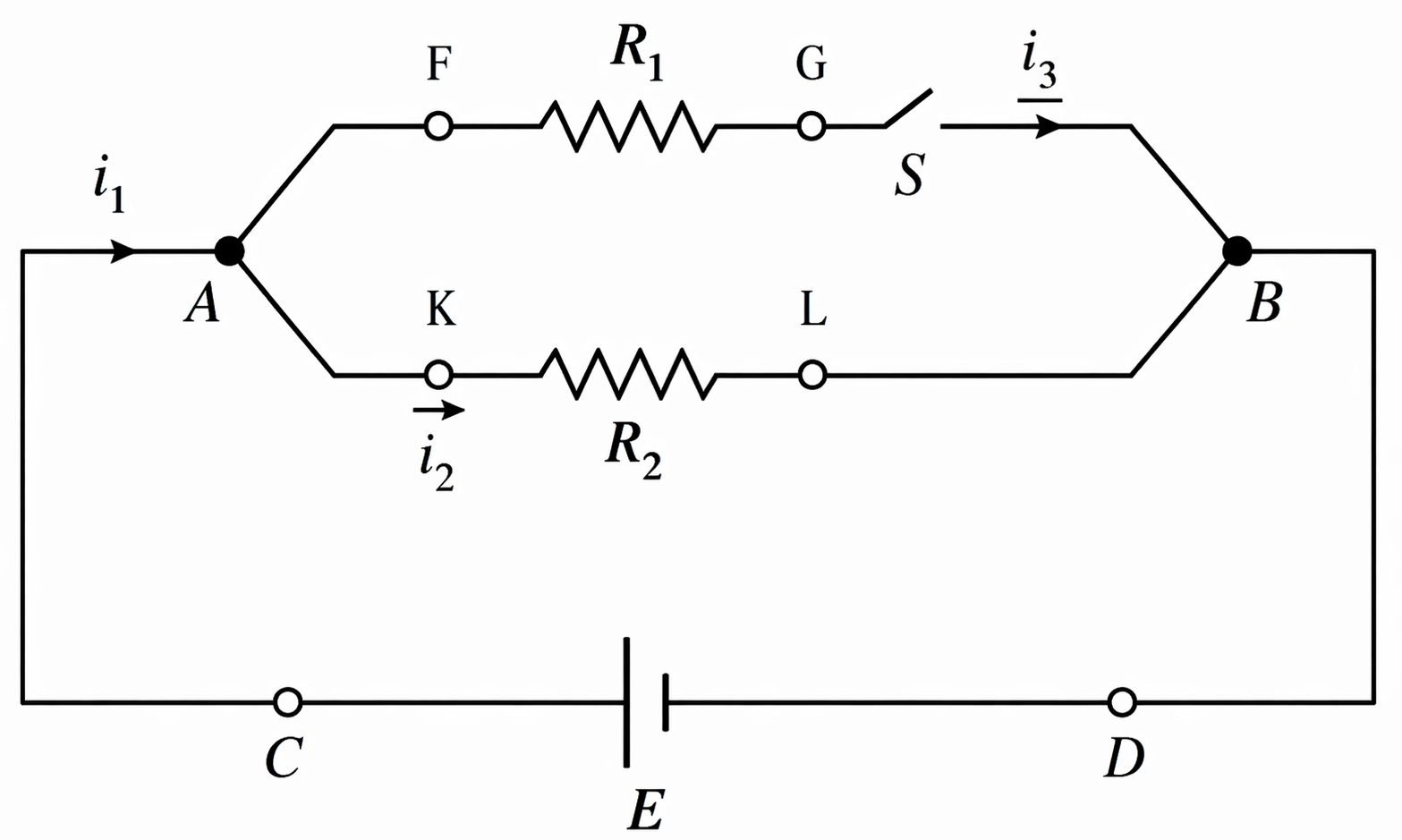
- In the circuit diagram shown in the figure, the resistance \( R_1 = 10 \, \Omega \), \( R_2 = 15 \, \Omega \) and E= 20 V. When the switch S is closed, the ratio of \( i_1 \) to \( i_3 \) will be:
 CUET 2025 Easy
 -
List-I List-II (A) Tollen's reagent (I) Rochelle salt (B) Jones reagent (II) Conc. HCl and \(ZnCl _2\) (C) Lucas reagent (III) Ammoniacal silver nitrate (D) Fehling solution (IV) Chromium trioxide-sulfuric acid
Choose the correct match:CUET 2024 Medium - Specific conductance (\ensuremath\{\kappa\}) is related to resistivity as:CUET 2025 Easy
- Which was the first restriction endonuclease discovered?CUET 2023 Hard
- Read the following passage carefully and answer the given questions.
Restriction endonuclease on finding its specific recognition sequence, bind to the DNA and cut each of the two strands of the double helix at specific points in their sugar -phosphate backbones. Each restriction endonuclease recognises a specific palindromic nucleotide sequences in the DNA. Since the DNA is enclosed within the membranes, we have to break the cell open to release DNA along with other macromolecules such as RNA, proteins, polysaccharides and also lipids. This can be achieved by treating the bacterial cells/plant or animal tissue with enzymes such as lysozyme (bacteria), cellulase (plant cells), chitinase (fungus). Now a days the most commonly used matrix is agarose which is a natural polymer extracted from sea weeds. The DNA fragments separate (resolve) according to their size through sieving effect provided by the agarose gel. The first restriction endonuclease-Hind II, whose functioning depended on a specific DNA nucleotide sequence was isolated and characterised five years later. It was found that Hind II always cut DNA molecules at a particular point by recognising a specific sequence of six base pairs. In addition to 'ori', the vector requires a selectable marker, which helps in identifying and eliminating non-transformants and selectively permitting the growth of the transformants. Transformation is a procedure through which a piece of DNA is introduced in a host bacterium. Normally, the genes encoding resistance to antibiotics such as ampicillin, chloramphenicol, tetracycline or kanamycin, etc., are considered useful selectable markers for E. coli.
Transformation is a procedure through which:CUET 2025 Easy