


CUET · CHEMISTRY · PYQ PAPER 2023
The standard reduction potential for \(Zn^{2+}/Zn\) is \(-0.76\) V and that for \(Fe^{2+}/Fe\) is \(-0.41\) V. The galvanic cell can be correctly represented by :
- A \(Fe(s)/Fe^{2+}(aq)\) || \(Zn^{2+}(aq)/Zn(s)\)
- B \(Fe^{2+}(aq)/Fe(s)\) || \(Zn^{2+}(aq)/Zn(s)\)
- C \(Zn(s)/Zn^{2+}(aq)\) || \(Fe^{2+}(aq)/Fe(s)\)
- D \(Zn^{2+}(aq)/Zn(s)\) || \(Fe(s)/Fe^{2+}(aq)\)
Answer & Solution
Correct Answer
(C) \(Zn(s)/Zn^{2+}(aq)\) || \(Fe^{2+}(aq)/Fe(s)\)
Step-by-step Solution
Detailed explanation
More positive reduction potential: \(Fe^{2+}/Fe\) acts as cathode. More negative reduction potential: \(Zn^{2+}/Zn\) acts as anode. Cell representation: Anode || Cathode \(Zn(s)/Zn^{2+}(aq)\) || \(Fe^{2+}(aq)/Fe(s)\)
See the Complete Solution
Get step-by-step explanations for this and 2.5 Lakh+ more JEE, NEET & CET questions.
- Unlock all solutions
- Practice the full chapter
- Track accuracy across PYQs
4.8 rated on Google Play · 14,000+ reviews
More questions from CHEMISTRY
- Answer the question on basis of passage given below :
Adsorption is surface phenomenon and it differs from absorption which occurs throughout the body of the substance which absorbs. In physisorption the attractive forces are mainly van der Waal forces while in chemisorption actual bonding occurs between the particles of adsorbent and adsorbed more easily on the surface of a solid as compared to the gases which are liquified with difficulty. Adsorption increases with the increases in pressure and decreases as temperature is increased.
Freundlich adsorption isotherm gives a straight line on plotting.CUET 2023 Hard - Calculate the Gibbs free energy for the given reaction, with the standard electrode potential equal to 1.1 V
\(Zn ( s )+ Cu ^{2+}( aq ) \rightarrow Zn ^{2+}( aq )+ Cu ( s )\)CUET 2025 Easy - The rate of a first order reaction is 0.06 mol \(L^{-1} s^{-1}\) after 20 seconds and 0.03 mol \(L^{-1} s^{-1}\) after 30 seconds from the start of the reaction. The half life period of this reaction isCUET 2025 Hard
- Answer the question on the basis of passage given below :
Formaldehyde is the first member of the aldehydic series. It is present in green leaves of plants where its presence is supposed to be due to the reaction of \(CO_2\) with water in the presence of sunlight and chlorophyll. Commercially, formaldehyde is obtained by the controlled oxidation of methane in the presence of molybdenum oxide (\(MoO\)) acting as a catalyst. Formaldehyde is a constituent of a number of polymers also called resins. These are non volatile solids or semi solids which are obtained directly from certain plants and can be synthesized in the laboratory.
Question: How is formalin useful?CUET 2023 Medium - "Answer the question on basis of passage given below :
Carboxylic acids are weaker than mineral acids, but they are stronger acids than alcohols and many simple phenols (\(\text{pKa}\) is ~ 16 for ethanol and 10 for phenol). The higher acidity of carboxylic acids as compared to phenols can be understood similarly. The conjugate base of carboxylic acid, a carboxylate ion, is stabilised by two equivalent resonance structures in which the negative charge is at the more electronegative oxygen atom. The conjugate base of phenol, a phenoxide ion, has non-equivalent resonance structures in which the negative charge is at the less electronegative carbon atom. Further, the negative charge is delocalised over two electronegative oxygen atoms in carboxylate ion whereas it is less effectively delocalised over one oxygen atom and less electronegative carbon atoms in phenoxide ion. Thus, the carboxylate ion is more estabilised than phenoxide ion, so carboxylic acids are more acidic than phenols.
Effect of substituents on the acidity of carboxylic acids: substituents may affect the stabliity of the conjugate base and thus, also affect the acidity of the carboxylic acids. Electron withdrawing group increase the acidity of carboxylic acids by stabilising the conjugate base through delocalisation of the negative charge by inductive and/or resonance effects. Conversely, electron donating groups decrease the acidity by destabilising the conjugate base.
The correct order of decreasing acid strength of:
Acetic acid (A), Formic acid (B), Benzoic acid (C) is:"CUET 2023 Hard - The presence or absence of hydroxyl group on which carbon atom of sugar differentiate RNA and DNA :CUET 2023 Hard
More PYQs from CUET
- If \(\left|\begin{array}{cc}2 x & 5 \\ 8 & x\end{array}\right|=\left|\begin{array}{cc}3 & 0 \\ 4 & -8\end{array}\right|\), then value(s) of \(x\) is/areCUET 2025 Medium
- Which of the following will have 46 chromosomes?CUET 2025 Hard
- Three cells with internal resistance are connected as shown in the figure. The equivalent emf of the combination of three cells is:
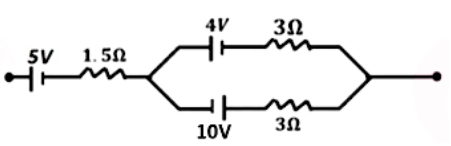 CUET 2025 Easy
 - Which of the following statements is true for \(f(x)=(x-1)^3(x-2)^2\)?
(A) f(x) decreases on \(\left(-\infty, \frac{8}{5}\right)\)
(B) f(x) increases on \(\left[\frac{8}{5}, 2\right]\)
(C) f(x) has point of inflection at x = 1
(D) f(x) decreases on \((2, \infty)\)
Choose the correct answer from the options given below:CUET 2023 Hard - A beam of electron is used in Young's double slits experiment. The slit width is d . When velocity of electron is increased, then :CUET 2023 Medium
- If \(y=x^x, \frac{d y}{d x}\) will be:CUET 2023 Easy