


CUET · CHEMISTRY · PYQ PAPER 2025
The standard electrode potential for a Daniell cell is 1.1 V. Calculate the standard Gibbs energy for the reactiction
\(Zn ( s )+ Cu ^{2+}( aq ) \rightarrow Zn ^{2Solution+}( aq )+ Cu ( s )\)
- A \(-220.27 kJ mol ^{-1}\)
- B \(-240.5 kJ mol ^{-1}\)
- C \(-212.27 kJ mol ^{-1}\)
- D \(-198 kJ mol ^{-1}\)
Answer & Solution
Correct Answer
(C) \(-212.27 kJ mol ^{-1}\)
Step-by-step Solution
Detailed explanation
\(E^{\circ}_{cell} = E^{\circ}_{Cu^{2+}/Cu} - E^{\circ}_{Zn^{2+}/Zn}\) \(E^{\circ}_{cell} = (+0.34 V) - (-0.76 V) = 1.10 V\) \(\Delta G^{\circ} = -nFE^{\circ}_{cell}\)…
See the Complete Solution
Get step-by-step explanations for this and 2.5 Lakh+ more JEE, NEET & CET questions.
- Unlock all solutions
- Practice the full chapter
- Track accuracy across PYQs
4.8 rated on Google Play · 14,000+ reviews
More questions from CHEMISTRY
- What is the product of the following reaction?
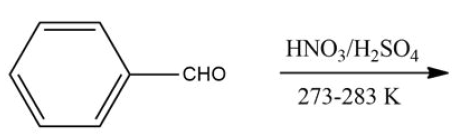 CUET 2025 Medium
 - Which of the following compounds can be used as antifreeze in automobile radiators?CUET 2023 Medium
- Consider the following hypothetical redox reaction
\(\mathrm{A}(s)+2 \mathrm{~B}^{+}(a q) \rightarrow \mathrm{A}^{2+}(a q)+2 \mathrm{~B}(s): E_{\mathrm{cell}}^0=0.295 \mathrm{~V}\)
The equilibrium constant of the reaction at 298 K will be:CUET 2025 Hard - Match List-l with List-ll:
List-1 (Molecule) List-II (Van't Hoff Factor) (A) Glucose (I) 3 (B) \(K _2 SO _4\) (II) 5 (C) \(Ca _3\left( PO _4\right)_2\) (III) 1 (D) \(K _3\left[ Fe ( CN )_6\right]\) (IV) 4
Choose the correct answer from the options given below:CUET 2025 Medium - Which of the following ethers cannot be prepared by bimolecular dehydration of alcohol?
(A) 2-Methoxy-2-methylpropane
(B) 2-Methoxy propane
(C) 1-Ргорохургopane
(D) 2-Ethoxy butane
Choose the correct answer from the options given below:CUET 2025 Hard - Match List I with List II
Choose the correct answer from the options given below:LIST I (Order) LIST II (Units of k) A. Zero order reactions I. \(\backslash s^{-1}\) B. 1st order II. \(m \operatorname{mol}^{-2} L^2 s^{-1}\) C. 2nd order III. \(\operatorname{mol} L^{-1} s^{-1}\) D. 3rd order IV. \(\backslash\) mol \(^{-1} L s^{-1}\) CUET 2023 Easy
More PYQs from CUET
- Thiosulphte \(\mathrm{S}_2 \mathrm{O}_3^{2-}\) is oxidized to __________ in presence of permanganate ion.CUET 2025 Easy
- A random variable has the following probability distribution:\(\begin{array}{llllll}X= x_{-} i & 2 & 3 & 4 & 5 \\P\left(X=x \_i\right) & 4 k & k & 5 k & 2 k\end{array}\)The value of \(P(X<3)\) isCUET 2023 Easy
- p-block elements are placed in groups 13 to 18 of the periodic table. Group 15 is nitrogen family.
Nitrogen makes various compounds like \(NH _3, HNO _3, N_2 O , NO _2\) etc. Phosphorus exists in the form of white and red phosphorus. White phosphorus glows in dark. \(PH _3\) gas is used as smoke screen. Group 16 is called oxygen family. Dry air contains \(21% O_2\) gas by volume. Combined sulphur exists as sulphates such as gypsum, epsome salt, baryte etc. The allotropic forms of sulphur are Rhombic and monoclinic sulphur. \(S_2\) is paramagnetic like \(O_2\) and it stable at high temperature. Group 17 is Halogen family. \(F _2\) is highly reactive, \(Cl _2\) is greenish yellow gas. Both \(SO _2\) and \(Cl _2\) are used for bleaching. Group 18 is Noble gas family but some noble gases also form compounds.
Complete hydrolysis of \(XeF _6\) gives HF and \(XeO _3\) as main products. The permanent bleaching effect is caused by :CUET 2023 Hard - The factors that affect the Hardy-Weinberg equilibrium are:
(A) Gene migration or gene flow
(B) Natural selection
(C) Mutation
(D) Genetic drift
Choose the correct answer from the options given below:CUET 2025 Hard - If the binomial distribution \(X \sim B(n, p)\) has mean 3 and variance \(\frac{3}{2},(p+q)=1\), then which of the following is/are TRUE?
(A) \(q=\frac{1}{2}, n=6\)
(B) \(P(X \leq 5)=\frac{63}{64}, p=\frac{1}{2}\)
(C) \(q=\frac{1}{3}, p=\frac{2}{3}\)
(D) \(P(X=4)=\frac{15}{64}, n=6\)
Choose the correct answer from the options given below:CUET 2025 Hard - Electric field \(\vec{E}\) at the surface of charged conductor is:
A. \(|\vec{E}| = \frac{\sigma}{\epsilon_0}\)
B. \(\vec{E}\) has a tangential component
C. Electric field is zero everywhere inside the conductor.
D. Any excess charge must reside on the surface of the conductor.
Choose the correct answer from the options given below:CUET 2023 Medium