


CUET · CHEMISTRY · PYQ PAPER 2025
The IUPAC name of the given compound is
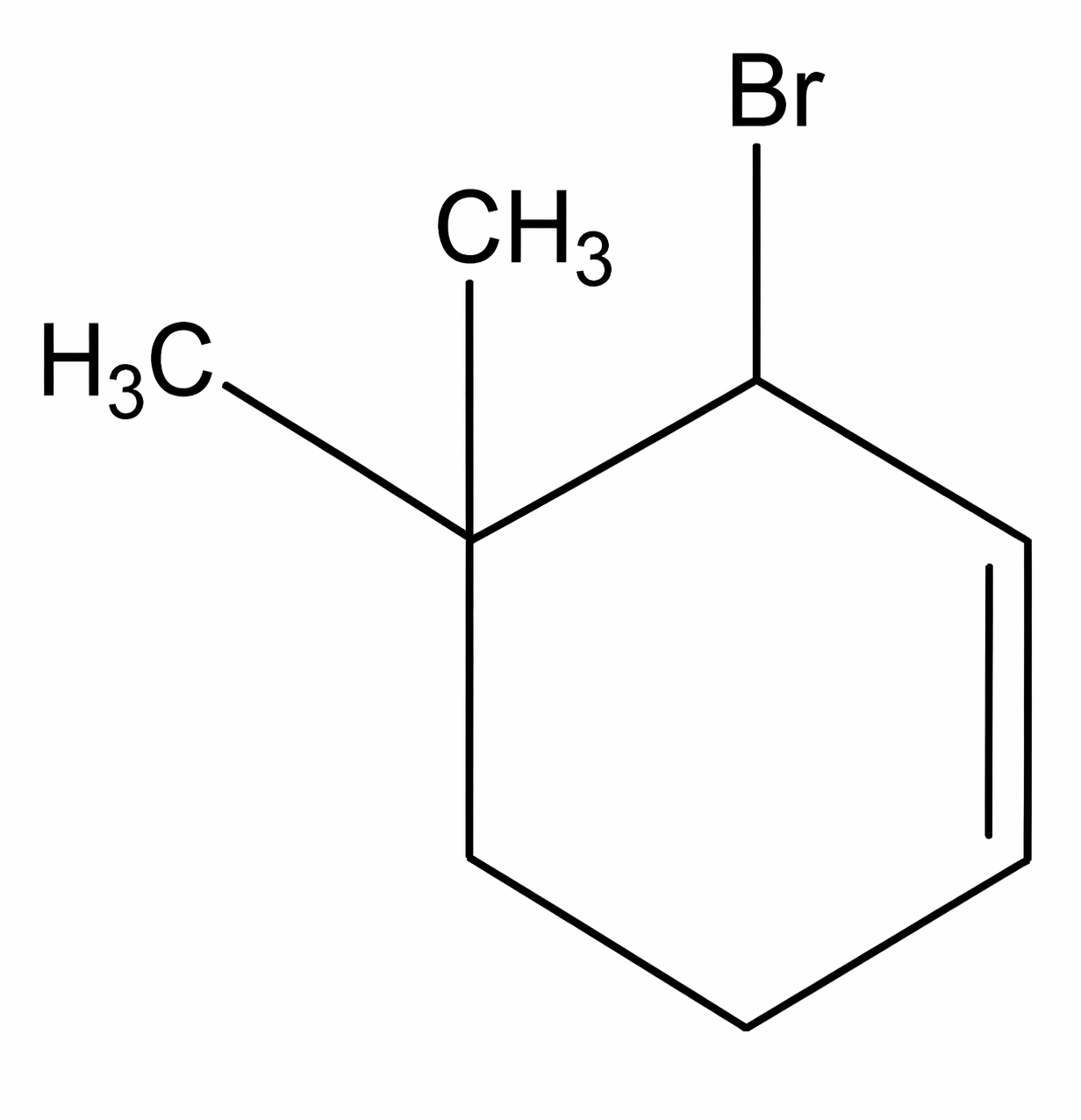
- A 3-Bromo-4,4-dimethyl-cyclohexene
- B 1-Bromo-2,2-dimethyl-cyclohexene
- C 1,1-dimethyl-2-bromo-cyclohexene
- D 1,1-dimethyl-2-bromo-cyclohexene
Answer & Solution
Correct Answer
(A) 3-Bromo-4,4-dimethyl-cyclohexene
Step-by-step Solution
Detailed explanation
\(2\)-Bromo-\(1,1\)-dimethylcyclohexene
See the Complete Solution
Get step-by-step explanations for this and 2.5 Lakh+ more JEE, NEET & CET questions.
- Unlock all solutions
- Practice the full chapter
- Track accuracy across PYQs
4.8 rated on Google Play · 14,000+ reviews
More questions from CHEMISTRY
- The Galvanic cells will behave like an electrolytic cell whenCUET 2025 Easy
- Read the passage carefully and answer the following questions
Aldehydes, carboxylic acids and ketones are widespread in the animal and plant kingdoms. They play a pivotal role in various biochemical processes of life. Their presence in nature adds fragrance and flavor. These compounds are widely used in food products, pharmaceuticals, paints, resins and other important product industries. These compounds are prepared by various laboratory methods, which mainly include oxidation, formylation, acylation and reduction. Due to the polar nature of the carbonyl group in aldehydes and ketones, they can exhibit different reactions like nucleophilic addition. They do exhibit redox and various condensation reactions which lead to the formation of various important compounds. On the other hand, the carboxylic acids are mainly prepared by oxidation and hydrolysis of different compounds. The carboxylic acid consists of a carbonyl group and the hydroxy group (attached to the carbonyl carbon atom). This makes it possible for the carboxylic acid to participate in various chemical reactions which involve cleavage of the C-OH bond and the O-H bond along with the reactions involving the complete - COOH group.
The reagent which doesn't react with both acetone and benzaldehyde is :CUET 2025 Medium - Correct order of the following acids in order of their increasing acidic strength is
(A) \(CCl _3 COOH\)
(B) \(ClCH _2 COOH\)
(C) \(CH _3 COOH\)
(D) \(CHCl _2 COOH\)
Choose the correct answer from the options given below:CUET 2025 Easy - Answer the question on the basis of passage given below :
A colloid is a heterogeneous system in which a substance is dispersed (dispersed phase) as fine particles in another substance called dispersion medium.
Their particle size is intermediate between that of pure solutions (less than 1 nm) and suspensions (greater than 1000 nm).
They are known for interesting properties such as enormous surface area,
Tyndall effect, Brownian motion etc.
They are widely used in industries and day to day life.
Some prominent uses of colloids are those in smoke precipitators, purification of water, medicines, cleansers etc.
Which of the following is true for enzyme catalytic reaction?CUET 2023 Easy - Aqueous \(CuSO _4\) solution gives green precipitate of \(( X )\) with aqueous KF.
Correct formula of X is:CUET 2023 Easy - What is the common name of the given compound?
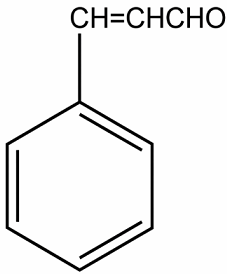 CUET 2025 Medium
More PYQs from CUET
- When a capacitor is subjected to a D.C. source it takes small time internal to get fully charged up. During this small time interval there is no passage of charge through dielectric, yet we use a term - displacement current. This term is used because :CUET 2023 Hard
- The rate of change of the area of an equilateral triangle with respect to its side when its side \(=2\) is :CUET 2023 Hard
- Write the formula for Tetramminediaquacobalt (III) chloride.CUET 2023 Medium
- The feasible region of a linear programming problem is bounded. The corresponding objective function is \(Z = 3x - 4y\). The objective function attains:CUET 2025 Medium
- Two particles \( P_1 \) and \( P_2 \), having equal charges accelerated by the same potential difference enter a region of uniform magnetic field and describe circular paths of radii \( R_1 \) and \( R_2 \), respectively. The ratio of the mass of \( P_1 \) to that of \( P_2 \) will beCUET 2025 Medium
- Match the ions given in List - I with number of unpaired electrons given in List - II
List - I (Ion) List-II (Number of unpaired electrons) (A) \(V ^{ 2 + }\) (I) 1 (B) \(Cr ^{2+}\) (II) 4 (C) \(Ti ^{2+}\) (III) 3 (D) \(Cu ^{2+}\) (IV) 2
Choose the correct answer from the options given below:CUET 2025 Hard