


CUET · CHEMISTRY · PYQ PAPER 2023
The integrated rate equation for a first order reaction is \(\frac{kt}{2.303} = \log R_0 - \log R_t\). The straight line graph is obtained by plotting :
- A time vs \(R_t\)
- B time vs \(\log R_t\)
- C time vs \(\frac{1}{R_t}\)
- D time vs \(R_0\)
Answer & Solution
Correct Answer
(B) time vs \(\log R_t\)
Step-by-step Solution
Detailed explanation
\(\frac{kt}{2.303} = \log R_0 - \log R_t\) \(\log R_t = \log R_0 - \frac{k}{2.303}t\) This is in the form \(y = c + mx\), where \(y = \log R_t\) and \(x = t\). Therefore, a straight line is obtained by plotting time vs \(\log R_t\).
See the Complete Solution
Get step-by-step explanations for this and 2.5 Lakh+ more JEE, NEET & CET questions.
- Unlock all solutions
- Practice the full chapter
- Track accuracy across PYQs
4.8 rated on Google Play · 14,000+ reviews
More questions from CHEMISTRY
- Zr and Hf (transition metals) occur together in nature and are difficult to separate. This can be attributed toCUET 2025 Easy
- Question based on following passage :
Adsorption is the process of attracting and retaining the adsorbate molecules on the surface of adsorbent. It is of two types i.e. Physisrption and chemisorption. To increase the rate of reaction, the substance called 'catalyst' is added. Promotors enhance the activity of catalyst while poison decrease the catalyst activity. Solutions may be true solution, suspension and colloids. Colloids are heterogenous but quite stable. On the basis of nature of interaction, colloids may be Lyophilic or Lyophobic. On the basis of type of dispersed phase particles, there may be multimolecular colloids, macromlecular colloids and associated colloids. The congulation of colloids may be done by boiling, dialysis or by mixing oppositely charged sols.
The best coagulating agent for \(Fe(OH)_3\) solution is :CUET 2023 Medium - With reference to Arrhenius equation \(k=A e^{-E_a / R T}\)CUET 2025 Hard
- A cell is prepared by dipping a Cu rod in \(1\ M\ CuSO_4\) solution and Sn rod in \(1\ M\ SnCl_2\) solution.
The standard electrode potential of Cu is \(+0.34\ V\) and Sn is \(-0.14\ V\). Emf of cell will be :CUET 2023 Medium - \(CH_3CH_2COCH_3 \xrightarrow{Y} CH_3CH_2CH_2CH_3\) The reagent Y is:CUET 2023 Easy
- Read the passage carefully and answer the Questions:
Amines are classified as primary \(\left(1^{\circ}\right)\), secondary \(\left(2^{\circ}\right)\) and tertiary \(\left(3^{\circ}\right)\) depending upon the number of hydrogen atoms replaced by alkyl or aryl groups in ammonia molecules. Aliphatic amines are a stronger bases due to \(+I\) effect of an alkyl groups. Intermolecular hydrogen bonding in primary and secondary amines affects the boiling points of amines. The intermolecular association is more in primary amines than in secondary amines as there are more number of hydrogen atoms available for hydrogen bond formation. Nitro compounds are reduced to amines by passing hydrogen gas in the presence of finely divided nickel, palladium or platinum and also by reduction with metals in an acidic medium. Gabriel synthesis is used for the preparation of primary amines. Primary amines react with nitrous acid to give unstable diazonium-salts which can be used to synthesize a variety of compounds.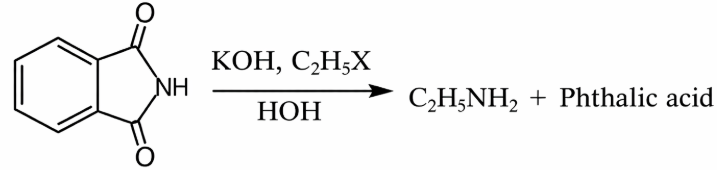
The reaction is an example of:CUET 2023 Hard
More PYQs from CUET
- Value of \(\mu(20)+\sigma(20)\) is (where \(\mu(n)\) is the Mobius function and \(o(n)\) is the sum of all positive divisors of \(n\) )CUET 2023 Medium
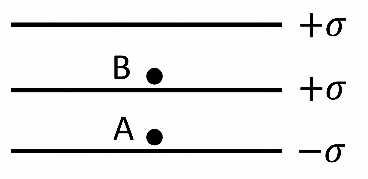
- In this diagram, three infinite plane sheets of charges are shown with surface charge densities \(+\sigma, +\sigma, -\sigma\). The value of electric field at points A and B are
 CUET 2025 Medium
 - The area of the triangle with vertices \((1,4),(2,7)\) and \((4,13)\) is:CUET 2023 Easy
- The optical length of an astronomical telescope with magnifying power of 10 for normal adjustment is 55 cm. What is the focal length of the objective ?CUET 2023 Hard
- Match List-l with List-ll
Choose the correct answer from the options given below :List-l (Differential Equation) List-ll (Order and degree of differential equation) (A) \(\frac{d^2 y}{d x^2}+2\left(\frac{d y}{d x}\right)^2=e^{\frac{d y}{d x}}+1\) (I) Order = 1, Degree = 2 (B) \(\left(\frac{d^2 y}{d x^2}\right)^2+4\left(\frac{d y}{d x}\right)^3=e^y-1\) (II) Order = 2, Degree = 1 (C) \(3\left(\frac{d y}{d x}\right)+4 y+e^y=\frac{d x}{d y}\) (III) Order = 2 , Degree = 2 (D) \(\frac{d^2 y}{d x^2}+3\left(\frac{d y}{d x}\right)=\left(e^y+\frac{d y}{d x}\right)^2\) (IV) Order = 2, Degree = Not defined CUET 2025 Hard - Embryological support for evolution was disapproved byCUET 2023 Medium