


CUET · CHEMISTRY · PYQ PAPER 2025
The conductivity of an electrolytic solution does not depend on
- A Osmotic pressure
- B Concentration of the electrolyte
- C The nature of electrolyte
- D Temperature
Answer & Solution
Correct Answer
(A) Osmotic pressure
Step-by-step Solution
Detailed explanation
Osmotic pressure
See the Complete Solution
Get step-by-step explanations for this and 2.5 Lakh+ more JEE, NEET & CET questions.
- Unlock all solutions
- Practice the full chapter
- Track accuracy across PYQs
4.8 rated on Google Play · 14,000+ reviews
More questions from CHEMISTRY
-
List-I (Biomolecule) List-II (Function/Diseases) (A) Vitamin A (I) Menstrual cycle (B) Thiamine (II) Xerophthalmia (C) Glucocorticoids (III) Beri-Beri (D) Estradiol (IV) Addison's disease
Choose the correct match:CUET 2024 Easy - Read the passage carefully and answer the questions
Replacement of a hydrogen atom in a hydrocarbon by an alkoxy or carboxyl group yields a class of compounds known as ethers. Ethers are classified as symmetrical or unsymmetrical on the basis of groups attached to the oxygen atoms. Diethyl ether, a symmetrical ether, has been widely used as an inhalation anesthetic. Ethers can be prepared by acid catalyzed intermolecular dehydration of alcohols and Williamson's synthesis. Acid catalyzed dehydration of alcohols is not generally preferred as it gives a mixture of elimination and substitution products. In Williamson's synthesis, an alkyl halide is allowed to react with sodium alkoxide. Ethers containing substituted Alkyl groups may also be prepared by this method. The C-O bond in ether is weakly polar and is cleaved under drastic conditions with excess of hydrogen halides. In electrophilic substitution, the alkoxy group deactivates the aromatic ring and directs the incoming group to ortho and para positions.
Which is most reactive hydrogen halide for cleavage of ethers?CUET 2025 Easy - Arrange the following in decreasing order of their basic strength in aqueous solution
(A)C6H5NH2
(B)C2H5NH2
(C) (C2H5)2NH
(D)NH3CUET 2025 Easy - Read the Passage carefully and answer the Questions
Kinetic studies not only help us to determine the rate of a chemical reaction but also describe the conditions by which the reaction rates can be altered. The factors such as concentration, temperature, pressure and catalyst affect the rate of a reaction.
The speed of a reaction or the rate of a reaction can be defined as the change in concentration of a reactant or product in unit time.
Rate \(=k[A]^x[B]^y\)
Here \(k\) is the rate constant
\(x+y\) gives the overall order of a reaction, whereas \(x\) and \(y\) represent the order with respect to the reactants \(A\) and \(B\), respectively.
Which of the following statements are correct?
(A) Catalysts increase the rate of a chemical reaction.
(B) Catalysts can catalyze both spontaneous and non-spontaneous reactions.
(C) Higher the activation energy for a chemical reaction, lower is the rate of the reaction.
(D) Catalyst increases the potential energy barrier.
Choose the correct answer from the options given below:CUET 2025 Easy - Select the correct formula for the coordination compound "Dichloridobis(ethane-1,2-diamine)cobalt(III) chloride"CUET 2025 Medium
- The IUPAC name of the following compound is
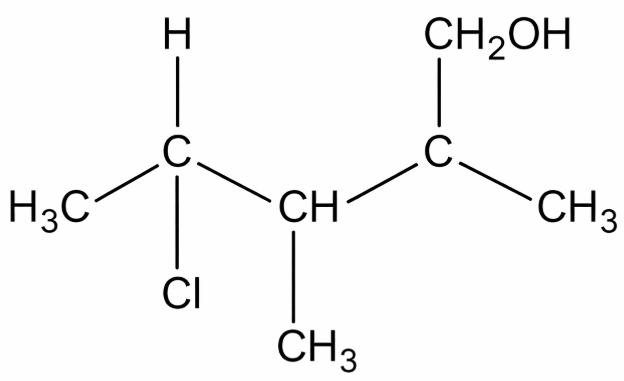 CUET 2025 Hard
More PYQs from CUET
- Which of the following microbes is not used as a biocontrol agent?CUET 2023 Hard
- \(P, Q, R\) and \(S\) are four wires of resistances \(3,3,3\) and \(4 \Omega\) respectively. They are connected to form the four arms of a wheatstone bridge circuit. The resistance with which S must be shunted in order that the bridge may be balanced isCUET 2024 Easy
- For what value of \(\alpha\), the function \(f\) defined by \(f(x)=\left\{\begin{array}{ll}\alpha\left(x^2-2 x+1\right), & \text { if } x \leq 0 \\ 2 x+1, & \text { if } x>0\end{array}\right.\) is continuous at \(x=0\) ?CUET 2025 Easy
- Choose the correct circuit for the forward bias of p-n junction diode:
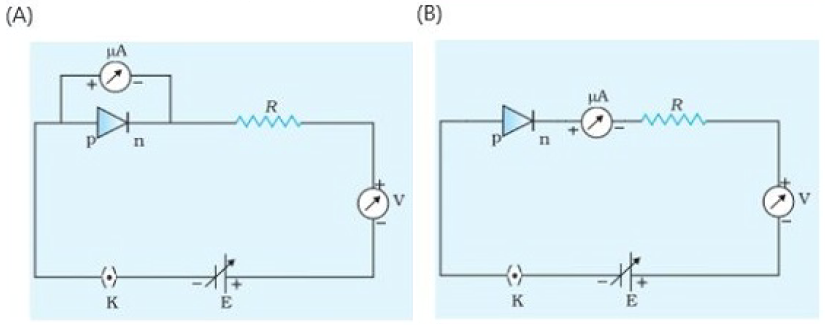
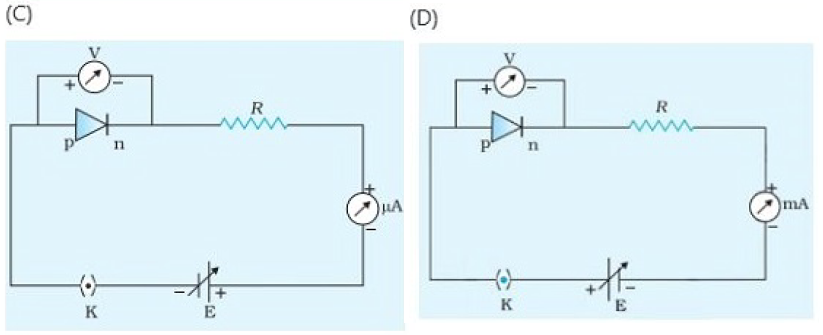
Choose the correct answer from the options given below:CUET 2025 Hard - The particular solution of the differential equation \(\frac{d y}{d x}+\frac{3 y}{x}=0, y(1)=1\) isCUET 2025 Hard
- A cell of emf 10 V and the internal resistance 1 \( \Omega \) is being charged by an external supply of 100 V. An external resistance of 8 \( \Omega \) is connected to the charging circuit. The current in the circuit isCUET 2025 Easy