


CUET · CHEMISTRY · PYQ PAPER 2023
The conductivity of 0.001 mol \(\text{L}^{-1}\) acetic acid is \(5.01 \times 10^{-5} \text{ S cm}^{-1}\).
Calculate its dissociation constant if \(\Lambda_m^{\circ}\) for acetic acid is
390.5 \(\text{S cm}^2 \text{mol}^{-1}\).
- A \(1.78 \times 10^{-5} \text{ mol L}^{-1}\)
- B \(1.89 \times 10^{-5} \text{ mol L}^{-1}\)
- C \(1.78 \times 10^5 \text{ mol L}^{-1}\)
- D \(1.89 \times 10^5 \text{ mol L}^{-1}\)
Answer & Solution
Correct Answer
(B) \(1.89 \times 10^{-5} \text{ mol L}^{-1}\)
Step-by-step Solution
Detailed explanation
\(\Lambda_m = \frac{\kappa \times 1000}{c} = \frac{5.01 \times 10^{-5} \text{ S cm}^{-1} \times 1000 \text{ cm}^3 \text{ L}^{-1}}{0.001 \text{ mol L}^{-1}} = 50.1 \text{ S cm}^2 \text{mol}^{-1}\)…
See the Complete Solution
Get step-by-step explanations for this and 2.5 Lakh+ more JEE, NEET & CET questions.
- Unlock all solutions
- Practice the full chapter
- Track accuracy across PYQs
4.8 rated on Google Play · 14,000+ reviews
More questions from CHEMISTRY
- The composition of Fehling solution A and Fehling solution B respectively are:CUET 2025 Easy
- Formaldehyde undergoes the Cannizzaro reaction because:
(A) It has alpha-hydrogen atom.
(B) It does not have alpha-hydrogen atom.
(C) It does not undergo self-oxidation and reduction on heating with concentrated alkali.
(D) It undergoes self-oxidation and reduction on heating with concentrated alkali.
Choose the correct answer from the options given below :CUET 2024 Medium - Water soluble vitamins are excreted out of our body through urination. Identify the vitamin which is stored in our body for a number of years?CUET 2023 Easy
- Certain Aldehydes, Retore and certain alcohol undergo iodoform test. Certain Aldehydes ketones undergo aldol condensation. While certain aldehydes undergo Cannizaro's reaction. Aldehydes responds to tollen reagent and fehling reagent test.
Which amongst the following will respond to Tollens' reagent test?
A. Benzaldehyde \((C_6H_5CHO)\)
B. Formaldehyde \((HCHO)\)
C. Formic acid \((HCOOH)\)
D. Acetone \((CH_3COCH_3)\)
Choose the correct optionCUET 2023 Easy - The quantity of charge required to obtain \(2\text{ mol}\) of \(\text{Mn}^{2+}\) from \(\text{MnO}_4^{-}\) is:CUET 2023 Medium
- A solution of 2.5 g of ethanoic acid in 75 g of benzene is prepared. What is the molar mass of ethanoic acid, moles of ethanoic acid, mass of benzene and molality of ethanoic acid?
(A) \(0.556 \text{ mol } kg^{-1}\)
(B) \(0.0417 \text{ mol}\)
(C) \(60 \text{ g } mol^{-1}\)
(D) \(0.075 \text{ kg}\)
Choose the correct answer from the options given below:CUET 2025 Medium
More PYQs from CUET
- Identify the correct statement(s).
(A) In any lens, the optical centre is always at the centre of the lens.
(B) In a lens, if the curvature of its two surfaces is equal, the optical centre is at the centre of the lens.
(C) A light ray passing through the optical centre of a lens never shifts from the direction of the incident ray.
(D) A ray of light incident perpendicularly on a lens passes through its focus after refraction.
Choose the correct answer from the following given options.CUET 2025 Hard - In a Wheatstone bridge, the resistances \( R_1, R_2, R_3 \) and \( R_4 \) present in four arms are \( 10 \Omega, 30 \Omega, 30 \Omega \) and \( 90 \Omega \) respectively. If the galvanometer resistance is \( 50 \Omega \) and the voltage of the battery is 7 V and its internal resistance is \( 5 \Omega \), then the total current drawn from the battery is
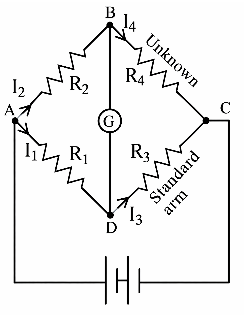 CUET 2025 Medium
 - Observe the diagram and answer the following questions:
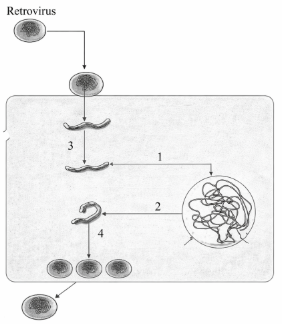
Which enzyme can form DNA from RNA?CUET 2023 Medium - The sickle cell anaemia is aCUET 2023 Medium
- Read the following passage carefully and answer the given questions.
Plasmodium, a tiny protozoan is responsible for the disease malaria. Different species of Plasmodium (P. vivax, P. malaria and P. falciparum) are responsible for different types of malaria. Of these, malignant malaria caused by Plasmodium falciparum is the most serious one and can even be fatal. Innate immunity consist of four types of barriers. These are – (i) Physical barriers- skin on our body is the main barrier which prevents entry of the micro-organisms. (ii) Physiological barriers- Acid in the stomach, saliva in the mouth, tears from eyes-all prevent microbial growth. (iii) Cellular barriers- Certain types of leukocytes (WBC) of our body like polymorpho-nuclear leukocytes (PMNL-neutrophils) and monocytes and natural killer (type of lymphocytes) in the blood as well as macrophages in tissues can phagocytose and destroy microbes. (iv) Cytokine barriers- virus-infected cells secrete proteins called interferons which protect non-infected cells from further viral infection. Allergy is due to the release of chemicals like histamine and serotonin from the mast cells. The use of drugs like anti-histamine, adrenalin and steroids quickly reduce the symptoms of allergy. Drugs like barbiturates, amphetamines, benzodiazepines, and other similar drugs, that are normally used as medicines to help patients cope with mental illnesses like depression and insomnia, are often abused.
Malignant malaria is caused by _____ is the most serious one and can even be fatal.CUET 2025 Medium - Which of the following is NOT true?CUET 2023 Medium