


CUET · CHEMISTRY · PYQ PAPER 2025
Read the passage carefully and answer
When a metal is placed in a solution of its ions, the metal can lose electron and can go in the solution as ion or the metal ion in the solution can take electron from the electrode and get deposited as metal. Thus, the electrode acquires either positive or negative charge with respect to the solution leading to the development of a potential difference between the metal electrode and the solution. This potential difference is called the electrode potential of the metal. The electrode potential of a metal is a measure of relative tendency to undergo oxidation (loss of electron) or reduction (gain of electron). When the concentration of the ions in the solution is unity, the electrode potential is called standard electrode potential. The magni of potential depends upon the nature of electrode, concentration of ions in solution and the temperature. In a galvanic cell, the electrode at which oxidation occurs is known as anodic half-cell and the electrode at which reduction occurs is known as cathodic half cell. The emf of the cell in terms of standard reduction potential is given by \(E_{\text {cell }}^{\circ}=E_{\text {cathode }}^{\circ}-E_{\text {anode. }}^{\circ}\).The standard free energy change of the redox reaction taking place in the cell is related to \(E_{\text {cell }}^{\circ}\) by \(\Delta G^{\circ}=-n F E^{\circ}\). A redox reaction would occur spontaneously if the free energy change is negative. The equilibrium constant of the reaction is related to the standard free energy change by \(\Delta G^{\circ}=-R T \ln K\).
The equillibrium constant of a feasible cell reaction is
- A Less than one
- B Greater than one
- C Equal to one
- D Zero
Answer & Solution
Correct Answer
(B) Greater than one
Step-by-step Solution
Detailed explanation
Greater than one
See the Complete Solution
Get step-by-step explanations for this and 2.5 Lakh+ more JEE, NEET & CET questions.
- Unlock all solutions
- Practice the full chapter
- Track accuracy across PYQs
4.8 rated on Google Play · 14,000+ reviews
More questions from CHEMISTRY
- Question based on following passage:
Adsorption is the process of attracting and retaining the adsorbate molecules on the surface of adsorbent. It is of two types i.e. Physisrption and chemisorption. To increase the rate of reaction, the substance called 'catalyst' is added. Promotors enhance the activity of catalyst while poison decrease the catalyst activity. Solutions may be true solution, suspension and colloids. Colloids are heterogenous but quite stable. On the basis of nature of interaction, colloids may be Lyophilic or Lyophobic. On the basis of type of dispersed phase particles, there may be multimolecular colloids, macromlecular colloids and associated colloids. The congulation of colloids may be done by boiling, dialysis or by mixing oppositely charged sols.
Molybdenum used in Haber process, acts as a :CUET 2023 Medium - Propene on addition with bromine in CCl4 givesCUET 2025 Hard
- Match List I with List II
Choose the correct answer from the options given below:LIST I LIST II A. Pain killers I. Antipyretics B. Treatment of infections II. Analgesics C. Reducing fever III. Antibiotics D. Treatment of depression IV. Tranquilizers CUET 2023 Hard - Number of hydrogen bond formed between adenine and thymine to connect each other is /areCUET 2023 Hard
- Match List-I with List-II
List-I (Reaction Name) List-II (Reaction) (A) Rosenmund Reaction (I) 
(B) Stephen Reaction (II) 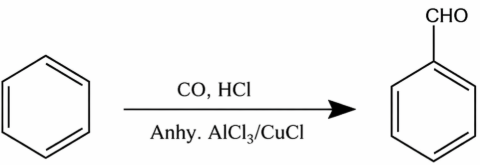
(C) Gattermann Koch Reaction (III) 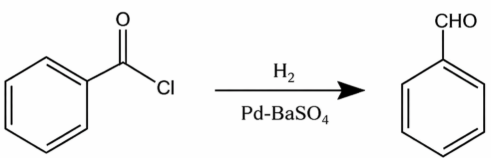
(D) Etard Reaction (IV) 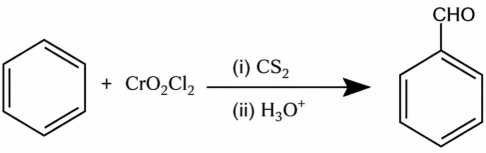
Choose the correct answer from the options given below:CUET 2025 Hard - Reaction of Phenol with conc. \(HNO _3\) givesCUET 2025 Easy
More PYQs from CUET
- The potential energy of an electron in the first excited state of hydrogen atom is -6.8 eV. The kinetic energy of the electron in its ground state will be :CUET 2023 Hard
- Let \(A=\left[\begin{array}{cc}\cos \theta & -\sin \theta \\ \sin \theta & \cos \theta\end{array}\right]\) and \(I=\left[\begin{array}{ll}1 & 0 \\ 0 & 1\end{array}\right]\). If \(A^T+A=I\), then:CUET 2025 Hard
- The correct statement regarding a carbonyl compound with hydrogen atom on its alpha carbon is :
A. A carbonyl compound with hydrogen atom on its a-carbon rapidly equilibrates with its corresponding enol and this process is known as carbonylation.
B. A carbonyl compound with hydrogen atom on its a-carbon rapidly equilibrates with its corresponding enol and this process is known as keto enol tautomerism.
C. A carbonyl compound with hydrogen atom on its a-carbon never equilibrates with corresponding enol.
D. A carbonyl compound with hydrogen atom on its a-carbon rapidly equilibrates with its corresponding enol and this process is known as aldehyde-ketone equilibration.
Choose the correct answer from the options given below :CUET 2023 Hard - If A and B are independent events, then which of the following is/are true?
(A) \(\bar{A}\) and B are independent events
(B) \(P(A \cap B)=0\)
(C) \(\bar{A}\) and \(\bar{B}\) are independent events
(D) \(P(A \cap B)=P(A)+P(B)\)
Choose the correct answer from the options given below:CUET 2025 Hard - The reagent involved in the Clemmensen reduction of carbonyl compound isCUET 2025 Hard
- Which of the following is NOT correct in the case of the output obtained from a full wave rectifier?CUET 2025 Easy