


CUET · CHEMISTRY · PYQ PAPER 2025
Read the passage carefully and answer the Questions
Werner in 1898, propounded his theory of coordination compounds. In coordination compounds metals show two types of linkages (valences)-primary and secondary. The primary valences are normally ionisable and are satisfied by negative ions. The secondary valences are non-ionisable. These are satisfied by neutral molecules or negative ions. The secondary valence is equal to the coordination number and is fixed for a metal. The ions or group bound by the secondary linkages to the metal have characteristic spatial arrangements corresponding to the different coordination numbers. Both double salts as well as complexes are formed by the combination of two or more stable compounds in stoichiometric ratio. However, they differ in the fact that double salts such as carnallite, Mohr's salt, potash alum etc. dissociate into simple ions completely when dissolved in water. But complex ions do not dissociate completely into simple ions.
When \(1 mol CrCl _3 \cdot 6 H _2 O\) is treated with excess of \(AgNO _3, 3 mol\) of AgCl are obtained. The formula of the complex is:
- A \([CrCl_{3}(H_{2}O)_{3}] \cdot 3H_{2}O\)
- B \([CrCl_{2}(H_{2}O)_{4}]Cl \cdot 2H_{2}O\)
- C \([CrCl(H_{2}O)_{5}]Cl_{2} \cdot H_{2}O\)
- D \([Cr(H_{2}O)_{6}]Cl_{3}\)
Answer & Solution
Correct Answer
(D) \([Cr(H_{2}O)_{6}]Cl_{3}\)
Step-by-step Solution
Detailed explanation
\(mol \ AgCl = 3\) Number of ionizable \(Cl^-\) ions = 3 The complex formula is \([Cr(H_2O)_6]Cl_3\)
See the Complete Solution
Get step-by-step explanations for this and 2.5 Lakh+ more JEE, NEET & CET questions.
- Unlock all solutions
- Practice the full chapter
- Track accuracy across PYQs
4.8 rated on Google Play · 14,000+ reviews
More questions from CHEMISTRY
- The Gattermann-Koch reaction is used in the industrial preparation of benzaldehyde.
The electrophile involved in this reaction is:CUET 2024 Easy - What is the coordination number of Ni in \([Ni(NH_{3})_{4}]\) complex?CUET 2025 Hard
- The most suitable substrates for preparation of following alcohol is
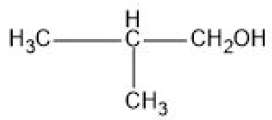 CUET 2025 Medium
 - Magnetic moment of first series of transition metal complexes is determined by........CUET 2023 Medium
- Which one of the following is a low spin complex?CUET 2023 Hard
- Which of the following is/are not considered as transition elements?
Ag, Mo, Zn, Hg, WCUET 2023 Easy
More PYQs from CUET
- A deutron and an \(\alpha\)-particle moving with the same velocity enter into a uniform magnetic field acting normal to the plane of their motion. The ratio of the circular paths described by the deutron and \(\alpha\)-particle isCUET 2023 Hard
- An ac source has a frequency of 60 Hz. The time taken for the voltage to change from peak value to zero is :CUET 2023 Medium
- A square planar complex is formed by hybridisation :CUET 2023 Easy
- A conducting circular loop is placed in a uniform magnetic field of 10 T with its plane normal to the field. Now, the radius of the loop starts shrinking at the rate 5 mm/s. When the radius is 5 cm then the induced emf isCUET 2025 Medium
- Based on the data given below, which metal in its +2 oxidation state will not liberate hydrogen from acids ?
Metal V Ti Co Cr \(\mathrm{E}^{\circ}\left(\mathrm{M}^{3+} / \mathrm{M}^{2+}\right)\) -0.26 -0.37 +1.97 -0.41 CUET 2025 Hard - If C is the original value of the asset, S is the scrap value, n is the useful life of the asset and D is the annual depreciation, thenCUET 2025 Hard