


CUET · CHEMISTRY · PYQ PAPER 2025
Read the passage carefully and answer the questions
The transition metals and their compounds are known for their catalytic activity. This activity is ascribed to their ability to adopt multiple oxidation states and to form complexes. Vanadium(V) oxide (in Contact Process), finely divided iron, and nickel (in Catalytic Hydrogenation) are some of the examples. Catalysts at a solid surface involve the formation of bonds between reactant molecules and atoms of the surface of the catalyst (first row transition metals utilise 3d and 4s electrons for bonding). This has the effect of increasing the concentration of the reactants at the catalyst surface and also weakening of the bonds in the reacting molecules (the activation energy is lowering). Also because the transition metal ions can change their oxidation states, they become more effective as catalysts.
Which of the following catalyses the oxidation of SO2 in the manufacture of sulphuric acid?
- A Vanadium(V) oxide
- B finely divided iron
- C nickel
- D Vanadium(II) oxide
Answer & Solution
Correct Answer
(A) Vanadium(V) oxide
Step-by-step Solution
Detailed explanation
Vanadium(V) oxide
See the Complete Solution
Get step-by-step explanations for this and 2.5 Lakh+ more JEE, NEET & CET questions.
- Unlock all solutions
- Practice the full chapter
- Track accuracy across PYQs
4.8 rated on Google Play · 14,000+ reviews
More questions from CHEMISTRY
- The molecule having largest \(C - X\) bond length isCUET 2025 Medium
- Which of the following is an ore of copperCUET 2023 Medium
- Which biomolecule is an example of fibrous protein?CUET 2025 Medium
- Which property is observed in an emulsion ?CUET 2023 Medium
- The value of van't Hoff factor, i, for CH3COOH solution in water will beCUET 2025 Hard
- Catalytic hydrogenation of ketones with lithium aluminium hydride givesCUET 2025 Medium
More PYQs from CUET
- Which vector is used for introducing nematode specific genes into the tobacco host plant.CUET 2023 Hard
- Observe the given figures and answer the question
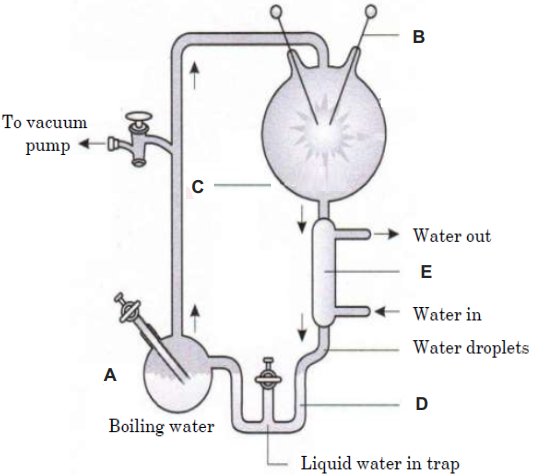
Identify the statements which hold true for Miller's experiment:
(A) He created an electric discharge in a closed flask containing CH4, N2, NH3 and water vapour at 1200°°C
(B) He created electric discharge in a closed flask containing CH4, N2, NH3 and water vapour at 800°C
(C) He observed the formation of amino acids only
(D) He observed the formation of amino acids, sugars and fats
Choose the correct answer from the options given below:CUET 2023 Hard - If \(\operatorname{det}\left(\begin{array}{cc}2 x & 5 \\ 8 & x\end{array}\right)=\operatorname{det}\left(\begin{array}{cc}6 & -2 \\ 1 & 1\end{array}\right)\), then the value of \(x\) isCUET 2025 Easy
- A first order reaction is found to have a rate constant \(k = 5.5 \times 10^{-14}\ s^{-1}\).
Find the half-life of the reaction.CUET 2023 Hard - The ratio of intensities of two waves is 16:1. If these two are superimposed, What is the ratio of maximum and minimum intensities?CUET 2023 Hard
- Read the passage given below and answer the question.
The transition elements which give the greatest number of oxidation states occur in or near the middle of the series. Manganese, for example, exhibits all the oxidation states from +2 to +7 . The lesser number of oxidation states at extreme ends stems from either too few electrons to lose or share (Sc, Ti) on too many d-electrons (hence fewer orbitals available in which to share electrons with others) for higher valence \(( Cu , Zn )\). Thus early in the series scandium (II) is virtually unknown and titanium (IV) is more stable than Ti (III) or Ti (II). At the other end, the only oxidation state of zinc is \(+ 2\) (no d electrons are involved). The maximum oxidation states of reasonable stability correspond in value to the sum of the s - and d-electrons upto manganese ( \(Ti ^{I V} O _2, V^V O _2^{+}, Cr ^{V I} O _4^{2-}\), \(Mn ^{\text {VII }} O _4\) ) followed by a rather abrupt decrease in stability of higher oxidation states, so that the typical species to follow are \(Fe ^{I I, I I I}, Co ^{I I, I I I}, Ni ^{I I}, Cu ^{I, I I}, Zn ^{I I}\).
The variability of oxidation states, a characteristic of transition elements, arises out of incomplete filling of d-orbitals in such a way that their oxidation states differ from each other by unity, e.g. \(V ^{I I}, V^{I I I}, V^{I V}, V^V\). This is in contrast with the variability of oxidation states of non transition elements where oxidation states normally differ by a unit of two.
An interesting feature in the variability of oxidation states of the d-block elements is noticed among the groups (groups 4 through 10). Although in the p-block, the lower oxidation states are favoured by the heavier members (due to inert pair effect), the opposite is true in the groups of dblock. For example, in group 6, \(Mo ( VI )\) and \(W ( VI )\) are found to be more stable than \(Cr ( VI )\). The \(Cr ( VI )\) in the form of dichromate in acidic medium is a strong oxidising agent, whereas \(MoO _3\) and \(WO _3\) are not.
Low oxidation states are found when a complex compound has ligands capable of \(\pi\)-acceptor character in addition to the \(\sigma\)-bonding. For example, in \(Ni ( CO )_4\) and \(Fe ( CO )_5\), the oxidation state of nickel and iron is zero.
Identify the stable pair of ions :CUET 2023 Easy