


CUET · CHEMISTRY · PYQ PAPER 2025
Read the passage carefully and answer the questions
The resistance ( \(R\) ) of an object is given by the expression \(R=\rho \frac{l}{A}\)
The inverse of \(R\) is called conductance and the inverse of \(\rho\) is called conductivity or specific conductance represented by \(\kappa\).
The conductivity depends upon the nature of the material (insulator, semiconductor or conductor) and the temperature of the substance.
Similarly, the conductance due to the ions present in the solution. (ionic conductance) depends upon the nature of the electrolyte, size of ions, the nature of the solvent and the temperature.
Molar conductivity ( \(\Lambda _{ m }\) ) of a solution at a given concentration is the conductance of volume \(V\) containing one mole of electrolyte kept between two electrodes of area \(A\) and unit distance apart.
It is given by the expression.\(A_m=\kappa V .\)
Molar conductivity increases with decrease in concentration and when concentration approaches sero, it is called limiting molar conductivity.
The decrease is linear for a strong electrolyte. However, for a weak electrolyte the change is gradual at higher concentrations and sharp near zero concentration.
Using limiting molar conductivity values of strong electrolytes we can calculate the limiting molar conductivity of weak electrolytes using Kohlrausch law of independent migration of ions.
From molar conductivity and limiting molar conductivity we can determine the degree of dissociation \(\left(\frac{\Lambda_m}{\Lambda_m^0}\right)\) and the ionisation constant of a weak acid.
The limiting molar conductivity values for \(HCl , NaCl\) and \(CH _3 COONa\) are \(425.9,126.4\) and \(91.0 S cm ^2 mol^{-1}\), respectively.
Calculate the limiting molar conductivity value for acetic acid.
- A \(643.3 S cm ^2 mol^{-1}\)
- B \(208.5 S cm ^2 mol^{-1}\)
- C \(390.5 S cm ^2 mol^{-1}\)
- D \(461.3 S cm ^2 mol^{-1}\)
Answer & Solution
Correct Answer
(C) \(390.5 S cm ^2 mol^{-1}\)
Step-by-step Solution
Detailed explanation
\( \Lambda^0_m(CH_3COOH) = \Lambda^0_m(CH_3COONa) + \Lambda^0_m(HCl) - \Lambda^0_m(NaCl) \) \( \Lambda^0_m(CH_3COOH) = 91.0 + 425.9 - 126.4 \) \( \Lambda^0_m(CH_3COOH) = 390.5 S cm^2 mol^{-1} \)
See the Complete Solution
Get step-by-step explanations for this and 2.5 Lakh+ more JEE, NEET & CET questions.
- Unlock all solutions
- Practice the full chapter
- Track accuracy across PYQs
4.8 rated on Google Play · 14,000+ reviews
More questions from CHEMISTRY
- When \(CuSO_4\) solution is electrolysed using platinum electrodes, which of the following is true ?CUET 2023 Easy
- In process of froth floatation, which is used for the removing gangue from sulphide ores. Depressant used is :CUET 2023 Easy
- Aniline upon heating with concentrated \(HNO_3\) and concentrated \(H_2SO_4\) mixture gives:CUET 2023 Medium
- From binary solution of two liquids, A and B
Match List-I with List-II
Choose the correct answer from the options given below:List-I: Inter-molecular interaction List-II: Behavior (A) A-A & B-B are nearly equal to A-B (I) Negative deviation from Raoult's Law (B) A-A & B-B are stronger compared to A-B (II) Azeotropes (C) A-A & B-B are weaker compared to A-B (III) Positive deviation from Raoult's Law (D) Very strong A-B interaction (IV) No deviation from Raoult's Law CUET 2025 Easy - Copper can be extracted from:
(A) Cryolite
(B) Malachite
(C) Calamine
(D) Copper glance
(E) Cuprite
Choose the correct answer from the options given below :CUET 2023 Easy - Read the passage carefully and answer the Questions
Haloalkanes undergo nucelophilic substitution reactions owing to the polarity of CX bond. The nucleophile reacts with the haloalkane on the carbon possessing a partial positive charge holding the halogen atom. The halogen atom \(X\) is replaced by a nucleophile. Depending on the kinetics and mode of bond breaking, the mechanism can be either SN1 or SN2 reaction. The rate of SN1 reaction is governed by the stability of carbocation and in SN2 reaction, the rate of reaction is governed by steric factor. Chirality is the main factor in both SN1and SN2. In SN1 reaction, the chirality of alkyl halide is accompanied by racemization of the product, while in SN2 reaction, the product is characterized by inversion of configuration. The structure of alkyl halide and the nature of the solvent also governs the mechanism of the substitution.
Which of the following compound will undergo \(S_N 1\) reaction readily?CUET 2025 Easy
More PYQs from CUET
- The approximate volume of a cube of side a meters on increasing the side by 4% is:CUET 2023 Easy
- The hormone releasing IUDs function by-CUET 2023 Easy
- Which of the following are autosomal recessive gene disorders?
(A) Thalassemia
(B) Phenylketonuria
(C) Haemophilia
(D) Sickle cell anemia
Choose the correct answer from the options given below:CUET 2025 Easy - Two cells of emf 2 V and 4 V and internal resistance of \( 0.5 \text{ } \Omega \) each are connected with an external resistor of resistance \( 3 \text{ } \Omega \) as shown in the figure. The terminal potential difference of 2 V cell is:
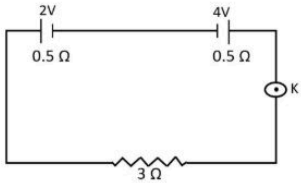 CUET 2025 Hard
 - The reaction occurring at the cathode during discharging of a lead-storage battery is:CUET 2023 Medium
- The Wheatstone bridge is an arrangement of four resistances \( R_1, R_2, R_3, R_4 \) as shown in the figure given below. The null-point condition is not given by:
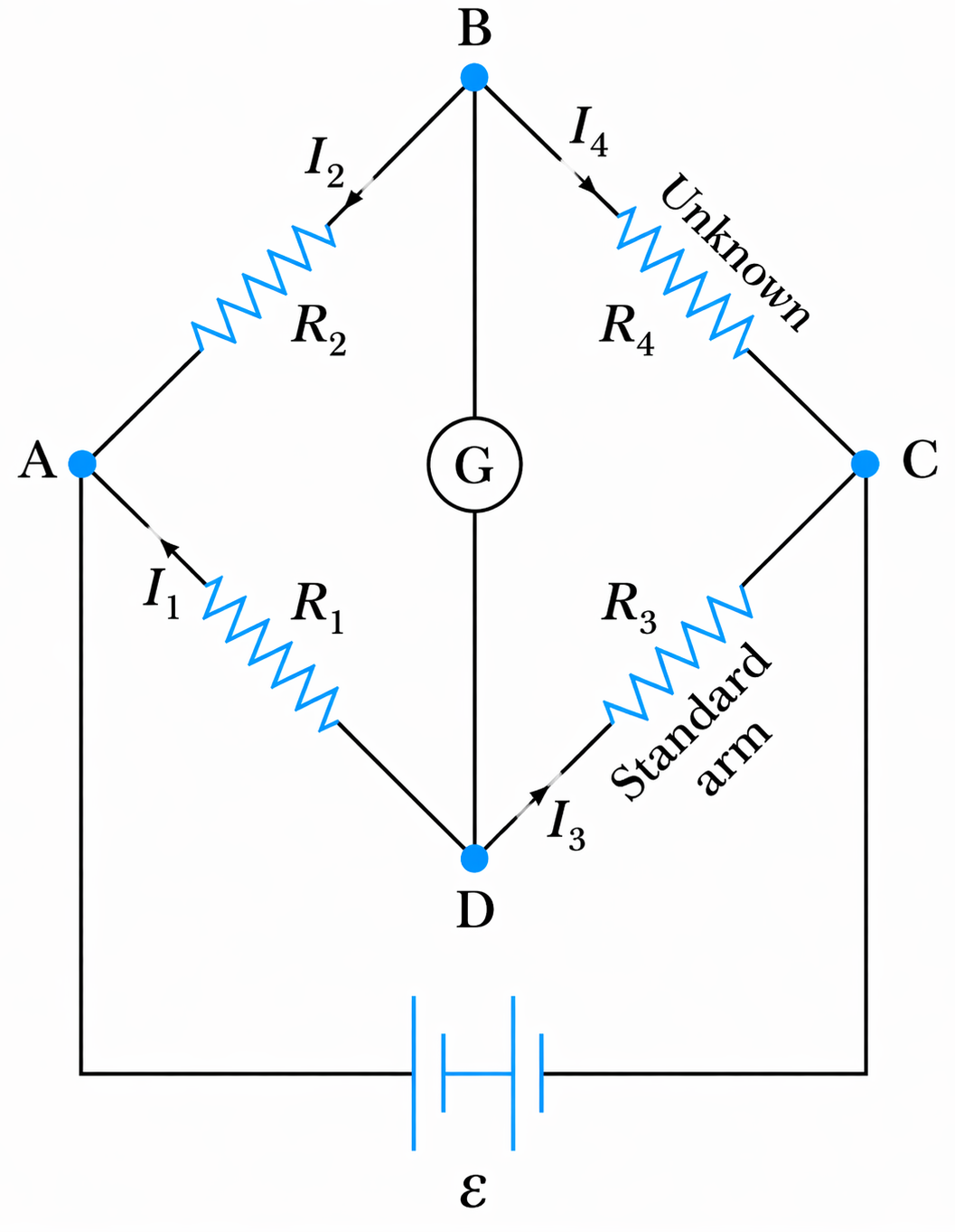 CUET 2025 Easy