


CUET · CHEMISTRY · PYQ PAPER 2025
Read the passage carefully and answer the questions
Optically active polyhydroxy aldehydes or ketones or molecules which provide such units on hydrolysis are called carbohydrates. They can be broadly classified as monosaccharides, disaccharides and polysaccharides depending on their behavior towards hydrolysis. They are also classified as reducing or non-reducing sugars. Another class of biomolecules is proteins which are polymers of twenty different amino acids linked by peptide bonds. Amino acids can be classified as acidic, basic or neutral depending on the relative number of amino and carboxyl groups in their molecule. The essential amino acids cannot be synthesized by our body and hence must be provided through diet. Nucleic acids are the polymers of nucleotides which in turn consist of a base, pentose sugar and phosphate. There are two types of nucleic acids namely, DNA and RNA which differ in the composition of sugar and a base
The side chain ( \(R\) group) present in the "Aspartic Acid" amino acid is
- A \(H_{3}C-S-CH_{2}-CH_{2}-\)
- B \(HOOC-CH_{2}-\)
- C \(HOOC-CH_{2}-CH_{2}-\)
- D \(HO-CH_{2}-\)
Answer & Solution
Correct Answer
(B) \(HOOC-CH_{2}-\)
Step-by-step Solution
Detailed explanation
The side chain (R group) for Aspartic Acid is \(HOOC-CH_{2}-\).
See the Complete Solution
Get step-by-step explanations for this and 2.5 Lakh+ more JEE, NEET & CET questions.
- Unlock all solutions
- Practice the full chapter
- Track accuracy across PYQs
4.8 rated on Google Play · 14,000+ reviews
More questions from CHEMISTRY
- The liquid which causes formation of poisonous gas when exposed to sunlight in presence of air or oxygen (\(\text{O}_2\)), is:CUET 2023 Medium
- In the following diagram, to prevent osmosis, if excess pressure is applied on one side of the semipermeable membrane (SPM), then I, II, III and IV are, respectively,
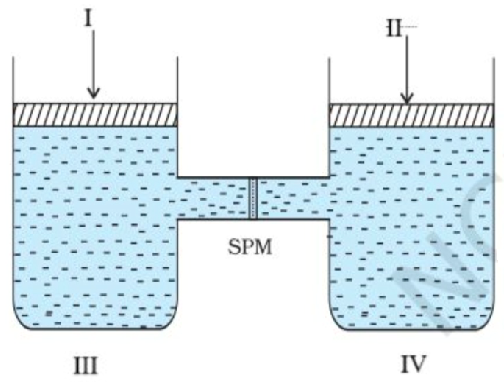
(A) Solution
(B) \(P_{\text {atm }}\)
(C) \(P_{\text {atm }}+\Pi\)
(D) Solvent
Choose the correct answer from the options given below:CUET 2025 Hard - Read the passage carefully and answer the questions:
The degeneracy of the \(d\) orbitals has been removed due to ligand electron-metal electron repulsions in the octahedral complex to yield three orbitals of lower energy, \(t_2\), set and two orbitals of higher energy, \(e_g\) set. This splitting of the degenerate levels due to the presence of ligands in a definite geometry is termed as crystal field splitting and the energy separation is denoted by \(\Delta_0\). Thus energy of the two \(e_g\) orbitals will increase by \((3 / 5) \Delta_0\) and that of three \(t_{2 g}\) will decrease by \((2 / 5) \Delta_0\). The crystal field splitting \(\Delta_{\circ}\) depends upon the field produced by the ligand and charge on the metal ion. Some ligands are able to produce strong fields, in which case the splitting will be large, whereas others produce weak fields and consequently result in small splitting of \(d\) orbitals. Relative magnitude of crystal field splitting energy \(\Delta_0\) and pairing energy, \(P\) (energy required for electron pairing in a single orbital) determine the formation of low spin ( \(\Delta_{\circ}>P\) ) or high spin ( \(\Delta_{\circ}<P\) ) complex. In tetrahedral coordination entity formation, the d-orbital splitting is inverted and is smaller as compared to the octahedral field splitting. The crystal field theory attributes the colour of the complex to \(d-d\) transition of the electron. The colour of the coordination compounds depends on the crystal field splitting. In the absence of ligand, crystal field splitting does not occur and hence the substance is colourless.
What will be the crystal field splitting energy for tetrahedral \(\left[ CoCl _4\right]^{2-}\) if its value for octahedral \(\left[ CoCl _6\right]^{4-}\) is \(18,000 cm^{-1}\) ?CUET 2025 Easy - Which is the correct decreasing order of boiling point
A. 1 - Bromoethane
B. 1 - Bromopentane
C. 1 - Bromobenzene
D. 1 - Bromopropane
Choose the correct answer from the options given below:CUET 2023 Hard - \(2KClO_3 \xrightarrow{653-873K} 2KCl + 3O_2\)
On adding manganese dioxide to the above reaction, the subsequent decomposition takes place at:CUET 2023 Hard - Match List-I with List-II
Choose the correct answer from the options given below:List-I ( Common name) List-II ( IUPAC name) (A) Vinyl Chloride (I) 1-Chloro-2-methylbenzene (B) Chloroform (II) Dichloromethane (C) Methylene chloride (III) Trichloromethane (D) o-Chlorotoluene (IV) Chloroethene CUET 2025 Medium
More PYQs from CUET
- Match List-I with List-II
Choose the correct answer from the options given below:List-I (Conditions) List-II (Type of matrix) (A) Square matrix \(A\) (I) \(A=\left[a_{i j}\right]_{m \times m}\), where \(\left\{\begin{array}{ll}a_{i j}=0 & , i \neq j \\ a_{i j}=k & , i=j\end{array}\right.\) where \(k \neq 0\) is constant (B) Scalar Matrix \(A\) (II) \(A=\left[a_{i j}\right]_{m \times m}\) (C) Diagonal matrix \(A\) (III) \(A=\left[a_{i j}\right]_{m \times m}\), where \(\left\{\begin{array}{ll}a_{i j}=0 & , i \neq j \\ a_{i j}=1 & , i=j\end{array}\right.\) (D) Identity matrix \(A\) (IV) \(A=\left[a_{i j}\right]_{m \times m}\), where \(a_{i j}=0, i \neq j\) CUET 2025 Hard - Identify, which is not the example of homology in evolution.CUET 2025 Easy
- An urn I contains \(3\) white and \(4\) blue balls, while urn II contains \(5\) white and \(6\) blue balls. One ball is drawn at random from one of the urns and it is found to be white. The probability that it was drawn from urn II is:CUET 2025 Hard
- The domain of the function \(f(x)=\sin ^{-1}(2 x-3)\) is :CUET 2023 Medium
- Recombinant DNA technology involves the following steps in a specific sequence.
(A) Culture of the host cell
(B) Extraction of desired product
(C) Isolation of desired DNA fragments
(D) Transformation of the recombinant DNA into the host cell
Arrange these sequences correctly and choose the correct answer from the options given below:CUET 2023 Hard - In which of one the following all the concentration terms are independent of temperature?CUET 2025 Easy