


CUET · CHEMISTRY · PYQ PAPER 2025
Read the Passage carefully and answer the Questions
Kinetic studies not only help us to determine the rate of a chemical reaction but also describe the conditions by which the reaction rates can be altered. The factors such as concentration, temperature, pressure and catalyst affect the rate of a reaction.
The speed of a reaction or the rate of a reaction can be defined as the change in concentration of a reactant or product in unit time.
Rate \(=k[A]^x[B]^y\)
Here \(k\) is the rate constant
\(x+y\) gives the overall order of a reaction, whereas \(x\) and \(y\) represent the order with respect to the reactants \(A\) and \(B\), respectively.
The unit of rate constant for first order reaction is
- A \(mol L ^{-1} s^{-1}\)
- B \(mol L s ^{-1}\)
- C \(L ^{-1} s^{-1}\)\(mol L s ^{-1}\)
- D \(s ^{-1}\)
Answer & Solution
Correct Answer
(D) \(s ^{-1}\)
Step-by-step Solution
Detailed explanation
\(Rate = k[A]^1\) \(mol L^{-1} s^{-1} = k (mol L^{-1})\) \(k = s^{-1}\)
See the Complete Solution
Get step-by-step explanations for this and 2.5 Lakh+ more JEE, NEET & CET questions.
- Unlock all solutions
- Practice the full chapter
- Track accuracy across PYQs
4.8 rated on Google Play · 14,000+ reviews
More questions from CHEMISTRY
- Identify the chiral molecule from the following,
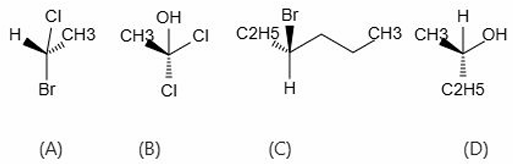
Choose the correct answer from the options given below :CUET 2025 Medium - The reagents involved in the following conversion are
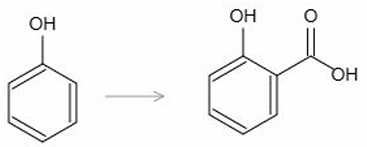 CUET 2025 Hard
 - Read the passage carefully and answer the questions based on the passage:
The number of reacting species (atoms, ions or molecules) taking part in an elementary reaction, which must collide simultaneously in order to bring about a chemical reaction is called molecularity of a reaction. In the rate equation Rate \(=k[\mathrm{~A}]^x[\mathrm{~B}]^y\)
\(x\) and \(y\) indicate how sensitive the rate is to the change in concentration of A and B, respectively. Sum of these exponents, i.e., \(x +y\) gives the overall order of a reaction where \(x\) and \(y\) represent the order with respect to the reactants A and B respectively. Hence, the sum of powers of the concentration of the reactants in the rate law expression is called the order of that chemical reaction. For a first order reaction, the concentration of the reactant varies as \([\mathrm{R}]=[\mathrm{R}]_0 e^{-k t}\)
Which of the following statements is not true for order of a reaction?CUET 2025 Hard - Read the passage carefully and answer the questions:
The degeneracy of the \(d\) orbitals has been removed due to ligand electron-metal electron repulsions in the octahedral comple: to yield three orbitals of lower energy, \(t_{2 g}\) set and two orbitals of higher energy, \(e_g\) set. This splitting of the degenerate levels due to the presence of ligands in a definite geometry is termed as crystal field splitting and the energy separation is denoted by \(\Delta_0\). Thus energy of the two \(e_g\) orbitals will increase by \((3 / 5) \Delta_0\) and that of three \(t_{2 g}\) will decrease by \((2 / 5) \Delta_0\). The crystal field splitting \(\Delta_0\) depends upon the field produced by the ligand and charge on the metal ion. Some ligands are able to produce strong fields, in which case the splitting will be large, whereas others produce weak fields and consequently result in small splitting of \(d\) orbitals. Relative magnitude of crystal field splitting energy \(\Delta_0\) and pairing energy, \(P\) (energy required for electron paring in a single orbital) determine the formation of low spin ( \(\Delta_0>P\) ) or high spin ( \(\Delta_0<P\) ) complex. In tetrahedral coordination entity formation, the \(d\)-orbital splitting is inverted and is smaller as compared to the octahedral field splitting. The crystal field theory attributes the colour of the complex to \(d-d\) transition of the electron. The colour of the coordination compounds depends on the crystal field splitting. In the absence of ligand, crystal field splitting does not occur and hence the substance is colourless.
Which of the following complex is not expected to be coloured?CUET 2023 Medium - Which of the following classes of compounds on hydrolysis yields carboxylic acids?
(A) RCN
(B) \(RCONH_{2}\)
(C) RCOCl
(D) RCOOR'
Choose the \textbf\{correct answer\} from the options given below:CUET 2025 Medium - Which factors are responsible for making fluorine the strongest oxidising agent ?
(A) \quad Highest electronegativity
(B) \quad High electron gain enthalpy
(C) \quad High bond dissociation enthalpy
(D) \quad Small size of flourine
Choose the correct answer from the options given below :CUET 2023 Medium
More PYQs from CUET
- If \(y =\sin ^{-1} x\), thenCUET 2023 Hard
- Match List-I with List-II
Choose the correct answer from the options given below:List-I ( Common name) List-II ( IUPAC name) (A) Vinyl Chloride (I) 1-Chloro-2-methylbenzene (B) Chloroform (II) Dichloromethane (C) Methylene chloride (III) Trichloromethane (D) o-Chlorotoluene (IV) Chloroethene CUET 2025 Medium - Match List-I with List-II
Choose the correct answer from the options given below :List-I List-II (A) If A is a non singular matrix of order n, then \(| A (\operatorname{adjA})|\) is equal to (I) \(|A|^{n-1}\) (B) If A is a non singular matrix of order n, then |adj(adj A)| is equal to (II) \(|A|^{n-2} A\) (C) If A is a non singular matrix of order n, then \(\operatorname{adj}(\operatorname{adj} A )\) is equal to (III) \(|A|^n\) (D) if A is a non singular matrix of order n, then \(|(\operatorname{adj} A)|\) is equal to (IV) \(|A|^{(n-1)^2}\) CUET 2025 Easy - Darwin's finches and Australian marsupials are an example of:CUET 2023 Medium
- Two identical short bar magnets each of magnetic moment \( 12.5 \text{ Am}^2 \) are placed with 10 cm separation between their centers as shown in the figure. The magnitude of magnetic field at O is
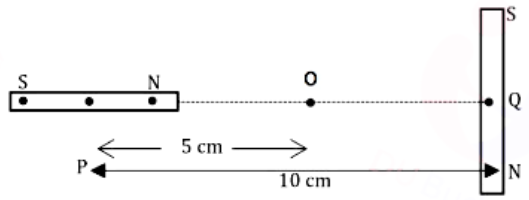 CUET 2025 Easy
 - Reaction of Phenol with conc. \(HNO _3\) givesCUET 2025 Easy