


CUET · CHEMISTRY · PYQ PAPER 2025
Read the passage carefully and answer the Questions
Haloalkanes undergo nucelophilic substitution reactions owing to the polarity of CX bond. The nucleophile reacts with the haloalkane on the carbon possessing a partial positive charge holding the halogen atom. The halogen atom \(X\) is replaced by a nucleophile. Depending on the kinetics and mode of bond breaking, the mechanism can be either SN1 or SN2 reaction. The rate of SN1 reaction is governed by the stability of carbocation and in SN2 reaction, the rate of reaction is governed by steric factor. Chirality is the main factor in both SN1and SN2. In SN1 reaction, the chirality of alkyl halide is accompanied by racemization of the product, while in SN2 reaction, the product is characterized by inversion of configuration. The structure of alkyl halide and the nature of the solvent also governs the mechanism of the substitution.
Which of the following bromo isomer of butane will react at a faster rate towards SN2 reaction?
- A t-butyl bromide
- B Sec-butyl bromide
- C Isobutyl bromide
- D n-butyl bromide
Answer & Solution
Correct Answer
(D) n-butyl bromide
Step-by-step Solution
Detailed explanation
SN2 reactivity: Methyl > Primary > Secondary > Tertiary. n-butyl bromide: Primary. Isobutyl bromide: Primary (with branch on \(\beta\)-carbon). Sec-butyl bromide: Secondary. t-butyl bromide: Tertiary. n-butyl bromide has the least steric hindrance, thus reacts fastest in SN2…
See the Complete Solution
Get step-by-step explanations for this and 2.5 Lakh+ more JEE, NEET & CET questions.
- Unlock all solutions
- Practice the full chapter
- Track accuracy across PYQs
4.8 rated on Google Play · 14,000+ reviews
More questions from CHEMISTRY
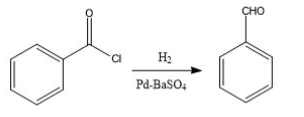
- The following reaction is known as
 CUET 2025 Easy
 - Read the passage carefully and answer the Questions
Werner in 1898, propounded his theory of coordination compounds. In coordination compounds metals show two types of linkages (valences)-primary and secondary. The primary valences are normally ionisable and are satisfied by negative ions. The secondary valences are non-ionisable. These are satisfied by neutral molecules or negative ions. The secondary valence is equal to the coordination number and is fixed for a metal. The ions or group bound by the secondary linkages to the metal have characteristic spatial arrangements corresponding to the different coordination numbers. Both double salts as well as complexes are formed by the combination of two or more stable compounds in stoichiometric ratio. However, they differ in the fact that double salts such as carnallite, Mohr's salt, potash alum etc. dissociate into simple ions completely when dissolved in water. But complex ions do not dissociate completely into simple ions.
Which of the following is a double salt?CUET 2025 Medium - Answer the question on the basis of passage given below :
There are three kinds of amines which are primary, secondary and tertiary amines. These amines may have alkyl group or aryl group or both alkyl and aryl groups. These amines can be distinguished from one another by various chemical tests.
An amine A on treatment with \(\text{NaNO}_2\) and \(\text{HCl}\) at 273-277 K, followed by treatment with ethyl alcohol, gives a compound B with empirical formula CH and molecular mass 78.
A is :CUET 2023 Hard -
List-I (Reaction Name) List-II (Reaction) (A) Carbylamine reaction (I) 
(B) Gatterman Rection (II) 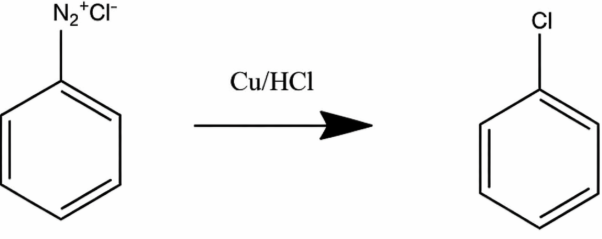
(C) Sandmeyer reaction (III) 
(D) Hoffmann Bromamide reaction (IV) 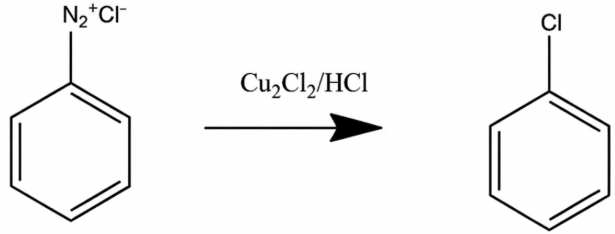
Choose the correct answer from the options given below:CUET 2025 Hard - Read the passage carefully and answer the questions The resistance ( \(R\) ) of an object is given by the expression \(R=\rho \frac{l}{A}\).
The inverse of \(R\) is called conductance and the inverse of \(\rho\) is called conductivity or specific conductance represented by \(\kappa\).
The conductivity depends upon the nature of the material (insulator, semiconductor or conductor) and the temperature of the substance.
Similarly, the conductance due to the ions present in the solution (ionic conductance) depends upon the nature of the electrolyte, size of ions, the nature of the solvent and the temperature.
Molar conductivity ( \(\Lambda_m\) ) of a solution at a given concentration is the conductance of volume \(V\) containing one mole of electrolyte kept between two electrodes of area \(A\) and unit distance apart. It is given by the expression \(\Lambda_m=\kappa V .\)
Molar conductivity increases with decrease in concentration and when concentration approaches zero, it is called limiting molar conductivity.
The decrease is linear for a strong electrolyte. However, for a weak electrolyte the change is gradual at higher concentrations and sharp near zero concentration.
Using limiting molar conductivity values of strong electrolytes we can calculate the limiting molar conductivity of weak electrolytes using Kohlrausch law of independent migration of ions.
From molar conductivity and limiting molar conductivity we can determine the degree of dissociation \(\left(\frac{\Lambda_m}{\Lambda_m^0}\right)\) and the ionization constant of a weak acid.
For a weak acid like acetic acid, the correct expression for the ionisation constant at concentration \(c\) isCUET 2025 Medium - The amines which are soluble in water
(A) Methanamine
(B) Ethanamine
(C) Propanamine
(D) Benzylamine
Choose the correct answer from the options given below:CUET 2025 Easy
More PYQs from CUET
- A point source S is placed at a distance of 12 cm from a converging lens of focal length 10 cm on its principal axis. Where should a diverging mirror of focal length 14 cm be placed from the lens so that a real image is formed on the source itself?CUET 2025 Medium
- Pollination achieved within the same flower is known as:CUET 2023 Easy
- If \(x, y\) and \(z\) are non zero real numbers, the inverse of matrix \(A=\left[\begin{array}{lll}x & 0 & 0 \\ 0 & y & 0 \\ 0 & 0 & z\end{array}\right]\) is:CUET 2023 Medium
- When blood cells are placed in 1\(\%\) (w/v) \(\text{NaCl}\) aqueous solution :CUET 2023 Medium
- A double convex lens of refractive index 1.5 has a radius of curvature R each. The focal length of the lens isCUET 2025 Medium
- If the matrix \(A=\left[\begin{array}{ccc}0 & x+y & 1 \\ 3 & z & 2 \\ x-y & -2 & 0\end{array}\right]\) is skew-symmetric, then:CUET 2023 Hard