


CUET · CHEMISTRY · PYQ PAPER 2025
Read the passage carefully and answer the questions based on the passage:
The number of reacting species (atoms, ions or molecules) taking part in an elementary reaction, which must collide simultaneously in order to bring about a chemical reaction is called molecularity of a reaction. In the rate equation Rate \(=k[\mathrm{~A}]^x[\mathrm{~B}]^y\)
\(x\) and \(y\) indicate how sensitive the rate is to the change in concentration of \(A\) and \(B\), respectively. Sum of these exponents, i.e., \(x +y\) gives the overall order of a reaction where \(x\) and \(y\) represent the order with respect to the reactants A and B respectively. Hence, the sum of powers of the concentration of the reactants in the rate law expression is called the order of that chemical reaction. For a first order reaction, the concentration of the reactant varies as \([\mathrm{R}]=[\mathrm{R}]_0 e^{-k t}\)
The initial concentration of \(\mathrm{N}_2 \mathrm{O}_5\) in the following first order reaction
\(\mathrm{N}_2 \mathrm{O}_5(g) \rightarrow 2 \mathrm{NO}_2(g)+1 / 2 \mathrm{O}_2(g)\)
- A \(0.040 \mathrm{~min}^{-1}\)
- B \(0.023 \mathrm{~min}^{-1}\)
- C \(0.032 \mathrm{~min}^{-1}\)
- D \(0.050 \mathrm{~min}^{-1}\)
Answer & Solution
Correct Answer
(A) \(0.040 \mathrm{~min}^{-1}\)
Step-by-step Solution
Detailed explanation
\(k = \frac{1}{t} \ln\left(\frac{[\mathrm{R}]_0}{[\mathrm{R}]}\right)\) \(k = \frac{1}{10 \mathrm{~min}} \ln\left(\frac{1.24 \mathrm{~mol/L}}{0.83 \mathrm{~mol/L}}\right)\) \(k = \frac{1}{10} \ln(1.49397)\) \(k \approx \frac{1}{10} \times 0.4000\)…
See the Complete Solution
Get step-by-step explanations for this and 2.5 Lakh+ more JEE, NEET & CET questions.
- Unlock all solutions
- Practice the full chapter
- Track accuracy across PYQs
4.8 rated on Google Play · 14,000+ reviews
More questions from CHEMISTRY
- Which of the following can be prepared from Sandmeyer's reaction?
(A) Chlorobenzene
(B) Bromobenzene
(C) lodobenzene
(D) Fluorobenzene
Choose the correct answer from the options given below:CUET 2023 Medium - The IUPAC name of the following compound is
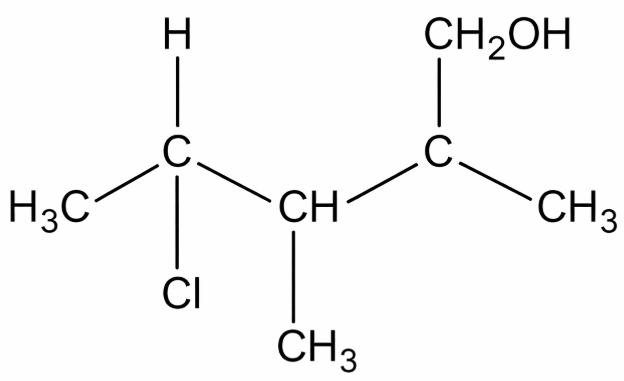 CUET 2025 Hard
 - Which of the metal is used in catalytic hydrogenation?CUET 2025 Hard
- Alkyl halides react with sodium to give alkanes with double number of carbon atoms inCUET 2023 Medium
- Which of the following complexes show linkage isomerism?CUET 2025 Easy
- Which of the following compounds will give a pair of enantiomers upon nucleophilic substitution reaction with a hydroxide ion?CUET 2025 Easy
More PYQs from CUET
- Which of the following option is correct for ammensalism?CUET 2023 Easy
- You are given a transformer that has 800 turns on its primary coil and 64 turns on its secondary coil. A voltage of 220 V is applied to the primary coil. What is the output voltage?CUET 2023 Hard
- Which of the following compound(s) does not react with Fehling solution?
(A) \(CH _3 CHO\)
(B) \(Ph - CHO\)
(C) Glucose
(D)
choose the correct answer from the options given below:CUET 2025 Hard - Read the passage carefully and answer the Questions
According to Valence Bond theory, the metal atom or ion under the influence of ligands can use its ( \(n-1\) )d, ns, np or ns, np, nd orbitals for hybridisation to yield a set of equivalent orbitals of definite geometry such as octahedral, tetrahedral, square planar and so on. These hybridised orbitals are allowed to overlap with ligand orbitals that can donate electron pairs for bonding. While the VB theory, to a larger extent, explains the formation, structures and magnetic behaviour of coordination compounds, it suffers from the many shortcomings. The Crystal field theory (CFT) is an electrostatic model which considers the metal-ligand bond to be ionic arising purely from electrostatic interactions between the metal ion and the ligand. The five \(d\) orbitals in an isolated gaseous metal atom/ion have same energy, i.e., they are degenerate. This degeneracy is maintained if a spherically symmetrical field of negative charges surrounds the metal atom/ion. However, when this negative field is due to ligands in a complex, it becomes asymmetrical and the degeneracy of the \(d\) orbitals is lifted. It results in splitting of the \(d\) orbitals. The pattern of splitting depends upon the nature of the crystal field.
Which among the following are diamagnetic complexes?
\(\left[Ni(CN)_4\right]^{2-},\left[Co\left(C_2O_4\right)_3\right]^{3-},\left[Fe(CN)_6\right]^{4-},\left[CoF_6\right]^{3-},\left[Mn(CN)_6\right]^{3-}\)CUET 2025 Hard - Why are the number of trophic levels in a food chain limited?CUET 2023 Medium
- In an influenza epidemic, the number of cases diagnosed in a week were as follows:
The 3-day moving averages are :Day Monday Tuesday Wednesday Thursday Friday Saturday Sunday Number
of Cases10 12 8 16 9 14 4 CUET 2025 Medium