


CUET · CHEMISTRY · PYQ PAPER 2025
Read the passage carefully and answer the questions.
Amines are considered to be derivatives of ammonia obtained by replacement of hydrogen atoms with alkyl or aryl groups. They are usually prepared from nitro compounds, halides, amides, imides etc. The presence of hydrogen bonding influences its physical properties. In alkylamines, a combination of electron releasing steric and hydrogen bonding factors influences the stability of substituted ammonium cations in protic polar solvents and thus affects the basic nature of amines. Alkyl amines are found to be stronger bases than ammonia which is more basic than water. Primary and secondary amines are engaged in intermolecular association due to hydrogen bonding. This intermolecular association is more in primary amines than in secondary amines. Tertiary amines do not have intermoleulcar association due to the absenceof hydrogen atom available for hydrogen bonding. Thus, the boiling point of amines depends on hydrogen bonding. In aromatic amines, electron releasing and withdrawing groups increase and decrease their basic character. Aryl diazonium salts usually obtained from arylamine undergo replacement of the diazonium group with a variety of nucleophile. Their coupling reaction of aryl diazonium salts with phenol or arylamine results in formation of dyes.
Which of the following compounds will not undergo azo coupling with benzene diazonium chloride?
- A Anisole
- B Phenol
- C Aniline
- D Nitrobenzene
Answer & Solution
Correct Answer
(D) Nitrobenzene
Step-by-step Solution
Detailed explanation
Nitrobenzene
See the Complete Solution
Get step-by-step explanations for this and 2.5 Lakh+ more JEE, NEET & CET questions.
- Unlock all solutions
- Practice the full chapter
- Track accuracy across PYQs
4.8 rated on Google Play · 14,000+ reviews
More questions from CHEMISTRY
- Answer the question on basis of passage given below :
Alcohols and phenol are formed when a hydrogen atom in a hydrocarbon, aliphatic and aromatic respectively, is replaced by \(\text{-OH}\) group. The substitution of a hydrogen atom in a hydrocarbon by an alkoxy or aryloxy group forms ethers. Alcohols and phenol consist of two part, an alkyl/aryl group and a hydroxyl group. The properties of alcohols and phenols are primarily due to the hydroxyl group. The nature of alkyl and aryl groups simply modify these properties. Alcohol react both as nucleophiles and electrophiles whereas in phenols, the reactions that take place on the aromatic ring are electrophilic subtitution reactions.
Aspirin is an acetylation product of :CUET 2023 Medium - "Answer the question on basis of passage given below :
Carboxylic acids are weaker than mineral acids, but they are stronger acids than alcohols and many simple phenols (\(\text{pKa}\) is ~ 16 for ethanol and 10 for phenol). The higher acidity of carboxylic acids as compared to phenols can be understood similarly. The conjugate base of carboxylic acid, a carboxylate ion, is stabilised by two equivalent resonance structures in which the negative charge is at the more electronegative oxygen atom. The conjugate base of phenol, a phenoxide ion, has non-equivalent resonance structures in which the negative charge is at the less electronegative carbon atom. Further, the negative charge is delocalised over two electronegative oxygen atoms in carboxylate ion whereas it is less effectively delocalised over one oxygen atom and less electronegative carbon atoms in phenoxide ion. Thus, the carboxylate ion is more estabilised than phenoxide ion, so carboxylic acids are more acidic than phenols.
Effect of substituents on the acidity of carboxylic acids: substituents may affect the stabliity of the conjugate base and thus, also affect the acidity of the carboxylic acids. Electron withdrawing group increase the acidity of carboxylic acids by stabilising the conjugate base through delocalisation of the negative charge by inductive and/or resonance effects. Conversely, electron donating groups decrease the acidity by destabilising the conjugate base.
Which of the following compounds would have the smallest value of \(\text{pKa}\)?"CUET 2023 Easy - Predict the order of decreasing reactivity of the following compounds towards SN1 reaction.
(A) \(\mathrm{C}_6 \mathrm{H}_5 \mathrm{CH}_2 \mathrm{Br}\)
(B) \(\mathrm{C}_6 \mathrm{H}_5 \mathrm{CH}\left(\mathrm{C}_6 \mathrm{H}_5\right) \mathrm{Br}\)
(C) \(\mathrm{C}_6 \mathrm{H}_5 \mathrm{CH}\left(\mathrm{CH}_3\right) \mathrm{Br}\)
(D) \(\mathrm{C}_6 \mathrm{H}_5 \mathrm{C}\left(\mathrm{CH}_3\right)\left(\mathrm{C}_6 \mathrm{H}_5\right) \mathrm{Br}\)CUET 2025 Medium - Read the passage carefully and answer the Questions
In the formation of coordination complexes, if the inner \(d\) orbital \((n-1)d\) is used in hybridisation, the complex, is called an inner orbital or low spin or spin paired complex. And if it uses outer \(d\) orbital \((nd)\) in hybridisation (like \(sp^3d^2\)), it is called outer orbital or high spin or spin free complex. The degeneracy of the \(d\) orbitals has been removed due to ligand electron-metal electron repulsions in the complex. This splitting of the degenerate levels due to the presence of ligands in a definite geometry is termed as crystal field splitting. For coordination complexes, the magnetic moment is determined by the number of unpaired electrons and is calculated by using the 'spin-only' formula, \(\mu = \sqrt{n(n+2)}\) where \(n\) is the number of unpaired electrons and \(\mu\) is the magnetic moment in units of Bohr magneton \((BM)\). The coordination compounds are of great importance. These compounds are widely present in the mineral, plant and animal worlds and are known to play many important functions in the area of analytical chemistry, metallurgy, biological systems, industry and medicine.
\([Co(NH_3)_6]^{3+}\) and \([Ni(NH_3)_6]^{2+}\) respectively areCUET 2023 Hard - Select the correct expression for the parts per million (ppm) concentration term:CUET 2025 Hard
- Glucose reacts with Tollen's reagent (ammoniacal silver nitrate) due to the presence ofCUET 2025 Medium
More PYQs from CUET
- If \(x = \sqrt{a^{\sin^{-1}t}}, y = \sqrt{a^{\cos^{-1}t}}\), then \(\frac{dy}{dx}\) is:CUET 2023 Easy
- The rate constant for a first order reaction becomes 2 times when the temperature is raised from 330 K to 380 K . Then the energy of activation for the reaction will be:\[[\log 2=0.3010]\]CUET 2023 Hard
- The value of \(-\operatorname{cosec}^2\left(\cot ^{-1} y\right)+\sec ^2\left(\tan ^{-1} x\right)\) is equal to :CUET 2025 Easy
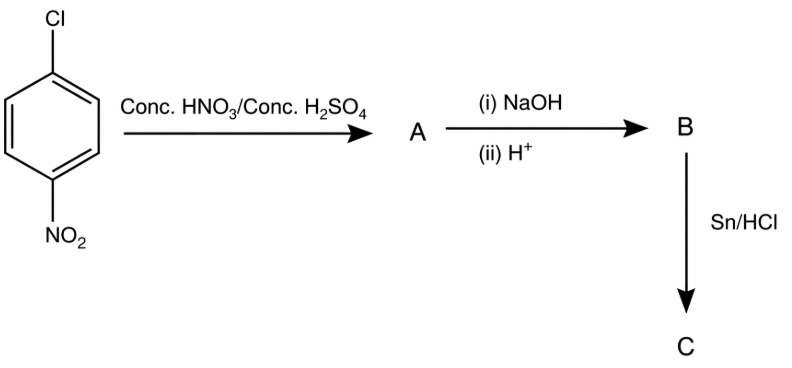
- Identify A, B, and C in the following reaction:
 CUET 2025 Easy
 - The historic convention on Biological Diversity ('The Earth Summit') held in __________ in 1992.CUET 2025 Hard
- The standard electrode potential of copper is positive. Which of the following statements is not true?CUET 2023 Easy