


CUET · CHEMISTRY · PYQ PAPER 2025
Read the passage carefully and answer the Questions
According to Valence Bond theory, the metal atom or ion under the influence of ligands can use its ( \(n-1) d, n s, n p\) or \(n s, n p, n d\)orbitals for hybridisation to yield a set of equivalent orbitals of definite geometry such as octahedral, tetrahedral, square planar and so on. These hybridised orbitals are allowed to overlap with ligand orbitals that can donate electron pairs for bonding. While the VB theory, to a larger extent, explains the formation, structures and magnetic behaviour of coordination compounds, it suffers from the many shortcomings. The Crystal field theory (CFT) is an electrostatic model which considers the metal-ligand bond to be ionic arising purely from electrostatic interactions between the metal ion and the ligand. The five \(d\) orbitals in an isolated gaseous metal atom/ion have same energy, i.e., they are degenerate. This degeneracy is maintained if a spherically symmetrical field of negative charges surrounds the metal atom/ion. However, when this negative field is due to ligands in a complex, it becomes asymmetrical and the degeneracy of the \(d\) orbitals is lifted. It results in splitting of the \(d\) orbitals. The pattern of splitting depends upon the nature of the crystal field.
The spin only magnetic moment of \(\left[ MnBr _4\right]^{2-}\) is 5.9 BM. Predict the geometry of the complex ion?
- A tetrahedral
- B square planar
- C trigonal pyramidal
- D distorted octahedral
Answer & Solution
Correct Answer
(A) tetrahedral
Step-by-step Solution
Detailed explanation
\(Mn^{2+}\) is \(3d^5\). \(\mu = 5.9 \text{ BM} \approx \sqrt{5(5+2)} = \sqrt{35}\) Number of unpaired electrons \(n=5\). \(Br^-\) is a weak field ligand. For a \(d^5\) ion with a weak field ligand, 5 unpaired electrons indicate a high-spin complex. For 4 ligands, tetrahedral…
See the Complete Solution
Get step-by-step explanations for this and 2.5 Lakh+ more JEE, NEET & CET questions.
- Unlock all solutions
- Practice the full chapter
- Track accuracy across PYQs
4.8 rated on Google Play · 14,000+ reviews
More questions from CHEMISTRY
- Read the passage carefully and answer the Questions In the formation of coordination complexes, if the inner \(d\) orbital \((n-1) d\) is used in hybridisation, the complex, is called an inner orbital or low spin or spin paired complex. And if it uses outer \(d\) orbital ( \(n d\) ) in hybridisation (like \(s p^3 d^2\) ), it is called outer orbital or high spin or spin free complex. The degeneracy of the \(d\) orbitals has been removed due to ligand electron-metal electron repulsions in the complex. This splitting of the degenerate levels due to the presence of ligands in a definite geometry is termed as crystal field splitting. For coordination complexes, the magnetic moment is determined by the number of unpaired electrons and is calculated by using the 'spin-only' formula, \(\mu=\sqrt{n(n+2)}\) where \(n\) is the number of unpaired electrons and \(\mu\) is the magnetic moment in units of Bohr magneton (BM). The coordination compounds are of great importance. These compounds are widely present in the mineral, plant and animal worlds and are known to play many important functions in the area of analytical chemistry, metallurgy, biological systems, industry and medicine.
\(\left[ Co \left( NH _3\right)_6\right]^{3+}\) and \(\left[ Ni \left( NH _3\right)_6\right]^{2+}\) respectively areCUET 2025 Hard - Match List-l with List-ll
List - I (Reactions) List - II (Products) (A) CH3CH2Br + alc.KOH (I) CH3CH2NO2 (B) CH3CH2Br + aq.KOH (II) CH2 = CH2 (C) CH3CH2Br + KNO2 (III) CH3CH2ONO (D) CH3CH2Br + AgNO2 (IV) CH3CH2OH
Choose the correct answer from the options given below:CUET 2023 Medium - Total number of isomers for the complex \([\text{FeCl}_2 (\text{C}_2\text{O}_4)_2]^{4-}\) is:CUET 2023 Medium
- Answer the question on the basis of passage given below :
All transition elements display typical metallic properties like high melting point, boiling point, tensile strength, high malleability and ductility, luster, etc. Their metallic character increases down the group and elements of 4d and 5d series exhibit higher metallic characters. They show variable oxidation states and forms a number of coloured compounds due to the presence of unpaired electrons which shows d-d transitions and makes them paramagnetic.
Which out of the following coordination compounds are colourless in nature?
A. \(\left[ Cr \left( NH _3\right)_6\right] Cl _3\)
B. \(\left[ Co \left( NH _3\right)_6\right] Br _3\)
C. \(K _3\left[ Fe ( CN )_6\right]\)
D. \(\left[ MnCl _2(e n)_2\right]^{+}\)
E. \(\left[ Ni ( CO )_4\right]\)
Choose the correct answer from the options given below :CUET 2023 Hard - For the reaction, \(R \rightarrow P\), the \(\log \left([ R ]_0 /[ R ]\right)\) verses time \(( t )\) plot is given below. What is the order of reaction and what are the units of rate constant ?
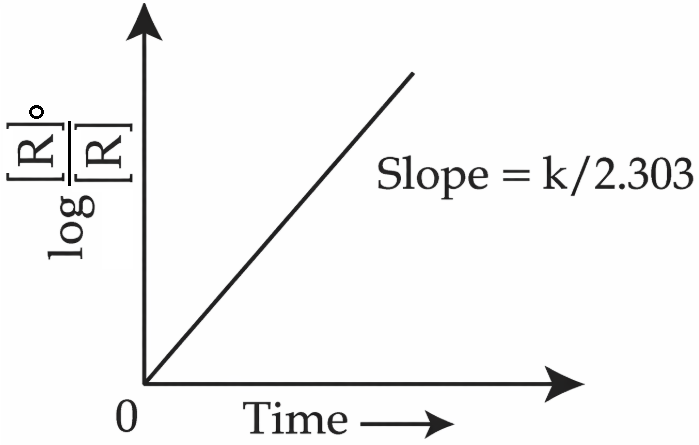 CUET 2023 Hard
 - Read the passage carefully and answer the questions based on the passage:
The number of reacting species (atoms, ions or molecules) taking part in an elementary reaction, which must collide simultaneously in order to bring about a chemical reaction is called molecularity of a reaction. In the rate equation Rate \(=k[\mathrm{~A}]^x[\mathrm{~B}]^y\)
\(x\) and \(y\) indicate how sensitive the rate is to the change in concentration of \(A\) and \(B\), respectively. Sum of these exponents, i.e., \(x +y\) gives the overall order of a reaction where \(x\) and \(y\) represent the order with respect to the reactants A and B respectively. Hence, the sum of powers of the concentration of the reactants in the rate law expression is called the order of that chemical reaction. For a first order reaction, the concentration of the reactant varies as \([\mathrm{R}]=[\mathrm{R}]_0 e^{-k t}\)
The initial concentration of \(\mathrm{N}_2 \mathrm{O}_5\) in the following first order reaction
\(\mathrm{N}_2 \mathrm{O}_5(g) \rightarrow 2 \mathrm{NO}_2(g)+1 / 2 \mathrm{O}_2(g)\)CUET 2025 Medium
More PYQs from CUET
- In an electromagnetic wave, the amplitude of magnetic field is \( 1.1 \times 10^{-6} \text{ T} \). What is the amplitude of electric field?CUET 2023 Medium
- \(\left|\begin{array}{lll}1 & 2 & 3 \\4 & 5 & 6 \\7 & 8 & 9\end{array}\right|=x\left|\begin{array}{ll}2 & 3 \\8 & 9\end{array}\right|+y\left|\begin{array}{ll}1 & 3 \\7 & 9\end{array}\right|+z\left|\begin{array}{ll}1 & 2 \\7 & 8\end{array}\right|\)
Then \(x+y+z\) is:CUET 2023 Medium - The type of pollination in which genetically different pollen grains fall on the stigma is known as:CUET 2023 Medium
- Photosynthetically active radiation is :CUET 2023 Easy
- The sequence of nitrogen bases of the template strand of DNA in a transcription unit is 3'-ATTGAACTG-5'. The sequence of nitrogen bases in its mRNA transcript would be:CUET 2023 Medium
- Which of the following is NOT correct about a Sinking Fund?CUET 2025 Medium