


CUET · CHEMISTRY · PYQ PAPER 2023
Question based on following passage :
Adsorption is the process of attracting and retaining the adsorbate molecules on the surface of adsorbent. It is of two types i.e. Physisrption and chemisorption. To increase the rate of reaction, the substance called 'catalyst' is added. Promotors enhance the activity of catalyst while poison decrease the catalyst activity. Solutions may be true solution, suspension and colloids. Colloids are heterogenous but quite stable. On the basis of nature of interaction, colloids may be Lyophilic or Lyophobic. On the basis of type of dispersed phase particles, there may be multimolecular colloids, macromlecular colloids and associated colloids. The congulation of colloids may be done by boiling, dialysis or by mixing oppositely charged sols.
The best coagulating agent for \(Fe(OH)_3\) solution is :
- A Potassium Chloride
- B Potassium Ferrocyanide
- C Aluminium sulphate
- D Aluminium phosphate
Answer & Solution
Correct Answer
(B) Potassium Ferrocyanide
Step-by-step Solution
Detailed explanation
Potassium Ferrocyanide
See the Complete Solution
Get step-by-step explanations for this and 2.5 Lakh+ more JEE, NEET & CET questions.
- Unlock all solutions
- Practice the full chapter
- Track accuracy across PYQs
4.8 rated on Google Play · 14,000+ reviews
More questions from CHEMISTRY
- Answer the question on basis of passage given below :
Look at the following chemical reactions and answer the following question :
(A) \(C_7H_8 \xrightarrow{\text{Conc. HNO}_3, 0^\circ C}
(B) \xrightarrow{Sn/HCl}
(C) \xrightarrow{NaNO_2/H_3O^+}
(D) \xrightarrow{H_2O, Heat} (E)\)
(E) \(CH_3I \xrightarrow{KMnO_4/H^+}
(F) \xrightarrow{H_3O^+} (G) \xrightarrow{NaOH} (H)\)
Which of the following compounds will undergo coupling reaction ?CUET 2023 Easy - On boiling with concentrated \(\text{HBr}\), phenyl ethyl ether will give:CUET 2023 Easy
- Read the passage carefully and answer the Questions
In the formation of coordination complexes, if the inner \(d\) orbital \((n-1)d\) is used in hybridisation, the complex, is called an inner orbital or low spin or spin paired complex. And if it uses outer \(d\) orbital \((nd)\) in hybridisation (like \(sp^3d^2\)), it is called outer orbital or high spin or spin free complex. The degeneracy of the \(d\) orbitals has been removed due to ligand electron-metal electron repulsions in the complex. This splitting of the degenerate levels due to the presence of ligands in a definite geometry is termed as crystal field splitting. For coordination complexes, the magnetic moment is determined by the number of unpaired electrons and is calculated by using the 'spin-only' formula, \(\mu = \sqrt{n(n+2)}\) where \(n\) is the number of unpaired electrons and \(\mu\) is the magnetic moment in units of Bohr magneton \((BM)\). The coordination compounds are of great importance. These compounds are widely present in the mineral, plant and animal worlds and are known to play many important functions in the area of analytical chemistry, metallurgy, biological systems, industry and medicine.
\([Co(NH_3)_6]^{3+}\) and \([Ni(NH_3)_6]^{2+}\) respectively areCUET 2023 Hard - The gold number range of some of the lyophilic colloids is given below:
A: 0.005-0.01, B: 0.15-0.25, C: 0.04-1.0, D: 15-25
Which among these can be used as a better protective colloid?CUET 2024 Easy - "In the electrochemical series written in the increasing order of reduction potential
(A) The elements which are placed above the hydrogen in the electrochemical series are stronger oxidizing agents.
(B) The elements which are placed above the hydrogen in the electrochemical series are stronger reducing agents.
(C) The elements with the positive electrode potential values lie below the hydrogen in the electrochemical series.
(D) The activity of both the metals and non-metals in the electrochemical series decreases from top to bottom.
Choose the correct answer from the options given below:"CUET 2023 Medium - Read the passage carefully and answer the questions based on the passage:
The number of reacting species (atoms, ions or molecules) taking part in an elementary reaction, which must collide simultaneously in order to bring about a chemical reaction is called molecularity of a reaction. In the rate equation Rate \(=k[\mathrm{~A}]^x[\mathrm{~B}]^y\)
\(x\) and \(y\) indicate how sensitive the rate is to the change in concentration of A and B, respectively. Sum of these exponents, i.e., \(x +y\) gives the overall order of a reaction where \(x\) and \(y\) represent the order with respect to the reactants A and B respectively. Hence, the sum of powers of the concentration of the reactants in the rate law expression is called the order of that chemical reaction. For a first order reaction, the concentration of the reactant varies as \([\mathrm{R}]=[\mathrm{R}]_0 e^{-k t}\)
The conversion of molecules \(X\) to \(Y\) follows second order kinetics. If the concentration of \(X\) is increased to four times, how does it affect the rate of formation of \(Y\) ?CUET 2025 Hard
More PYQs from CUET
- The IUPAC name of the following compound is
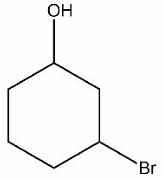 CUET 2025 Medium
 - The minimum value of \(\left(x^2+\frac{250}{x}\right)\) is :CUET 2023 Hard
- Answer the question on the basis of passage given below :
For the transition elements
Sc \(\quad\) Ti \(\quad\) V \(\quad\) Cr \(\quad\) Mn\(\quad\) Fe \(\quad\) Co \(\quad\) Ni \(\quad\) Cu \(\quad\) Zn
Atomic numbers :
21 \(\quad\) 22 \(\quad\) 23 \(\quad\) 24 \(\quad\) 25 \(\quad\) 26 \(\quad\) 27 \(\quad\) 28 \(\quad\) 29 \(\quad\) 30 \(\quad\)
Which transition metal ion \(\text{M}^{2+}\) gives magnetic moment 5.92 BM?CUET 2023 Hard - The physical quantity which does not change when X-rays of wavelength \( 10^{-10} \, \text{m} \), or visible light of wavelength 400 nm, or radio waves of 500 m wavelength pass through glass isCUET 2025 Hard
- Total number of isomers for the complex \([\text{FeCl}_2 (\text{C}_2\text{O}_4)_2]^{4-}\) is:CUET 2023 Medium
- Photo electric effect reveals the:CUET 2023 Easy