


CUET · CHEMISTRY · PYQ PAPER 2023
Match List I with List II
| List-l | List-II |
| A. \(K _2 SO _4( aq )\) with \(60 \%\) dissociation | I. \(i = 3 . 7\) |
| B. \(K _3\left[ Fe ( CN )_6\right]( aq )\) with \(90 \%\) dissociation | II. \(i=1.8\) |
| C. \(AlCl _3( aq )\) with \(80 \%\) dissociation | III. \(i=2.2\) |
| D. \(K _2 HgI _4( aq )\) with \(40 \%\) dissociation | IV. \(i=3.4\) |
- A А-ІII, В-І, С-II, D-IV
- B A-I, B-III, C-IV, D-II
- C A-III, B-I, C-II, D-IV
- D A-III, B-I, C-IV, D-II
Answer & Solution
Correct Answer
(D) A-III, B-I, C-IV, D-II
Step-by-step Solution
Detailed explanation
\(A. K_2SO_4 \rightarrow 2K^+ + SO_4^{2-}\), \(n=3\) \(i_A = 1 + \alpha(n-1) = 1 + 0.60(3-1) = 2.2\) \(B. K_3[Fe(CN)_6] \rightarrow 3K^+ + [Fe(CN)_6]^{3-}\), \(n=4\) \(i_B = 1 + \alpha(n-1) = 1 + 0.90(4-1) = 3.7\) \(C. AlCl_3 \rightarrow Al^{3+} + 3Cl^-\), \(n=4\)…
See the Complete Solution
Get step-by-step explanations for this and 2.5 Lakh+ more JEE, NEET & CET questions.
- Unlock all solutions
- Practice the full chapter
- Track accuracy across PYQs
4.8 rated on Google Play · 14,000+ reviews
More questions from CHEMISTRY
- Reaction :
Benzene \(\xrightarrow[\text { Anhyd. } AlCl l _{ s } / CuCl ]{ CO _{ Cl } HCl } X\)
\(X\) in above reaction isCUET 2023 Easy - The common name and IUPAC name of the following compound, respectively, are
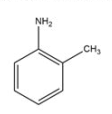 CUET 2025 Medium
 - Arrange the following amines in the order of decreasing basic character in gaseous phase:
(A) \(\text{NH}_3\)
(B) \((\text{CH}_3)_3\text{N}\)
(C) \((\text{CH}_3)_2\text{NH}\)
(D) \(\text{CH}_3\text{NH}_2\)
Choose the correct answer from the options given below:CUET 2023 Hard - In the reaction below, identify the species undergoing oxidation and reduction.
H\(_2\)\(\mathrm{S}\)(g) + Cl\(_2\)(g) \(\rightarrow\) 2HCl(g) + S(s)CUET 2025 Easy - Read the passage carefully and answer the questions based on the passage:
The number of reacting species (atoms, ions or molecules) taking part in an elementary reaction, which must collide simultaneously in order to bring about a chemical reaction is called molecularity of a reaction. In the rate equation Rate \(=k[\mathrm{~A}]^x[\mathrm{~B}]^y\)
\(x\) and \(y\) indicate how sensitive the rate is to the change in concentration of A and B, respectively. Sum of these exponents, i.e., \(x +y\) gives the overall order of a reaction where \(x\) and \(y\) represent the order with respect to the reactants A and B respectively. Hence, the sum of powers of the concentration of the reactants in the rate law expression is called the order of that chemical reaction. For a first order reaction, the concentration of the reactant varies as \([\mathrm{R}]=[\mathrm{R}]_0 e^{-k t}\)
The units of first and zero order rate constant of reactions are respectively:CUET 2025 Medium - "Answer the question on basis of passage given below :
Carboxylic acids are weaker than mineral acids, but they are stronger acids than alcohols and many simple phenols (\(\text{pKa}\) is ~ 16 for ethanol and 10 for phenol). The higher acidity of carboxylic acids as compared to phenols can be understood similarly. The conjugate base of carboxylic acid, a carboxylate ion, is stabilised by two equivalent resonance structures in which the negative charge is at the more electronegative oxygen atom. The conjugate base of phenol, a phenoxide ion, has non-equivalent resonance structures in which the negative charge is at the less electronegative carbon atom. Further, the negative charge is delocalised over two electronegative oxygen atoms in carboxylate ion whereas it is less effectively delocalised over one oxygen atom and less electronegative carbon atoms in phenoxide ion. Thus, the carboxylate ion is more estabilised than phenoxide ion, so carboxylic acids are more acidic than phenols.
Effect of substituents on the acidity of carboxylic acids: substituents may affect the stabliity of the conjugate base and thus, also affect the acidity of the carboxylic acids. Electron withdrawing group increase the acidity of carboxylic acids by stabilising the conjugate base through delocalisation of the negative charge by inductive and/or resonance effects. Conversely, electron donating groups decrease the acidity by destabilising the conjugate base.
The weakest among the following acid is :"CUET 2023 Medium
More PYQs from CUET
- The area of the triangle with vertices \((1,4),(2,7)\) and \((4,13)\) is:CUET 2023 Easy
- The major product formed when acetanilide undergoes bromination in presence of acetic acid is:CUET 2025 Medium
- For (i) \(I^-\) (ii) \(Cl^-\)(iii) \(Br^-\), the usual increasing order of nucleophilicities would beCUET 2023 Hard
- The product of the following chemical reaction is
Glucose \(\xrightarrow{ Br _2 \text { water }}\)CUET 2025 Easy - Radiation of frequency \(2 v _0\) incident on a metal with threshold frequency \(v _0\) results in maximum kinetic energy of photoelectrons as :CUET 2024 Easy
- If \(\int_0^a 3 x^2 d x=27\), then value of \(a\) is :CUET 2023 Medium