


CUET · CHEMISTRY · PYQ PAPER 2024
| List-I (Biomolecule) | List-II (Function/Diseases) |
| (A) Vitamin A | (I) Menstrual cycle |
| (B) Thiamine | (II) Xerophthalmia |
| (C) Glucocorticoids | (III) Beri-Beri |
| (D) Estradiol | (IV) Addison's disease |
Choose the correct match:
- A (A) - (III), (B) - (II), (C) - (I), (D) - (IV)
- B (A) - (II), (B) - (III), (C) - (I), (D) - (IV)
- C (A) - (III), (B) - (II), (C) - (IV), (D) - (I)
- D (A) - (II), (B) - (III), (C) - (IV), (D) - (I)
Answer & Solution
Correct Answer
(D) (A) - (II), (B) - (III), (C) - (IV), (D) - (I)
Step-by-step Solution
Detailed explanation
(A) Vitamin A - (II) Xerophthalmia (B) Thiamine - (III) Beri-Beri (C) Glucocorticoids - (IV) Addison's disease (D) Estradiol - (I) Menstrual cycle
See the Complete Solution
Get step-by-step explanations for this and 2.5 Lakh+ more JEE, NEET & CET questions.
- Unlock all solutions
- Practice the full chapter
- Track accuracy across PYQs
4.8 rated on Google Play · 14,000+ reviews
More questions from CHEMISTRY
- Complete the reaction:
\(\text{NH}_2\text{CONH}_2 + \text{H}_2\text{O} \rightarrow \text{ ?}\)CUET 2023 Easy - Which of the following process is used in the extractive metallurgy of magnesium?CUET 2023 Hard
- The calculated magnetic moment using the 'spin only' formula \(\mu=\sqrt{n(n+2)}\) for \(\mathrm{Cr}^{2+}\) and \(\mathrm{Fe}^{2+}\) respectively isCUET 2025 Medium
- Which compound will exhibit the lowest boiling point ?CUET 2025 Medium
- Read the following passage given below and answer the question.
Aldehydes and ketones undergo nucleophilic addition reactions. A nucleophile attacks the electrophilic carbon atom of polar carbonyl group from perpendicular to plane of \(sp^2\) hybridised orbitals of carbonyl carbon. The hybridisation of carbon changes from \(sp^2\) to \(sp^3\) and a tetrahedral alkoxide intermediate is formed. This captures \(H^+\) to give neutral product. In carboxylic acids, carbonyl carbon is less electrophilic than carbonyl carbon in aldehydes and ketones.
An organic compound \(C_3H_6O\) does not give a precipitate with 2,4-dinitrophenylhydrazine and also does not react with metallic sodium. It could be :CUET 2023 Easy - Read the passage carefully and answer the questions
The resistance ( \(R\) ) of an object is given by the expression \(R=\rho \frac{l}{A}\).
The inverse of \(R\) is called conductance and the inverse of \(\rho\) is called conductivity or specific conductance represented by \(\kappa\).
The conductivity depends upon the nature of the material (insulator, semiconductor or conductor) and the temperature of the substance.
Similarly, the conductance due to the ions present in the solution (ionic conductance) depends upon the nature of the electrolyte, size of ions, the nature of the solvent and the temperature.
Molar conductivity ( \(\Lambda_m\) ) of a solution at a given concentration is the conductance of volume \(V\) containing one mole of electrolyte kept between two electrodes of area \(A\) and unit distance apart. It is given by the expression \(\Lambda_m=\kappa V\).
Molar conductivity increases with decrease in concentration and when concentration approaches zero, it is called limiting molar conductivity.
The decrease is linear for a strong electrolyte. However, for a weak electrolyte the change is gradual at higher concentrations and sharp near zero concentration.
Using limiting molar conductivity values of strong electrolytes we can calculate the limiting molar conductivity of weak electrolytes using Kohlrausch law of independent migration of ions.
From molar conductivity and limiting molar conductivity we can determine the degree of dissociation \(\left(\frac{\Lambda_m}{\Lambda_m^0}\right)\) and the ionization constant of a weak acid.
Which of the following is an insulator?CUET 2025 Easy
More PYQs from CUET
- A small telescope has an objective lens of focal length 100 cm and an eye-piece of focal length 5 cm. The magnifying power of the telescope when the final image is formed at the least distance of distinct vision will beCUET 2025 Easy
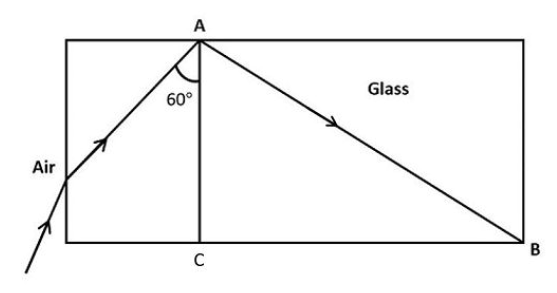
- A light ray from air is incident on a glass slab (\( \mu = 1.5 \)) as shown in the figure. It undergoes a total internal reflection and travels along AB. The thickness AC of the glass slab is 20 cm. The time taken by light to cross the glass slab after reflection is
 CUET 2025 Easy
 - Match List-I and List-II
List-I List-II A. Elementary reactions I. No energy of activation B. Complex reactions II. Single step C. Free radical combination III. High energy of activation D. Slow reactions IV. Several elementary steps
Choose the correct answer from the options given below:CUET 2023 Hard - Read the following passage carefully and answer the given questions
The earthworm is referred to as the farmer's friend. This is because they help in the breakdown of complex organic matter as well as in loosening of soil. Similarly, decomposers break down complex organic matter into inorganic substances like carbon dioxide, water and nutrients and the process is called decomposition. Dead plant remains such as leaves, bark, flowers and dead remains of animals, including fecal matter, constitute detritus, which is the raw material for decomposition. Some of the steps in the process of decomposition are fragmentation, catabolism, leaching, humification etc.
The degradation of detritus into simpler inorganic substances by the bacterial and fungal enzymes is called as-CUET 2025 Easy - Which of the following is the correct formula of a colligative property?CUET 2023 Medium
- Select the properties of cancer cell
(A) Forms benign tumors
(B) Causes very little damage to the surrounding tissues
(C) Can show Metastasis
(D) Lacks contact inhibitionCUET 2023 Hard