


CUET · CHEMISTRY · PYQ PAPER 2025
Interstitial transition metal compounds
(A) have higher melting points than those of pure metals.
(B) have more reactivity than those of pure metals.
(C) are non-stoichiometric compounds.
(D) formed when small atoms like H, C or N are trapped inside the crystal lattice of the metals.
Choose the correct answer from the options given below:
- A (A), (C) and (D) only
- B (A), (B) and (C) only
- C (A), (B), and (D) only
- D (B), (C) and (D) only
Answer & Solution
Correct Answer
(A) (A), (C) and (D) only
Step-by-step Solution
Detailed explanation
(A) Interstitial compounds generally have higher melting points due to strong bonding. (B) Interstitial compounds are generally less reactive (chemically inert). (C) Many interstitial compounds are non-stoichiometric. (D) This is the definition of interstitial compounds.…
See the Complete Solution
Get step-by-step explanations for this and 2.5 Lakh+ more JEE, NEET & CET questions.
- Unlock all solutions
- Practice the full chapter
- Track accuracy across PYQs
4.8 rated on Google Play · 14,000+ reviews
More questions from CHEMISTRY
- Why do the actinoids exhibit a higher number of oxidation states than lanthanoids?CUET 2024 Medium
- Deficiency of which vitamin is responsible for osteomalacia?CUET 2023 Easy
- Arrange the following in decreasing order of the number of molecules contained in:
(A) \(1 6 ~ g\) of \(O _2\)
(B) \(1 6 ~ g\) of \(CO _2\)
(C) \(1 6 ~ g\) of \(CO ^{-}\)
(D) \(16 g of H _2\)
Choose the correct order:CUET 2024 Hard - Boiling of Sucrose with water in the presence of acid \(H+\) will give :CUET 2025 Easy
- The flocculating power of \(\left[ Fe ( CN )_6\right]^{4-}\) is higher than \(PO _4^{3-}\) ion because :CUET 2023 Easy
- If we plot graph for first order reaction involving reactant R, then it will be a straight line if plotted for :CUET 2023 Easy
More PYQs from CUET
- Answer the question on basis of passage given below :
Look at the following chemical reactions and answer the following question :
(A) \(C_7H_8 \xrightarrow{\text{Conc. HNO}_3, 0^\circ C}
(B) \xrightarrow{Sn/HCl}
(C) \xrightarrow{NaNO_2/H_3O^+}
(D) \xrightarrow{H_2O, Heat} (E)\)
(E) \(CH_3I \xrightarrow{KMnO_4/H^+}
(F) \xrightarrow{H_3O^+} (G) \xrightarrow{NaOH} (H)\)
Which of the following compounds will undergo coupling reaction ?CUET 2023 Easy - If \(\vec{a}=3 \hat{i}-6 \hat{j}+\hat{k}\) and \(\vec{b}=2 \hat{i}-4 \hat{j}+\lambda \hat{k}\) are such that \(\vec{a} \| \vec{b}\), then \(3 \lambda+2=\)CUET 2025 Easy
- E and V, respectively, denote electric field intensity and electrostatic potential at a point. The correct relation between the two isCUET 2025 Medium
- \(\int_0^{1.5}[x] d x\), where [x] denotes the greatest integer function \(\leq x\), is equal to:CUET 2023 Easy
- The number of moles of potassium dichromate needed to oxidize 3 moles of ferrous ions in acidic medium will be ___________CUET 2025 Hard
- Observe the illustration and answer the following question:
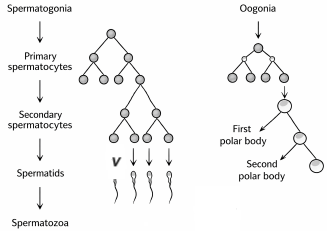
Meiotic division in primary oocytes is arrested at:CUET 2023 Medium