


CUET · CHEMISTRY · PYQ PAPER 2023
Indium is mainly refined by :
- A Vapour phase refining
- B Distillation
- C Zone refining
- D Liquation
Answer & Solution
Correct Answer
(C) Zone refining
Step-by-step Solution
Detailed explanation
Zone refining
See the Complete Solution
Get step-by-step explanations for this and 2.5 Lakh+ more JEE, NEET & CET questions.
- Unlock all solutions
- Practice the full chapter
- Track accuracy across PYQs
4.8 rated on Google Play · 14,000+ reviews
More questions from CHEMISTRY
- Calculate the spin only magnetic moment of a \(Ni ^{2+}\) in \(\left[ Ni ( CN )_4\right]^{2-}\) (atomic number of Ni is 28 ).CUET 2025 Easy
- The synthesis of alkyl fluoride is best achieved throughCUET 2025 Medium
- What types of bond (linkage) are present in nucleotide?CUET 2025 Easy
- Read the passage carefully and answer
When a metal is placed in a solution of its ions, the metal can lose electron and can go in the solution as ion or the metal ion in the solution can take electron from the electrode and get deposited as metal. Thus, the electrode acquires either positive or negative charge with respect to the solution leading to the development of a potential difference between the metal electrode and the solution. This potential difference is called the electrode potential of the metal. The electrode potential of a metal is a measure of relative tendency to undergo oxidation (loss of electron) or reduction (gain of electron). When the concentration of the ions in the solution is unity, the electrode potential is called standard electrode potential. The magni of potential depends upon the nature of electrode, concentration of ions in solution and the temperature. In a galvanic cell, the electrode at which oxidation occurs is known as anodic half-cell and the electrode at which reduction occurs is known as cathodic half cell. The emf of the cell in terms of standard reduction potential is given by \(E_{\text {cell }}^{\circ}=E_{\text {cathode }}^{\circ}-E_{\text {anode. }}^{\circ}\).The standard free energy change of the redox reaction taking place in the cell is related to \(E_{\text {cell }}^{\circ}\) by \(\Delta G^{\circ}=-n F E^{\circ}\). A redox reaction would occur spontaneously if the free energy change is negative. The equilibrium constant of the reaction is related to the standard free energy change by \(\Delta G^{\circ}=-R T \ln K\).
The equillibrium constant of a feasible cell reaction isCUET 2025 Hard - Read the passage carefully and answer the Questions
Aldehydes, carboxylic acids and ketones are widespread in the animal and plant kingdoms.
They play a pivotal role in various biochemical processes of life. Their presence in nature adds fragrance and flavor. These compounds are widely used in food products, pharmaceuticals, paints, resins and other important product industries. These compounds are prepared by various laboratory methods, which mainly include oxidation, formylation, acylation and reduction. Due to the polar nature of the carbonyl group in aldehydes and ketones, they can exhibit different reactions like nucleophilic addition. They do exhibit redox and various condensation reactions which lead to the formation of various important compounds. On the other hand, the carboxylic acids are mainly prepared by oxidation and hydrolysis of different compounds. The carboxylic acid consists of a carbonyl group and the hydroxy group (attached to the carbonyl carbon atom). This makes it possible for the carboxylic acid to participate in various chemical reactions which involve cleavage of the C-OH bond and the O_H bond along with the reactions involving the complete -COOH group.
Propyne on hydration in presence of mercury ions produceCUET 2025 Easy - 1 mole of a symmetrical alkene on ozonolysis gives 2 moles of an aldehyde with molecular mass 44w. The alkene isCUET 2023 Medium
More PYQs from CUET
- The curve \(y = f ( x )\) is normal probability curve, then which of the following statements are correct?
(A) mean, median and mode of the distribution coincide.
(B) the area bounded by the curve \(y = f ( x )\) and \(x\)-axis is one unit.
(C) The curve is symmetrical about the line \(x =\mu\), where \(\mu\) is the mean.
(D) y -axis is an asymptote to the curve.
Choose the correct answer from the options given below :CUET 2025 Medium - An electromagnetic wave moves in vacuum. Its speed is c. Choose the correct options about the characteristics of electromagnetic waves:
(A) \( c = \frac{1}{\sqrt{\mu_0 \epsilon_0}} \)
(B) Electromagnetic waves are transverse in nature.
(C) Both the electric field and magnetic field vibrate perpendicular to the direction of propagation of waves
(D) Electromagnetic waves are longitudinal in nature.
Choose the correct answer from the options given below:CUET 2025 Easy - The figure shows a current loop having two circular arcs joined by two radial lines. If radius OA is 'a' and OD is 'b', the magnetic field at the centre O is.
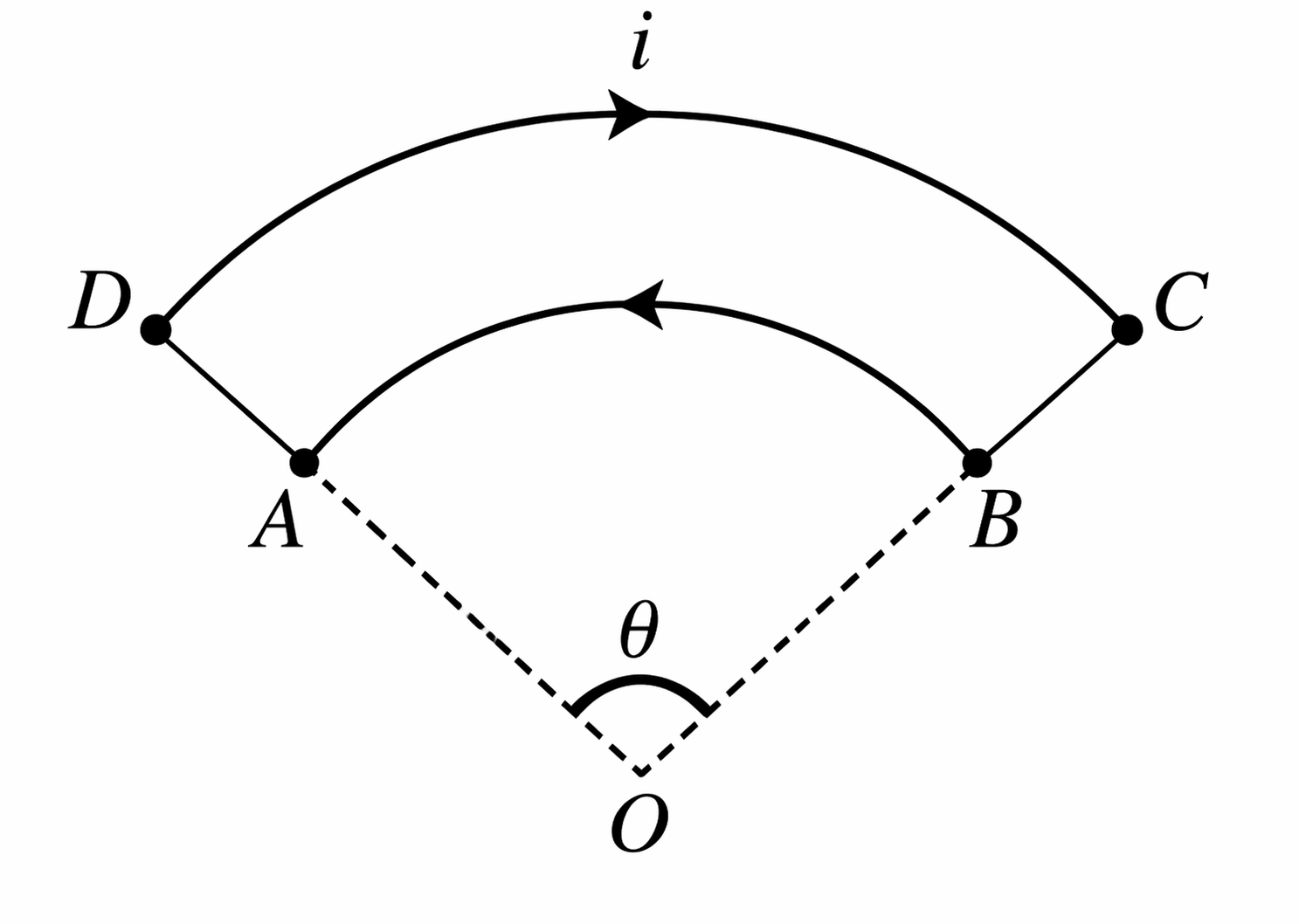 CUET 2025 Medium
 - Which of the following statements are correct?
(A) Magnetic susceptibility is defined as ratio of Intensity of magnetisation to magnetic field intensity.
(B) Magnetic susceptibility is a ratio of similar quantities therefore has no unit.
(C) The value of magnetic susceptibility for vacuum is one.
(D) Greater is the value of intensity of magnetisation, smaller is the value of susceptibility.
(E) Smaller is the value of magnetic field intensity, smaller is value of susceptibility.
Choose the correct answer from the options given below :CUET 2023 Medium - The area (in sq.units) of the region enclosed by the curve \(y = cos\) \(x\), \(-\frac{\pi}{2} \leq x \leq \frac{\pi}{2}\) and the \(x\) - axis is:CUET 2025 Medium
- A. General solution of \(\frac{d y}{d x}=\frac{1+y^2}{1+x^2}\) is \(\tan ^{-1} y=\tan ^{-1} x+c\); Where c is a constant
B. General solution of \(\frac{d y}{d x}+\frac{\sqrt{1-y^2}}{\sqrt{1-x^2}}=0\) is \(\sin ^{-1} y-\sin ^{-1} x=c\); Where c is a constant
C. General solution of \(\frac{y d x-x d y}{y}=0\) is \(y=c x\); Where c is a constant
D. General solution of \(\frac{d y}{d x}=e^{x+y}\) is \(e^x+e^y=c\); Where c is a constant
E. \(\left(x^2+x y\right) d y=\left(x^2+y^2\right) d x\) is a homogeneous differential equation
Choose the correct answer:CUET 2023 Medium