


CUET · CHEMISTRY · PYQ PAPER 2023
In which of the following pairs, both the ions are coloured in an aqueous solution?
- A \(\text{Ni}^{2+}\), \(\text{Cu}^{+}\)
- B \(\text{Ni}^{2+}\), \(\text{Ti}^{3+}\)
- C \(\text{Sc}^{3+}\), \(\text{Ti}^{3+}\)
- D \(\text{Sc}^{3+}\), \(\text{Co}^{2+}\)
Answer & Solution
Correct Answer
(B) \(\text{Ni}^{2+}\), \(\text{Ti}^{3+}\)
Step-by-step Solution
Detailed explanation
\(\text{Ni}^{2+}\) has \(3d^8\) configuration (colored). \(\text{Ti}^{3+}\) has \(3d^1\) configuration (colored).
See the Complete Solution
Get step-by-step explanations for this and 2.5 Lakh+ more JEE, NEET & CET questions.
- Unlock all solutions
- Practice the full chapter
- Track accuracy across PYQs
4.8 rated on Google Play · 14,000+ reviews
More questions from CHEMISTRY
- A' \(+ H _2 O / H\) _________ ' \(B\) ' \(+ N a O H + C a O\) _________ Benzene
The compound ' A ' is:CUET 2023 Medium - Benzene ring in phenol is expected to give the characteristic substitution or replacement reactions i.e. halogenation, nitration, sulphonation, alkylation etc. In these reactions, the attacking reagent is electrophile. The phenolic group activates the ortho and para positions in the ring due to conjugation. Disubstitution reactions are quite fast as the electron density in the ring has increased considerably. Phenols do not respond to nucleophilic substitution reactions as it is influenced by phenolic group.
Victor Meyer test gives following observations. Match List I with List II:List-I List-II A. Blood red colouration I. Tertiary alcohol B. Blue colouration II. Phenols C. Colourless solution III. Primary alcohol D. Violet colouration with \(\text{FeCl}_3\) IV. Secondary alcohol
Choose the correct answer from the options given below:CUET 2023 Easy - Which among the following are coordination complexes?
(A) Mohr's salt
(B) Tetraamminediaquacobalt (II) ion
(C) Carnallite
(D) Potassium ferricyanide
Choose the correct answer from the options given below:CUET 2025 Easy - Read the passage carefully and answer
Carbohydrates are essential for both plants and animals. Some common examples of carbohydrates are glucose, fructose, sucrose, glycogen, cellulose and starch. They form a major portion of our food. Honey has been used for a long time as an instant source of energy in Ayurvedic medicine. Carbohydrates are used as storage molecules in both plants and animals. The cell wall of bacteria and plants is made of cellulose. We use cellulose in the form of wood for making furniture and as cotton fiber for clothing. They also provide raw material for textiles, paper, lacquers, and breweries. Carbohydrates are classified as Monosaccharides, Oligosaccharides and Polysaccharides on the basis of their behavior towards hydrolysis.
Monosaccharides cannot be hydrolyzed further to simpler units whereas oligosaccharides can yield 2-10 units of monosaccharides on hydrolysis. Polysaccharides, which are non-sugars yield a large number of monosaccharide units on hydrolysis.
Answer the following questions about carbohydrates:
Animal starch is popularly known asCUET 2025 Hard - Complete the following reaction.
\(\left( C _6 H _{10} O _5\right)_n+n H _2 O \xrightarrow[393 K, 2-3 atm]{ H ^{+}} ?\)CUET 2023 Hard - The chemical formula of mineral beryl isCUET 2023 Hard
More PYQs from CUET
- Identify the statement which do not hold true for Deoxyribose Nucleic Acid.
A. Only purine bases are present in DNA.
B. Deoxyribose sugar is present
C. A nitrogenous base is linked to the 1'C pentose sugar through N glycosidic linkage.
D. Phosphate group is linked to OH of 4'C of a nucleotide.
Choose the correct answer from the options given below:CUET 2023 Medium - Match List-I with List-II
List-I List-II (A) The degree of differential equation \(\frac{d^3 y}{d x^3}=e^{\frac{d y}{d x}}\) (I) 2 (B) The order of differential equation \(\left(\frac{d y}{d x}\right)^2+\frac{d^3 y}{d x^3}=0\) (II) 4 (C) The sum of order and degree of differential equation \(\frac{d}{d x}\left(\frac{d^2 y}{d x^2}\right)+\left(\frac{d y}{d x}\right)^5=x\) (III) not defined (D) The number of arbitrary constants in the general solution of a differential equation of order 2 (IV) 3
Choose the correct answer from the options given below :CUET 2025 Medium - The limiting molar conductivities for \(NaCl\), \(HCl\) and \(CH_3COONa\) are \(126.4\), \(425.9\) and \(91.0\ S\ cm^2\ mol^{-1}\), respectively. Calculate the limiting molar conductivity for acetic acid.CUET 2025 Medium
- The area (in sq. units) of the bigger portion of region enclosed by the curves \(4 x^2+9 y^2=36\) and \(2 x+3 y=6\) isCUET 2025 Hard
- Identify A and B in the following reaction.
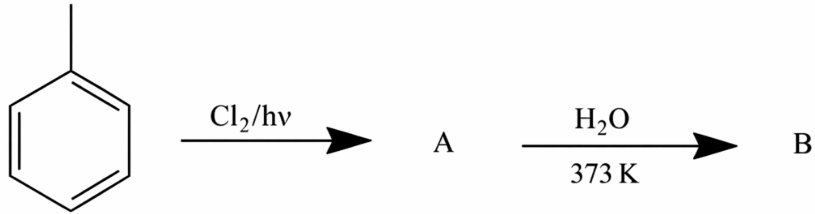 CUET 2025 Easy
 - Arrange the trophic levels in an order from lowest to highest in a terrestrial food chain:
(A). Wolf
(B). Grass
(C). Cow
(D). Lion
Choose the correct answer from the options given below:CUET 2023 Medium