


CUET · CHEMISTRY · PYQ PAPER 2025
In neutral or mild alkaline solutions, potassium permanganate oxidizes manganous salt \(\left( Mn ^{2+}\right)\) to ______________?
- A \(MnO _2\)
- B \(Mn ^{2+}\)
- C \(MnO _4^{-2}\)
- D \(MnO _4^{-}\)
Answer & Solution
Correct Answer
(A) \(MnO _2\)
Step-by-step Solution
Detailed explanation
\(MnO _2\)
See the Complete Solution
Get step-by-step explanations for this and 2.5 Lakh+ more JEE, NEET & CET questions.
- Unlock all solutions
- Practice the full chapter
- Track accuracy across PYQs
4.8 rated on Google Play · 14,000+ reviews
More questions from CHEMISTRY
- Gluconic acid is obtained whenCUET 2025 Hard
- Read the passage carefully and answer the Questions
Werner in 1898, propounded his theory of coordination compounds. In coordination compounds metals show two types of linkages (valences)-primary and secondary. The primary valences are normally ionisable and are satisfied by negative ions. The secondary valences are non-ionisable. These are satisfied by neutral molecules or negative ions. The secondary valence is equal to the coordination number and is fixed for a metal. The ions or group bound by the secondary linkages to the metal have characteristic spatial arrangements corresponding to the different coordination numbers. Both double salts as well as complexes are formed by the combination of two or more stable compounds in stoichiometric ratio. However, they differ in the fact that double salts such as carnallite, Mohr's salt, potash alum etc. dissociate into simple ions completely when dissolved in water. But complex ions do not dissociate completely into simple ions.
When \(1 mol CrCl _3 \cdot 6 H _2 O\) is treated with excess of \(AgNO _3, 3 mol\) of AgCl are obtained. The formula of the complex is:CUET 2025 Hard - Answer the question on the basis of passage given below :
For the transition elements
Sc \(\quad\) Ti \(\quad\) V \(\quad\) Cr \(\quad\) Mn\(\quad\) Fe \(\quad\) Co \(\quad\) Ni \(\quad\) Cu \(\quad\) Zn
Atomic numbers :
21 \(\quad\) 22 \(\quad\) 23 \(\quad\) 24 \(\quad\) 25 \(\quad\) 26 \(\quad\) 27 \(\quad\) 28 \(\quad\) 29 \(\quad\) 30 \(\quad\)
Which transition metal ion \(\text{M}^{2+}/\text{M}\) has standard electrode potential \(\text{E}^{\circ} = +0.34 \text{ V}\) ?CUET 2023 Medium - In the following compounds, what is the increasing order of their reactivity towards nucleophilic addition reactions?
Benzaldehyde, p-Tolualdehyde, p-Nitrobenzaldehyde, AcetophenoneCUET 2024 Hard - The IUPAC name of the given compound is
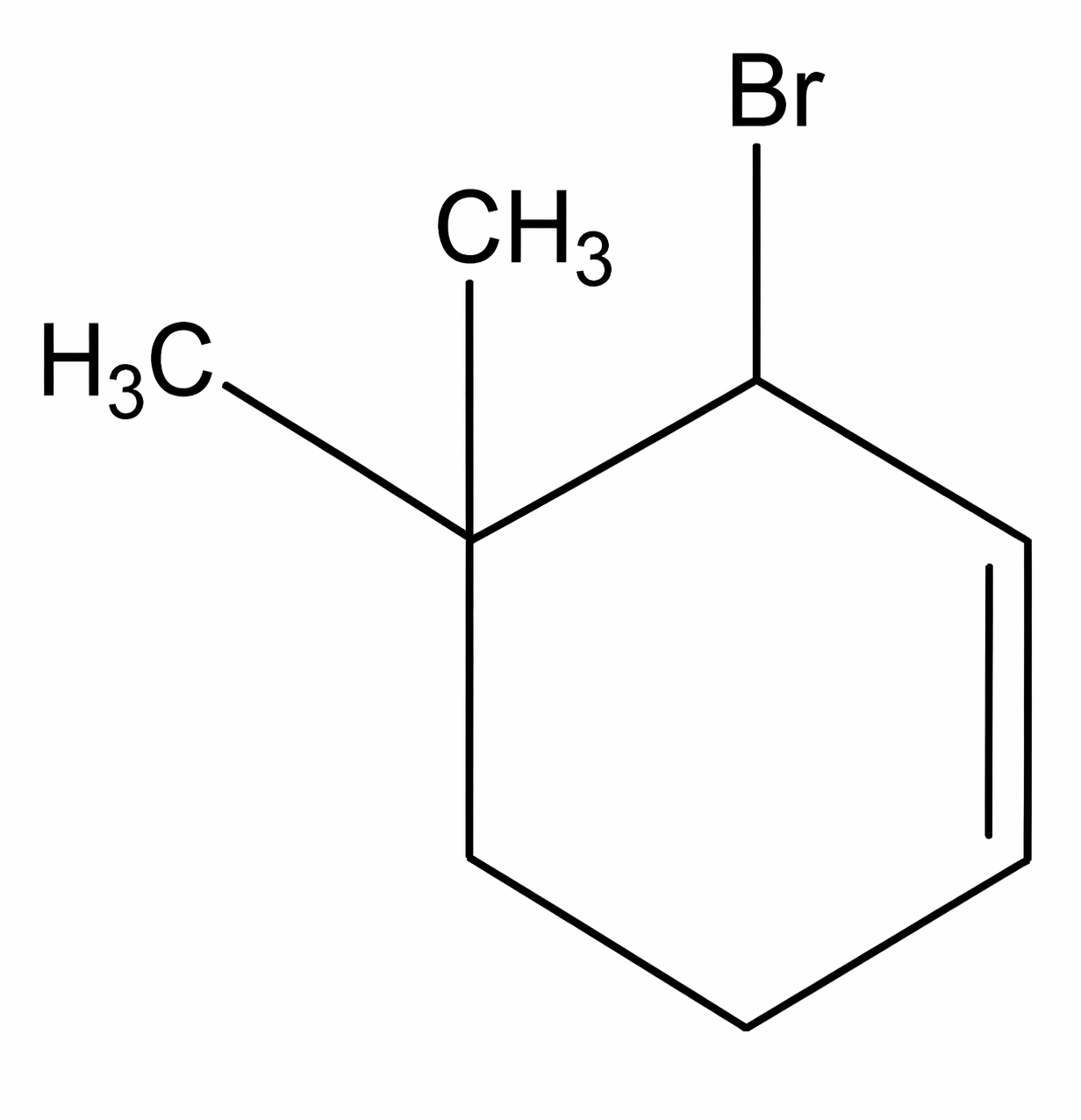 CUET 2025 Medium
 - Arrange the following carboxylic acids in increasing order of their acid strength.
A. \(CH _3 COOH\)
B. \(CH _3 CH _2 COOH\)
C. \(C _6 H _5 CH _2 COOH\)
D. \(C _6 H _5 COOH\)
Choose the correct answer from the options given below:CUET 2023 Easy
More PYQs from CUET
- Choose the most appropriate option about the presence of nitrogenous bases; Cytosine, 5-methyl uracil and Uracil.CUET 2025 Medium
- If 200 MeV energy is released in the fission of a single nucleus of uranium-235, how many fissions per second will produce a power of 32 kW?CUET 2025 Hard
- For \(A=\left[\begin{array}{lll}a_{11} & a_{12} & a_{13} \\ a_{21} & a_{22} & a_{23} \\ a_{31} & a_{32} & a_{33}\end{array}\right]\) if \(M_{i j}\) and \(A_{i j}\) are the minor and the cofactor of \(a_{i j}\) respectively, then \(|A|\) equals to :
(A) \(a_{11} A_{11}+a_{12} A_{12}+a_{13} A_{13}\)
(B) \(a_{21} A_{12}+a_{22} A_{22}+a_{23} A_{32}\)
(C) \(a_{11} M_{11}-a_{12} M_{12}+a_{13} M_{13}\)
(D) \(a_{11} M_{11}+a_{12} M_{12}+a_{13} M_{13}\)
Choose the correct answer from the options given below :CUET 2023 Medium - Match List-l with List-II
List-l (Genes of lac Operon) List-II (Codes for) (A) i (I) \( \beta \)-galactosidase (B) z (II) Transacetylase (C) a (III) Permease (D) y (IV) Repressor
Choose the correct answer from the options given below:CUET 2025 Medium - Let us consider an annuity whose periodic payment is ₹ R payable at the end of each payment period for ' \(n ^{\prime}\) periods, interest paid r% per period or \(i=\frac{r}{100}\), so the amount.CUET 2023 Easy
- Slope of the graph given is \(-9.2 J / mol\). The activation energy for the reaction is : [Given \(R =8.3 J K ^{-1} mol^{-1}\) ]
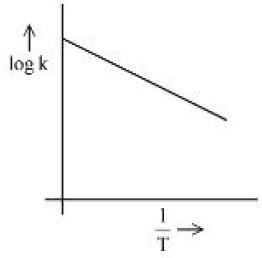 CUET 2023 Easy