


CUET · CHEMISTRY · PYQ PAPER 2023
How much charge is required for the reduction of 0.05 moles of \(MnO _4^{-}\) to \(MnO _2\)?
- A \(5 \times 96500 \times 0.05 C\)
- B \(3 \times 96500 \times 0.05 C\)
- C \(1 \times 96500 \times 0.05 C\)
- D \(2 \times 96500 \times 0.05 C\)
Answer & Solution
Correct Answer
(B) \(3 \times 96500 \times 0.05 C\)
Step-by-step Solution
Detailed explanation
Oxidation state of Mn in \(MnO_4^-\) is \(+7\). Oxidation state of Mn in \(MnO_2\) is \(+4\). Change in oxidation state \( = |+7 - (+4)| = 3\). Moles of electrons needed \( = 0.05 \times 3\). Charge…
See the Complete Solution
Get step-by-step explanations for this and 2.5 Lakh+ more JEE, NEET & CET questions.
- Unlock all solutions
- Practice the full chapter
- Track accuracy across PYQs
4.8 rated on Google Play · 14,000+ reviews
More questions from CHEMISTRY
- Match List-I with List-II
List-I (Structure of Protein) List-II (Function) (A) Primary Structure (I) Gives rise to Fibrous and Globular Proteins (B) Secondary structure (II) Sequence of amino acid (C) Tertiary Structure (III) shape of polypeptide chain (D) Quaternary Structure (IV) Spatial arrangement of sub-units
Choose the correct answer from the options given below:CUET 2025 Easy - Match the statement of set of orbitals given in List-I with orbitals and energy separation given in List-II
Choose the correct answer from the options given below:List – I (Statements) List-II (Orbitals and energy separation) (A) \(t_{2 g}\) set of orbitals in octahedral crystal field and energy separation from barycentre (I) \(d_{x^2-y^2}, d_{z^2}\) and \(3 / 5 \Delta_t\) (B) \(e_g\) set of orbitals in octahedral crystal field and energy separation from barycentre (II) \(d_{x y}, d_{x z}, d_{y z}\) and \(2 / 5 \Delta_t\) (C) \(t_2\) set of orbitals in tetrahedral crystal field and energy separation from barycentre (III) \(d_{x^2-y^2}, d_{z^2}\) and \(3 / 5 \Delta_0\) (D) \(e\) set of orbitals in tetrahedral crystal field and energy separation from barycentre (IV) \(d_{x y}, d_{x z}, d_{y z}\) and \(2 / 5 \Delta_0\) CUET 2025 Easy - 0.01 molal aqueous solutions of strong electrolytes \(NaCl , KCl , MgSO _4\) and \(K _2 SO _4\) are prepared.Which of the following statements is correct regarding their osmotic pressure ? (Assume complete dissociation of solute particles)CUET 2023 Easy
- The resistance of 1N solution of four different electrolytes are given below. Arrange them in increasing order of their equivalent conductance values if the same conductivity cell was used to measure the resistance of all the electrolytic solutions:
(A) 250 ohm
(B) 150 ohm
(C) 50 ohm
(D) 280 ohm
Choose the correct answer from the options given below:CUET 2025 Hard - Arrange the following compounds in increasing order of reactivity towards Nucleophilic Substitution Reaction
(A) Chlorobenzene
(B) 4- Nitrochlorobenzene
(C) 2,4 - Dinitrochlorobenzene
(D) 2,4,6-Trinitrochloronitrobenzene
Choose the correct answer from the options given below:CUET 2025 Easy - The presence or absence of hydroxyl group on which carbon is ribose sugar differentiate RNA and DNA?CUET 2023 Easy
More PYQs from CUET
- In the formation of a Leclanche cell, the space between electrodes is filled with:
(A) \(ZnCl _2\)
(B) \(NH _4 Cl\)
(C) \(AlCl _3\)
(D) ZnS
(E) \(NH _4 NO _3\)
Choose the correct answer from the options given below :CUET 2023 Medium - Identify the correct IUPAC name of the given compound:
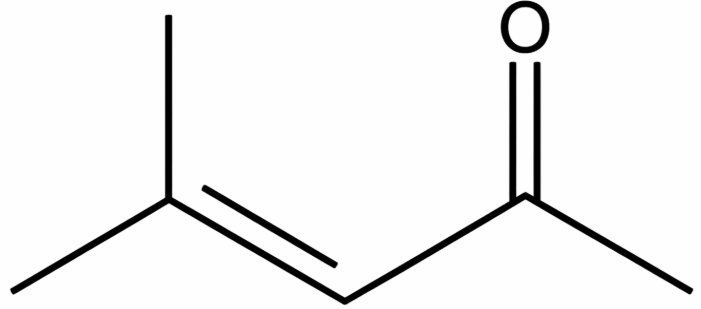 CUET 2025 Easy
 - What sum of money is needed to invest now, so as to get ₹5000 at the beginning of every month forever, if the money is worth \(6\%\) per annum compounded monthly?CUET 2025 Easy
- The puffed up appearance of dough is due to the production of:CUET 2023 Hard
- From a container full of milk, 10 liters (1) was drawn and replaced by water. This process is repeated one more time. The ratio of quantity of milk and water left in the container is \(4: 5\). Then the capacity of the container is :CUET 2025 Hard
- Read the passage carefully and answer
When a metal is placed in a solution of its ions, the metal can lose electron and can go in the solution as ion or the metal ion in the solution can take electron from the electrode and get deposited as metal. Thus, the electrode acquires either positive or negative charge with respect to the solution leading to the development of a potential difference between the metal electrode and the solution. This potential difference is called the electrode potential of the metal. The electrode potential of a metal is a measure of relative tendency to undergo oxidation (loss of electron) or reduction (gain of electron). When the concentration of the ions in the solution is unity, the electrode potential is called standard electrode potential. The magni of potential depends upon the nature of electrode, concentration of ions in solution and the temperature. In a galvanic cell, the electrode at which oxidation occurs is known as anodic half-cell and the electrode at which reduction occurs is known as cathodic half cell. The emf of the cell in terms of standard reduction potential is given by \(E_{\text {cell }}^{\circ}=E_{\text {cathode }}^{\circ}-E_{\text {anode. }}^{\circ}\).The standard free energy change of the redox reaction taking place in the cell is related to \(E_{\text {cell }}^{\circ}\) by \(\Delta G^{\circ}=-n F E^{\circ}\). A redox reaction would occur spontaneously if the free energy change is negative. The equilibrium constant of the reaction is related to the standard free energy change by \(\Delta G^{\circ}=-R T \ln K\).
The standard Oxidation potential \(E^0\) for the half cell reactions are
\(Zn \rightarrow Zn ^{2+}+2 e^{-}: E^0=+0.76 V\)
\(Fe \rightarrow Fe ^{2+}+2 e^{-}: E^0=+0.41 V\)
The emf of cell \(Fe ^{2+}+ Zn \rightarrow Zn ^{2+}+ Fe\) isCUET 2025 Easy