


CUET · CHEMISTRY · PYQ PAPER 2025
How does the osmotic pressure of a solution vary with the temperature?
- A decreases with increase in temperature
- B remains constant
- C increases with increase in temperature
- D first increases then decreases with the increase in temperature
Answer & Solution
Correct Answer
(C) increases with increase in temperature
Step-by-step Solution
Detailed explanation
Osmotic pressure increases with increase in temperature.
See the Complete Solution
Get step-by-step explanations for this and 2.5 Lakh+ more JEE, NEET & CET questions.
- Unlock all solutions
- Practice the full chapter
- Track accuracy across PYQs
4.8 rated on Google Play · 14,000+ reviews
More questions from CHEMISTRY
- The flocculating power of \(\left[ Fe ( CN )_6\right]^{4-}\) is higher than \(PO _4^{3-}\) ion because :CUET 2023 Easy
- The correct relation for determining the molar mass of solute (\(\text{M}_2\))
using osmotic pressure measurement, isCUET 2023 Medium - The gas which is used to produce and sustain powerful superconducting magnets, which form an essential part of Magnetic Resonance Imaging (MRI) system is :CUET 2023 Easy
- Read the passage carefully and answer the questions The resistance ( \(R\) ) of an object is given by the expression \(R=\rho \frac{l}{A}\).
The inverse of \(R\) is called conductance and the inverse of \(\rho\) is called conductivity or specific conductance represented by \(\kappa\).
The conductivity depends upon the nature of the material (insulator, semiconductor or conductor) and the temperature of the substance.
Similarly, the conductance due to the ions present in the solution (ionic conductance) depends upon the nature of the electrolyte, size of ions, the nature of the solvent and the temperature.
Molar conductivity ( \(\Lambda_m\) ) of a solution at a given concentration is the conductance of volume \(V\) containing one mole of electrolyte kept between two electrodes of area \(A\) and unit distance apart. It is given by the expression \(\Lambda_m=\kappa V .\)
Molar conductivity increases with decrease in concentration and when concentration approaches zero, it is called limiting molar conductivity.
The decrease is linear for a strong electrolyte. However, for a weak electrolyte the change is gradual at higher concentrations and sharp near zero concentration.
Using limiting molar conductivity values of strong electrolytes we can calculate the limiting molar conductivity of weak electrolytes using Kohlrausch law of independent migration of ions.
From molar conductivity and limiting molar conductivity we can determine the degree of dissociation \(\left(\frac{\Lambda_m}{\Lambda_m^0}\right)\) and the ionization constant of a weak acid.
For a weak acid like acetic acid, the correct expression for the ionisation constant at concentration \(c\) isCUET 2025 Medium - Match List - I with List - II
Choose the correct answer from the options given below:List - I List - II (A) \([Ni(CN)_4]^{2-}\) (I) \(EDTA^{4-}\) (B) bidentate (II) paramagnetic (C) chelate ligand (III) diamagnetic (D) \([Ni(Cl)_4]^{2-}\) (IV) oxalate CUET 2023 Easy - Read the passage carefully and answer the questions
Nearly all the transition elements display typical metallic properties such as high tensile strength, ductility, malleability, high thermal and electrical conductivity and metallic lustre. The transition metals (with the exception of Zn, Cd and Hg) are very hard and have low volatility. Their melting and boiling points are high. They have high enthalpies of atomization. lons of the same charge in a given series show progressive decrease in radius with increasing atomic number. However, the variation within a series is quite small. The filling of 4f before 5d orbital results in a regular decrease in atomic radii called Lanthanoid contraction which essentially compensates for the expected increase in atomic size with increasing atomic number. The net result of the lanthanoid contraction is that the second and the third d series exhibit similar radii (e.g., Zr 160 pm, Hf 159 pm) and have very similar physical and chemical properties. There is an increase in ionisation enthalpy along each series of the transition elements from left to right. The first ionisation enthalpy, in general, increases, but the magnitude of the increase in the second and third ionisation enthalpies for the successive elements, is much higher along a series. One of the notable features of a transition elements is the great variety of oxidation states these may show in their compounds.
Atomic number of Fe, Co, Ni and Cu are 26, 27, 28 and 29 respectively. Which among them is expected to possess the highest value for the second ionization enthalpy?CUET 2025 Medium
More PYQs from CUET
- Wings of an insect and wings of a bird are :CUET 2023 Easy
- Match List - I with List - II.
Choose the correct answer from the options given below:LIST I (Molecule) LIST II (Function) A. DNA ligase I. snRNAs B. RNA polymerase II II. Discontinuous RNA synthesis C. RNA polymerase III III. 28S rRNA D. RNA polymerase I IV. hn RNA CUET 2023 Hard - The self-inductance (L) of a long solenoid on doubling its number of turns and length, keeping other factors constant, will becomeCUET 2025 Easy
- On heating, \(\left[ Ti \left( H _2 O \right)_6\right] Cl _3\) becomes colorless because \(\backslash\) ldots \(\backslash\) ldots \(\backslash\) ldotsCUET 2025 Hard
- Match List - I with List - II.
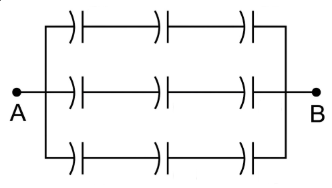
Choose the correct answer from the options given below :List - I List - II (A) Raoult's Law (I) \(\pi=C R T\) (B) Henry's Law (II) \(P=x_1 p_1^0+x_2 p_2^0\) (C) Elevation in Boiling point (III) \(P=K_H x\) (D) Osmotic Pressure (IV) \(\Delta T_b=k_b m\) CUET 2023 Easy - Each of the capacitors shown in the figure has a capacitance of \(3 \mu F\). The equivalent capacitance of the assembly between the points A and B is
 CUET 2025 Medium