


CUET · CHEMISTRY · PYQ PAPER 2023
Friedel-Craft reaction as shown below is an example of
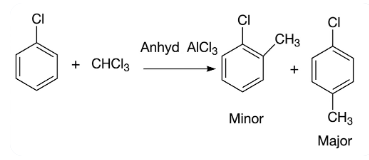
- A Electrophilic substitution reaction
- B Nucleophilic substitution reaction
- C Electrophilic addition reaction
- D Nucleophilic addition reaction
Answer & Solution
Correct Answer
(A) Electrophilic substitution reaction
Step-by-step Solution
Detailed explanation
Electrophilic substitution reaction
See the Complete Solution
Get step-by-step explanations for this and 2.5 Lakh+ more JEE, NEET & CET questions.
- Unlock all solutions
- Practice the full chapter
- Track accuracy across PYQs
4.8 rated on Google Play · 14,000+ reviews
More questions from CHEMISTRY
- Calculate the magnetic moment (spin-only) of a trivalent ion in aqueous solution if its atomic number is 22 .CUET 2025 Hard
- Read the passage carefully and answer the questions
The carbonyl group of aldehydes and ketones is highly polar. The positively charged carbon is readily attacked by electron-rich nucleophile and the negatively charged oxygen atom is attacked by an electro-deficient electrophile. Aldehydes and ketones undergo nucleophilic addition reactions in the presence of acid or a base. The mechanism involves attack of a nucleophile on the electron deficient carbonyl carbon to form a tetrahedral intermediate. A new bond is formed between the carbon and oxygen. Protonation of the anion furnished by the reaction medium yields a neutral addition product. The addition product is same whether the reaction is catalyzed by acid or a base. For example in the presence of base aldehydes and ketones react with hydrogen cyanide to form cyanohydrin.
Which of the following reactions is not a nucleophilic addition reaction of aldehydes and ketones?CUET 2025 Hard - Which of the following amine do not respond to Hinsberg test?CUET 2025 Medium
- Read the passage carefully and answer
When a metal is placed in a solution of its ions, the metal can lose electron and can go in the solution as ion or the metal ion in the solution can take electron from the electrode and get deposited as metal. Thus, the electrode acquires either positive or negative charge with respect to the solution leading to the development of a potential difference between the metal electrode and the solution. This potential difference is called the electrode potential of the metal. The electrode potential of a metal is a measure of relative tendency to undergo oxidation (loss of electron) or reduction (gain of electron). When the concentration of the ions in the solution is unity, the electrode potential is called standard electrode potential. The magni of potential depends upon the nature of electrode, concentration of ions in solution and the temperature. In a galvanic cell, the electrode at which oxidation occurs is known as anodic half-cell and the electrode at which reduction occurs is known as cathodic half cell. The emf of the cell in terms of standard reduction potential is given by \(E_{\text {cell }}^{\circ}=E_{\text {cathode }}^{\circ}-E_{\text {anode. }}^{\circ}\).The standard free energy change of the redox reaction taking place in the cell is related to \(E_{\text {cell }}^{\circ}\) by \(\Delta G^{\circ}=-n F E^{\circ}\). A redox reaction would occur spontaneously if the free energy change is negative. The equilibrium constant of the reaction is related to the standard free energy change by \(\Delta G^{\circ}=-R T \ln K\).
The half call reaction is the one thatCUET 2025 Medium - Match List-I with List-II
List-I (Order of reaction) List-II (Unit of rate constant, k) (A) nth order reaction (I) \(\left({mol} {L}^{-1}\right)^{1-{n}} {s}^{-1}\) (B) zero order reaction (II) \({mol} {L}^{-1} {~s}^{-1}\) (C) first order reaction (III) \({mol}^{-1} {~L} {~s}^{-1}\) (D) second order reaction (IV) \({s}^{-1}\)
Choose the correct answer from the options given below.CUET 2025 Hard - \(C_2 H_5 OH \xrightarrow{X} C_2 H_5 Cl \xrightarrow{Y} C_2 H_5 CN\)
\(X\) and \(Y\) used in the above reaction are :CUET 2023 Hard
More PYQs from CUET
- Arrange the following electrolytes in the increasing order of van't Hoff factor (i) for complete dissociation of solute.
A. \(\left[ Co \left( NH _3\right)_6\right] Cl _3\)
B. \(MgCl _2\)
C. \(K _4\left[ Fe ( CN )_6\right]\)
D. KCl
Choose the correct answer from the options given below:+CUET 2025 Hard - Match List-I with List-II
Choose the correct answer from the options given below :List-I List-II (A) If A is a non singular matrix of order n, then \(| A (\operatorname{adjA})|\) is equal to (I) \(|A|^{n-1}\) (B) If A is a non singular matrix of order n, then |adj(adj A)| is equal to (II) \(|A|^{n-2} A\) (C) If A is a non singular matrix of order n, then \(\operatorname{adj}(\operatorname{adj} A )\) is equal to (III) \(|A|^n\) (D) if A is a non singular matrix of order n, then \(|(\operatorname{adj} A)|\) is equal to (IV) \(|A|^{(n-1)^2}\) CUET 2025 Easy - Let \(f(x)=x|x|\). Then \(f(x)\) is:CUET 2023 Hard
- Answer the question on basis of passage given below
The noble gases have closed shell electronic configuration and are monatomic gases under normal conditions. The low boiling points of lighter noble gases are due to the weak dispersion forces between the atoms and the absence of other inter atomic interaction. The direct reaction of xenon with fluorine leads to a series of compounds with oxidation numbers \(+2, +4\) and \(+6\).
\(\text{XeF}_4\) reacts violently with water to give \(\text{XeO}_3\). The compound of Xenon exhibit stereoisomerism and their geometries can be deduced considering the total number of electrons in the valence shell.
Match List - I with List – II.
Choose the correct answer from the options given below :List - I List - II A. Its partial hydrolysis does not change the oxidation state of the central atom I. He B. It is used in modern diving apparatus II. \(\text{XeF}_6\) C. It is used to provide inert atmosphere for filling electrical bulbs III. \(\text{XeF}_4\) D. Its central atom is in \(\text{sp}^3\text{d}^2\) hybridisation state IV. Ar CUET 2023 Hard - The capacity to generate a whole plant from any cell/explant is known as:CUET 2023 Hard
- The maximum value of \(\sin x+\cos x, x \in R\) is:CUET 2023 Easy