


CUET · CHEMISTRY · PYQ PAPER 2023
For the reaction \(x + y \rightarrow z\),
rate law expression is rate \(= k [x] [y]^3\).
1 If the volume of the vessel is reduced to of its original volume, then rate of reaction will 3:
- A decrease 81 times.
- B increase 81 times.
- C decrease 9 times.
- D increase 27 times.
Answer & Solution
Correct Answer
(B) increase 81 times.
Step-by-step Solution
Detailed explanation
\( [x]' = 3[x] \), \( [y]' = 3[y] \) \( \text{rate}' = k [x]' [y]'^3 \) \( \text{rate}' = k (3[x]) (3[y])^3 = k \cdot 3 \cdot 27 [x] [y]^3 \) \( \text{rate}' = 81 \cdot (k [x] [y]^3) = 81 \cdot \text{rate} \) increase 81 times.
See the Complete Solution
Get step-by-step explanations for this and 2.5 Lakh+ more JEE, NEET & CET questions.
- Unlock all solutions
- Practice the full chapter
- Track accuracy across PYQs
4.8 rated on Google Play · 14,000+ reviews
More questions from CHEMISTRY
- Match List-I with List-II
Choose the correct answer from the options given below:List-I ( Common name) List-II ( IUPAC name) (A) Vinyl Chloride (I) 1-Chloro-2-methylbenzene (B) Chloroform (II) Dichloromethane (C) Methylene chloride (III) Trichloromethane (D) o-Chlorotoluene (IV) Chloroethene CUET 2025 Medium - The IUPAC Name for the complex \(Hg [Co(SCN)_4]\)CUET 2023 Easy
- Read the passage carefully and answer the questions based on the passage:
The number of reacting species (atoms, ions or molecules) taking part in an elementary reaction, which must collide simultaneously in order to bring about a chemical reaction is called molecularity of a reaction. In the rate equation Rate \(=k[\mathrm{~A}]^x[\mathrm{~B}]^y\)
\(x\) and \(y\) indicate how sensitive the rate is to the change in concentration of A and B, respectively. Sum of these exponents, i.e., \(x +y\) gives the overall order of a reaction where \(x\) and \(y\) represent the order with respect to the reactants A and B respectively. Hence, the sum of powers of the concentration of the reactants in the rate law expression is called the order of that chemical reaction. For a first order reaction, the concentration of the reactant varies as \([\mathrm{R}]=[\mathrm{R}]_0 e^{-k t}\)
Which of the following statements is not true for order of a reaction?CUET 2025 Hard - Read the passage carefully and answer the questions.
Amines are considered to be derivatives of ammonia obtained by replacement of hydrogen atoms with alkyl or aryl groups. They are usually prepared from nitro compounds, halides, amides, imides etc. The presence of hydrogen bonding influences its physical properties. In alkylamines, a combination of electron releasing steric and hydrogen bonding factors influences the stability of substituted ammonium cations in protic polar solvents and thus affects the basic nature of amines. Alkyl amines are found to be stronger bases than ammonia which is more basic than water. Primary and secondary amines are engaged in intermolecular association due to hydrogen bonding. This intermolecular association is more in primary amines than in secondary amines. Tertiary amines do not have intermoleulcar association due to the absenceof hydrogen atom available for hydrogen bonding. Thus, the boiling point of amines depends on hydrogen bonding. In aromatic amines, electron releasing and withdrawing groups increase and decrease their basic character. Aryl diazonium salts usually obtained from arylamine undergo replacement of the diazonium group with a variety of nucleophile. Their coupling reaction of aryl diazonium salts with phenol or arylamine results in formation of dyes.
Carbylamine reaction is used as a test forCUET 2025 Medium - "Answer the question on basis of passage given below :
Carboxylic acids are weaker than mineral acids, but they are stronger acids than alcohols and many simple phenols (\(\text{pKa}\) is ~ 16 for ethanol and 10 for phenol). The higher acidity of carboxylic acids as compared to phenols can be understood similarly. The conjugate base of carboxylic acid, a carboxylate ion, is stabilised by two equivalent resonance structures in which the negative charge is at the more electronegative oxygen atom. The conjugate base of phenol, a phenoxide ion, has non-equivalent resonance structures in which the negative charge is at the less electronegative carbon atom. Further, the negative charge is delocalised over two electronegative oxygen atoms in carboxylate ion whereas it is less effectively delocalised over one oxygen atom and less electronegative carbon atoms in phenoxide ion. Thus, the carboxylate ion is more estabilised than phenoxide ion, so carboxylic acids are more acidic than phenols.
Effect of substituents on the acidity of carboxylic acids: substituents may affect the stabliity of the conjugate base and thus, also affect the acidity of the carboxylic acids. Electron withdrawing group increase the acidity of carboxylic acids by stabilising the conjugate base through delocalisation of the negative charge by inductive and/or resonance effects. Conversely, electron donating groups decrease the acidity by destabilising the conjugate base.
The weakest among the following acid is :"CUET 2023 Medium - Isomerism shown by the complex pair \(\left[ Cr \left( H _2 O \right)_6\right] Cl _3\) and \(\left[ Cr \left( H _2 O \right)_5 Cl ]Cl _2 \cdot H _2 O\right.\) is ___________CUET 2025 Hard
More PYQs from CUET
- Match List-I with List-II
The function \(f(x)=(x-1)(x+1)^2\) has
Choose the correct answer from the options given below :List-I List-II (A) A local maxima at \(x=\) __________ (I) \(\frac{1}{3}\) (B) A local minima at x = __________ (II) \(0\) (C) The local minimum value of \(f(x)=\) __________ (III) \(-1\) (D) The local maximum value of \(f(x)=\) __________ (IV) \(-\frac{32}{27}\) CUET 2025 Medium - Let \( i_E, i_C \) and \( i_B \) represent the emitter current, collector current and base current respectively in a transistor. Choose the correct statement from the following:CUET 2023 Medium
- How can fringe width increase in Young's double slit experiment?CUET 2023 Easy
- Half life of the zero order reaction is:CUET 2025 Hard
- The correct sequence of reagents to carry out the following conversion is
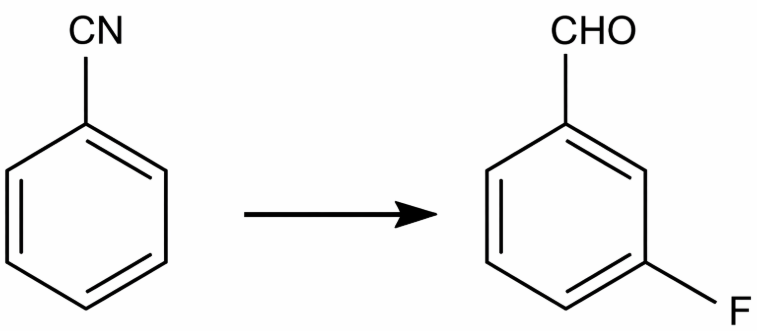 CUET 2025 Easy
 - Read the passage carefully and answer the Questions
Molar conductivity \(\left(\Lambda_m\right)\) of a solution at a given concentration (c) is the conductance of volume, V of solution, containing one mole of electrolyte kept between the two electrodes with area of cross-section A and at a distance of unit length. It increases with the decrease in concentration and when the concentration approaches zero, the molar conductivity is called limiting molar conductivity \(\left(\Lambda_m^0\right)\). For a strong electrolyte, \(\Lambda_m\) increases linearly with dilution and is given by \(\Lambda_m=\Lambda_m^0-A c^{1 / 2}\). The value of the constant A for a given solvent depends on the type of electrolyte along with temperature. According to Kohlrausch law, the value of \(\left(\Lambda_m^0\right)\) for an electrolyte is A\(\Lambda_m^0=\nu_{+} \lambda_{+}^0+\nu_{-} \lambda_{-}^0\), where \(\nu_{+}\)and \(\nu_{-}\) are the number of cations and anions, respectively, per molecule of the electrolyte and \(\lambda_{+}^0\) and \(\lambda_{-}^0\) are limiting molar conductivities of cation and anion, respectively. Kohlrausch law
finds many applications, like determining the solubility of a sparingly soluble salt, determining the degree of dissociation\(\left(\Lambda_m / \Lambda_m^0\right)\), and the dissociation constant of a weak electrolyte.
If the equivalent conductivity of 1 M Phthalic acid is \(12.8 S cm ^2 eq ^{-1}\) and the limiting equivalent conductivities of the
hydrogen and Phthalate ions are 42 and \(288.42 S cm ^2 eq ^{-1}\), respectively, the degree of dissociation of Phthalic acid will be :CUET 2025 Medium