


CUET · CHEMISTRY · PYQ PAPER 2023
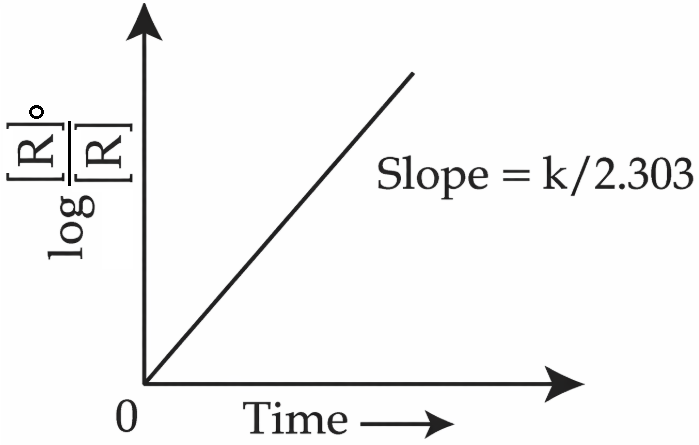
For the reaction, \(R \rightarrow P\), the \(\log \left([ R ]_0 /[ R ]\right)\) verses time \(( t )\) plot is given below. What is the order of reaction and what are the units of rate constant ?
- A Zero order, \(s ^{-1}\)
- B First order, \(s ^{-1}\)
- C Second order, \(mol ^{-1} L s ^{-1}\)
- D Zero order, \(mol L ^{-1} s^{-1}\)
Answer & Solution
Correct Answer
(B) First order, \(s ^{-1}\)
Step-by-step Solution
Detailed explanation
Plot of \(\log ([ R ]_0 /[ R ])\) vs \(t\) is linear, indicating first order reaction. For a first order reaction, units of rate constant \(k\) are \(s^{-1}\).
See the Complete Solution
Get step-by-step explanations for this and 2.5 Lakh+ more JEE, NEET & CET questions.
- Unlock all solutions
- Practice the full chapter
- Track accuracy across PYQs
4.8 rated on Google Play · 14,000+ reviews
More questions from CHEMISTRY
- The properties which depend on the number of solute particles irrespective of their nature relative to the total number of particles in the solution are called colligative properties. These are relative lowering of vapour pressure of the solvent, depression of freeaing point of the solvent, elevation of boiling point of the solvent and osmotic pressure of the solution. All of these properties help in calculating the observed molar mass of the solute.
Determination of osmotic pressure is considered best for the determination of molecular mass of the solute.
Which ssolution has the highest boiling point ?CUET 2023 Hard - Which isomerism is shown by the following pairs ?
\(CH_3CH_2CH_2OH\) and \(CH_3CH_2OCH_3\)CUET 2023 Hard - How many \(Cr-O\) bonds in dichromate ions are of the same bond length and are in resonance?CUET 2023 Hard
- What will be the increasing order of basic strength of the following compounds?
\(C_2 H_5 NH_2,\left(C_2 H_5\right)_2 NH,\left(C_2 H_5\right)_3 N, C_6 H_5 NH_2\)CUET 2024 Hard - Nitriles on reduction with lithium aluminum hydride produceCUET 2025 Hard
- Bases of RNA are -CUET 2023 Medium
More PYQs from CUET
- In the following diagram, to prevent osmosis, if excess pressure is applied on one side of the semipermeable membrane (SPM), then I, II, III and IV are, respectively,
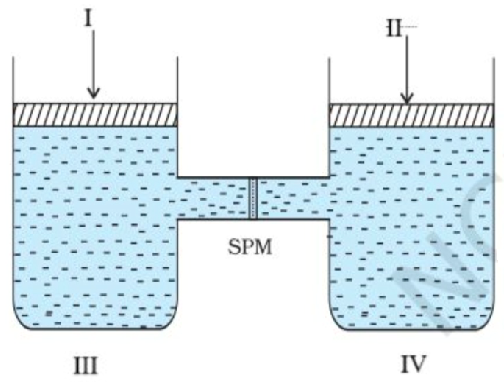
(A) Solution
(B) \(P_{\text {atm }}\)
(C) \(P_{\text {atm }}+\Pi\)
(D) Solvent
Choose the correct answer from the options given below:CUET 2025 Hard - The value of the determinant \(D=\) equation \(\left|\begin{array}{lll}x & a & a+x \\ y & b & b+y \\ z & c & c+z\end{array}\right|\) is:CUET 2023 Medium
- Genetically modified plants have been useful in:CUET 2025 Hard
- The semi vertical angle of a right circular cone of maximum volume of a given slant height isCUET 2025 Hard
- Which of the following is not a female contraceptive?CUET 2025 Hard
- Read the following paragraph and answer the given questions.
Repeated amplification is achieved by the use of a thermostable DNA polymerase (isolated from a bacterium, Thermusaquaticus}), which remain active during the high temperature induced denaturation of double stranded DNA. The separated DNA fragments can be visualised only after staining the DNA with a compound known as ethidium bromide followed by exposure to UV radiation. The separated bands of DNA are cut out from the agarose gel and extracted from the gel piece. The convention for naming these enzymes is the first letter of the name comes from the genus and the second two letters come from the species of the prokaryotic cell from which they were isolated, e.g., EcoRI comes from Escherichiacoli} RY 13. In EcoRI, the letter 'R' is derived from the name of strain. Roman numbers following the names indicate the order in which the enzymes were isolated from that strain of bacteria. Stanley Cohen and Herbert Boyer accomplished this in 1972 by isolating the antibiotic resistance gene by cutting out a piece of DNA from a plasmid which was responsible for conferring antibiotic resistance. Since the DNA is enclosed within the membranes, we have to break the cell open to release DNA, RNA, protein, polysaccharides etc. The RNA can be removed by treatment with ribonuclease whereas proteins can be removed by treatment with protease. Other molecules can be removed by appropriate treatments and purified DNA ultimately precipitates out after the addition of chilled ethanol.
The convention for naming restriction enzymes is:CUET 2025 Medium