


CUET · CHEMISTRY · PYQ PAPER 2023
Electrical disintegration or Bredig's Arc method involves
- A Fermentation
- B Condensation
- C Evaporation
- D Filtration
Answer & Solution
Correct Answer
(B) Condensation
Step-by-step Solution
Detailed explanation
Condensation
See the Complete Solution
Get step-by-step explanations for this and 2.5 Lakh+ more JEE, NEET & CET questions.
- Unlock all solutions
- Practice the full chapter
- Track accuracy across PYQs
4.8 rated on Google Play · 14,000+ reviews
More questions from CHEMISTRY
- Select the relation which correctly relates the variation of \(\Lambda_m\) with concentration for strong electrolytes.CUET 2025 Medium
- Read the passage carefully and answer the Questions:
According to Valence Bond theory, the metal atom or ion under the influence of ligands can use its ( \(n-1\) )d, \(n s, n p\) or \(n s, n p, n d\) orbitals for hybridisation to yield a set of equivalent orbitals of definite geometry such as octahedral, tetrahedral, square planar and so on. These hybridised orbitals are allowed to overlap with ligand orbitals that can donate electron pairs for bonding. While the VB theory, to a larger extent, explains the formation, structures and magnetic behaviour of coordination compounds, it suffers from the many shortcomings. The Crystal field theory (CFT) is an electrostatic model which considers the metal-ligand bond to be ionic arising purely from electrostatic interactions between the metal ion and the ligand. The five \(d\) orbitals in an isolated gaseous metal atom/ion have same energy, i.e., they are degenerate. This degeneracy is maintained if a spherically symmetrical field of negative charges surrounds the metal atom/lon. However, when this negative field is due to ligands in a complex, it becomes asymmetrical and the degeneracy of the \(d\) orbitals is lifted. It results in splitting of the \(d\) orbitals. The pattern of splitting depends upon the nature of the crystal field.
Which of the following is not true about the limitations of VBT:CUET 2023 Medium - A compound is formed by two elements X and Y.
Atoms of 'Y' make ccp and those of element 'X' occupy tetrahedral voids.
The formula of the compound is:CUET 2023 Hard - Match List-I (Name of the Base) with List-II (Structure)
List - I (Name of the Base) List - II (Structure) (A). Adenine (A) (I) 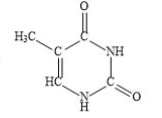
(B). Cytosine (C) (II) 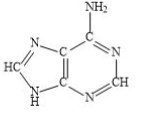
(C). Thymine (T) (III) 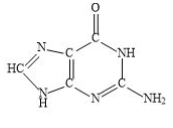
(D). Guanine (G) (IV) 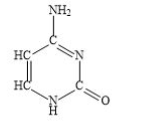
Choose the correct answer from the options given below:CUET 2025 Hard - Match List - I with List - II
List - I (Order of reaction) List - II (Unit) (A). Zero order reaction (I). \(L ^2 mol^{-2} s^{-1}\) (B). First order reaction (II). \(mol ^{-1} L s ^{-1}\) (C). Second order reaction (III). \(mol L ^{-1} s^{-1}\) (D). Third order reaction (IV). \(s ^{-1}\)
Choose the correct answer from the options given below:CUET 2025 Easy - Which of the following statements is NOT correct regarding the catalytic ability of transition metals?CUET 2025 Easy
More PYQs from CUET
- The synthesis of alkyl fluoride is best accomplished by the following reaction:
\(CH_3Br + AgF\rightarrow CH_3F + AgBr\)
The reaction is termed as:CUET 2023 Hard - In the plot of \(\log \frac{[R]_{0}}{[R]}\) versus time for a first order reaction (where [R] represents the concentration of the reactant), the slope and intercept are respectively equal toCUET 2025 Medium
- The aqueous solutions of \(ZnSO _4, AgNO _3, FeCl _3\) and \(WCl _6\) are electrolysed for 2 hours using a current of 5 amperes. The decreasing order of mass deposited of the following metals at the cathode will be:
(A) Zn
(B) Ag
(C) Fe
(D) W
(Atomic masses:\(Fe =56 g mol ^{-1}, Zn =65 g mol ^{-1}\),\(\left.Ag =108 g mol ^{-1}, W=184 g mol ^{-1}\right)\)
Choose the correct answer from the options given below:CUET 2025 Medium - The least positive integer \(x\) satisfying \(28=x(\bmod 6)\) is :CUET 2023 Medium
- Read the following paragraph carefully and answer the given questions.
In the year 1963 the two enzymes responsible for restricting the growth of bacteriophage in E. coli were isolated. The first restriction endonuclease - Hind II, whose functioning depended on a specific DNA nucleotide sequence was characterized five years later. It was found that Hind II always cut DNA molecules at a particular point by recognizing a specific sequence of six base pairs. This specific base sequence is known as the recognition sequence for Hind II. Besides Hind II, today we know more than 900 restriction enzymes that have been isolated from over 230 strains of bacteria, each of which recognize different recognition sequences.
In EcoR I the latter 'R' is derived from the -CUET 2023 Easy - The value of \(\int_{-5}^5|x+3|\) \(dx\) isCUET 2025 Medium