


CUET · CHEMISTRY · PYQ PAPER 2025
DNA and RNA do not differ from each other in which of the following
- A Nature of sugar
- B Nature of the nitrogenous bases
- C Nature of the backbone
- D Secondary structure
Answer & Solution
Correct Answer
(C) Nature of the backbone
Step-by-step Solution
Detailed explanation
Nature of the backbone
See the Complete Solution
Get step-by-step explanations for this and 2.5 Lakh+ more JEE, NEET & CET questions.
- Unlock all solutions
- Practice the full chapter
- Track accuracy across PYQs
4.8 rated on Google Play · 14,000+ reviews
More questions from CHEMISTRY
- Read the passage given below and answer the question.
Phenols and Alcohol have the same function group (-OH) but phenols are stronger acids than alcohol due the resonance stabilization of phenoxide ion than alkoxide ion (-RO\(^{-}\)). Electron withdrawing groups tend to increase the acidic strength while electron releasing groups tend to decrease it.
Compound 'A' on reaction with Conc. HCl and anhydrous \(ZnCl_2\), gives turbidity immediately.
Compound 'A' is :CUET 2023 Medium - Select the correct increasing order of conductivity of the given complexes in their solution
(A) \(\left[ Co \left( NH _3\right)_6\right] Cl _3\)
(B) \(\left[ Cr \left( NH _3\right)_5 Cl \right] Cl _2\)
(C) \(\left[ Co \left( NH _3\right)_4 Cl _2\right] Cl\)
(D) \(\left[ Co \left( NH _3\right)_3 Cl _3\right]\)
Choose the correct answer from the options given below:CUET 2025 Medium - In a reaction A and B reacts to form product. The initial rate of reaction was determined using different initial concentration of A and B.
What is the initial rate of reaction (\(r_o\)) when critical concentration of A and B is \(0.50\ mol/L\) and \(0.50\ mol/L\) respectively.A/molL-1 0.10 0.10 0.20 \(B / mol L ^{-1}\) 0.30 0.10 0.30 \(r_o / mol L ^{-1} s^{-1}\) \(6.81 \times 10^{-4}\) \(2.27 \times 10^{-4}\) \(13.62 \times 10^{-4}\) CUET 2023 Medium - Match List - I with List - II.
Choose the correct answer from the options given below :List - I (Ore) List - II (Metal) (A) Calamine (1) Copper (B) Malachite (II) Aluminium (C) Siderite (III) Zinc (D) Cryolite (IV) Iron CUET 2023 Hard - In aldehydes, the carbonyl group is bonded to a carbon and hydrogen, while in ketones it is bonded to two carbon atoms. The carbonyl compounds in which carbonyl group is bonded to oxygen are known as carboxylic acid and their derivatives.
The hybridisation of the \(C\) in the carbonyl group is:CUET 2023 Easy - Predict the correct sequence of reagents to carry out the following conversion:
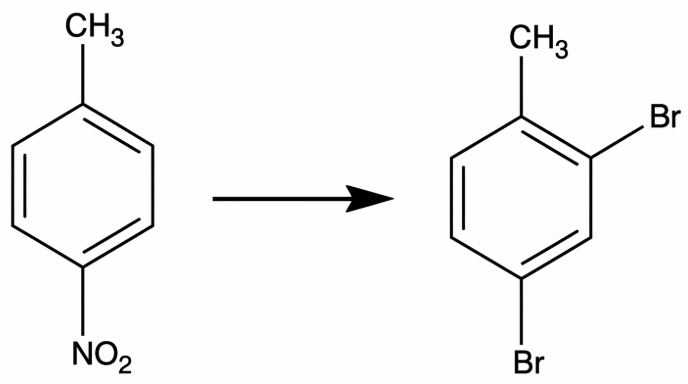 CUET 2025 Easy
More PYQs from CUET
- A rod of infinite length is placed along the axis of a concave mirror of focal length f.
The near end of the rod is at a distance u > f from the mirror. The length of its image is:CUET 2023 Medium - Baker's Yeast is:CUET 2023 Hard
- Match List I with List - II. -
List – l (Terms) List – II (Linked to) (A) Divergent evolution (l) Branching descent (B) Convergent evolution (II) Geographical habitats (C) Adaptive radiation (III) Analogous structures (D) Natural selection (IV) Homologous structures
Choose the correct answer from the options given below:CUET 2023 Easy - At what rate of interest will the present value of a perpetuity of ₹ 500 payable at the end of every 6 months be ₹ 20,000 ?CUET 2025 Easy
- The maximum distance between the transmitting and receiving antenna for a satisfactory communication in LOS mode is 48 Km . If the height of the receiving antenna is 8 (Given radius of earth \(R_e=6400 km\) )CUET 2023 Hard
- Read the following passage carefully and answer the given questions
The earthworm is referred to as the farmer's friend. This is because they help in the breakdown of complex organic matter as well as in loosening of soil. Similarly, decomposers break down complex organic matter into inorganic substances like carbon dioxide, water and nutrients and the process is called decomposition. Dead plant remains such as leaves, bark, flowers and dead remains of animals, including fecal matter, constitute detritus, which is the raw material for decomposition. Some of the steps in the process of decomposition are fragmentation, catabolism, leaching, humification etc.
The process of breaking down of detritus into smaller particles is called:CUET 2025 Easy