


CUET · CHEMISTRY · PYQ PAPER 2025
Considering the stability of Cu(II) and Cu(I) which of the following statements is true?
- A Cu(II) is more stable
- B stability of both Cu(II) and Cu(I) depends upon the nature of copper salt
- C Cu(II) is less stable
- D both Cu(II) and Cu(I) are equally stable
Answer & Solution
Correct Answer
(A) Cu(II) is more stable
Step-by-step Solution
Detailed explanation
Cu(II) is more stable
See the Complete Solution
Get step-by-step explanations for this and 2.5 Lakh+ more JEE, NEET & CET questions.
- Unlock all solutions
- Practice the full chapter
- Track accuracy across PYQs
4.8 rated on Google Play · 14,000+ reviews
More questions from CHEMISTRY
- Name the reaction when Benzene is treated with ethanoyl chloride in the presence of anhydrous AlCl\(_3\)CUET 2025 Easy
- Read the passage carefully and answer the questions.
Amines are considered to be derivatives of ammonia obtained by replacement of hydrogen atoms with alkyl or aryl groups. They are usually prepared from nitro compounds, halides, amides, imides etc. The presence of hydrogen bonding influences its physical properties. In alkylamines, a combination of electron releasing steric and hydrogen bonding factors influences the stability of substituted ammonium cations in protic polar solvents and thus affects the basic nature of amines. Alkyl amines are found to be stronger bases than ammonia which is more basic than water. Primary and secondary amines are engaged in intermolecular association due to hydrogen bonding. This intermolecular association is more in primary amines than in secondary amines. Tertiary amines do not have intermoleulcar association due to the absenceof hydrogen atom available for hydrogen bonding. Thus, the boiling point of amines depends on hydrogen bonding. In aromatic amines, electron releasing and withdrawing groups increase and decrease their basic character. Aryl diazonium salts usually obtained from arylamine undergo replacement of the diazonium group with a variety of nucleophile. Their coupling reaction of aryl diazonium salts with phenol or arylamine results in formation of dyes.
Which of the following compounds will not undergo azo coupling with benzene diazonium chloride?CUET 2025 Easy - Match List-l with List-ll
Choose the correct answer from the options given below:List-l List-II (A) Coupling reaction (I) Primary amines (B) Hofmann's degradation (II) Aromatic amines (C) Isocyanide test (III) Phenols and aromatic amines (D) Diazonium salts (IV) Amide to amine CUET 2025 Hard - Predict the correct sequence of reagents to carry out the following conversion:
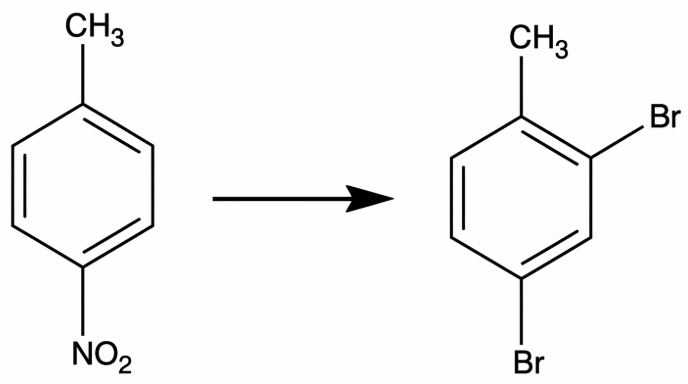 CUET 2025 Easy
 - Read the passage carefully and answer the following questions
There are mainly four series of the transition metals, \(3 d\) series ( \(S c\) to Zn), \(4 d\) series (Y to Cd), \(5 d\) series (La and Hf to Hg ) and 6d series which has Ac and elements from Rf to Cn . The two series of the inner transition metals; \(4 f\) ( Ce to Lu ) and \(5 f\) (Th to Lr ) are known as lanthanoids and actinoids respectively. Their chemical properties are transitional between those of \(s\) and \(p\) block elements. The transition metals (with the exception of Zn, Cd and Hg) are very hard and have low volatility. Their melting and boiling points are high. Transition metals have incomplete d subshell either in neutral atom or in their ions. With partly filled d orbitals these elements exhibit certain characteristic properties such as display of a variety of oxidation states, formation of coloured ions and entering into complex formation with a variety of ligands. The transition metals and their compounds are known for their catalytic activity.
In general the electronic configuration of outer orbitals of transition metals is \((n - 1)d^{1-10}ns^{1-2}\) but Pd shows an exceptional electronic configuration as......CUET 2025 Easy - Read the passage carefully and answer the questions:
The degeneracy of the \(d\) orbitals has been removed due to ligand electron-metal electron repulsions in the octahedral complex to yield three orbitals of lower energy, \(t_2\), set and two orbitals of higher energy, \(e_g\) set. This splitting of the degenerate levels due to the presence of ligands in a definite geometry is termed as crystal field splitting and the energy separation is denoted by \(\Delta_0\). Thus energy of the two \(e_g\) orbitals will increase by \((3 / 5) \Delta_0\) and that of three \(t_{2 g}\) will decrease by \((2 / 5) \Delta_0\). The crystal field splitting \(\Delta_{\circ}\) depends upon the field produced by the ligand and charge on the metal ion. Some ligands are able to produce strong fields, in which case the splitting will be large, whereas others produce weak fields and consequently result in small splitting of \(d\) orbitals. Relative magnitude of crystal field splitting energy \(\Delta_0\) and pairing energy, \(P\) (energy required for electron pairing in a single orbital) determine the formation of low spin ( \(\Delta_{\circ}>P\) ) or high spin ( \(\Delta_{\circ}<P\) ) complex. In tetrahedral coordination entity formation, the d-orbital splitting is inverted and is smaller as compared to the octahedral field splitting. The crystal field theory attributes the colour of the complex to \(d-d\) transition of the electron. The colour of the coordination compounds depends on the crystal field splitting. In the absence of ligand, crystal field splitting does not occur and hence the substance is colourless.
What will be the crystal field splitting energy for tetrahedral \(\left[ CoCl _4\right]^{2-}\) if its value for octahedral \(\left[ CoCl _6\right]^{4-}\) is \(18,000 cm^{-1}\) ?CUET 2025 Easy
More PYQs from CUET
- If 50000 J energy available to primary producer, then energy available to tertiary consumer will be:CUET 2023 Medium
- Answer the question on the basis of passage given below :
Adsorption is a surface phenomenon which can be expressed by means of an empirical relationship know as Freundlich Adsorption isotherm. The relationship given by \(\frac{x}{m} = Kp^{\frac{1}{n}}\ (n > 1)\)
x = Mass of the gas adsorbed
m = Mass of adsorbent
p = Pressure at which adsorption takes place
K and n are constant
The curve of above relationship indicate that at a fixed pressure there is a decrease in physical adsorption with increase in temperature. At high pressure, curves become parallel to pressure axis, indicating saturation of the surface of adsorbent.
Adsorption of a gas follow Freundlich isotherm shown below. \(\frac{x}{m}\) is proportional to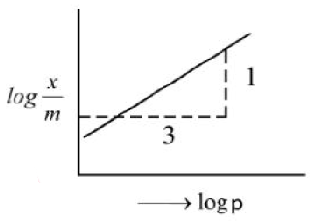 CUET 2023 Hard
 - The two alleles of a gene pair are located on -CUET 2025 Hard
- The exaggerated response of the immune system to certain antigens present in the environment is known as:CUET 2023 Easy
- Answer the question on the basis of passage given below :
Aldehydes and ketones represent two essential classes of organic compounds which are extensively used in the synthesis of a wide variety of other organic molecules. Due to the inherent polarity of the central carbonyl group, these substances readily undergo nucleophilic addition reactions. Broadly speaking, these addition reactions can be categorized into two types: one in which simple addition of the nucleophilic reagent occurs across the \(> C = O\) bond, and the second type where the initial addition is subsequently followed by the elimination of a water molecule. A variety of ammonia derivatives, including hydroxylamine, hydraaine, phenylhydraxine, 2,4-dinitroplhemylhdrasine, and semicarbaside, all belong to this second category of reactions. These specific derivatives are fundamentally used for the identification and definitive characterization of aldehydes and ketones. Significantly, both types of nucleophilic addition reactions are strongly influenced by both steric and electronic factors. As a general rule, aliphatic aldehydes exhibit higher reactivity compared to aromatic aldehydes. The aliphatic aldehydes demonstrate the ability to reduce both Fehling's solution and Tollen's reagent, whereas aromatic aldehydes are limited to reducing only Tollen's reagent. In a similar manner to aldehydes, aromatic ketones are observed to be less reactive than aliphatic ketones towards all nucleophilic addition reactions. In a separate context, phenols and carboxylic acids both exhibit acidic properties in nature. Both classes of compounds readily dissolve in NaOH solution and cause blue litmus to turn red. However, carboxylic acids stand out as much stronger acids than phenols and thus can decompose sodium bicarbonate \(\left( NaHCO _3\right)\) with the distinct evolution of \(CO _2\) gas, a reaction which phenols do not undergo. It is important to note that both electron- donating and electron- withdrawing substituents significantly influence the acid strength of both aliphatic as well as aromatic carboxylic acids. Furthermore, unlike all other common aliphatic acids, formic acid uniquely possesses reducing properties and simultaneously does not display the typical reactions characteristic of the allyl group.
Which of the following statement(s) is/are correct?
A. Aldehydes give positive test with Tollen's reagent.
B. Ketones give positive test with Fehling's solution
C. Ketones do not react with Fehling's solution.
D. Aldehydes with Schiff's reagent restore pink colour
E. Ketones with Schiff's reagent restore pink colour.
Choose the correct answer from the options given below:CUET 2023 Medium - Arrange the given steps of DNA fingerprinting in sequence.
(A) Transferring of separated DNA fragments on nitrocellulose membrane
(B) Isolation of DNA and digestion by restriction endonuclease
(C) Hybridisation using VNTR Probe
(D) Separation of isolated DNA fragments by Gel Electrophoresis
Choose the correct answer from the options given below :CUET 2023 Medium