


CUET · CHEMISTRY · PYQ PAPER 2023
Consider the two complex ions \(\text{[CoF}_6]^{3-}\) and \(\text{[Co(C}_2\text{O}_4)_3]^{3-}\), which of the following statement (s) is/are false :
(A) Both are octahedral.
(B) \(\text{[Co(C}_2\text{O}_4)_3]^{3-}\) is diamagnetic, while \(\text{[CoF}_6]^{3-}\) is paramagnetic.
(C) Both are outer orbital complexes.
(D) In both the complexes the central metal is in the same oxidation state.
Choose the correct answer from the options given below :
- A (B) and (C) Only
- B (B), (C) and (D) Only
- C (C) Only
- D (A), (C) and (D) Only
Answer & Solution
Correct Answer
(C) (C) Only
Step-by-step Solution
Detailed explanation
\(\text{Co}\) oxidation state in \(\text{[CoF}_6]^{3-}\) and \(\text{[Co(C}_2\text{O}_4)_3]^{3-}\) is \(+3\), corresponding to \(\text{Co}^{3+}\) (\(d^6\)). \(\text{[CoF}_6]^{3-}\): \(\text{F}^-\) is a weak field ligand. \(\text{Co}^{3+}\) forms a high spin \(d^6\) complex…
See the Complete Solution
Get step-by-step explanations for this and 2.5 Lakh+ more JEE, NEET & CET questions.
- Unlock all solutions
- Practice the full chapter
- Track accuracy across PYQs
4.8 rated on Google Play · 14,000+ reviews
More questions from CHEMISTRY
- Read the passage carefully and answer the following questions
Aldehydes, carboxylic acids and ketones are widespread in the animal and plant kingdoms. They play a pivotal role in various biochemical processes of life. Their presence in nature adds fragrance and flavor. These compounds are widely used in food products, pharmaceuticals, paints, resins and other important product industries. These compounds are prepared by various laboratory methods, which mainly include oxidation, formylation, acylation and reduction. Due to the polar nature of the carbonyl group in aldehydes and ketones, they can exhibit different reactions like nucleophilic addition. They do exhibit redox and various condensation reactions which lead to the formation of various important compounds. On the other hand, the carboxylic acids are mainly prepared by oxidation and hydrolysis of different compounds. The carboxylic acid consists of a carbonyl group and the hydroxy group (attached to the carbonyl carbon atom). This makes it possible for the carboxylic acid to participate in various chemical reactions which involve cleavage of the C-OH bond and the O-H bond along with the reactions involving the complete - COOH group.
The reagent which doesn't react with both acetone and benzaldehyde is :CUET 2025 Medium - The IUPAC name of the given compound is
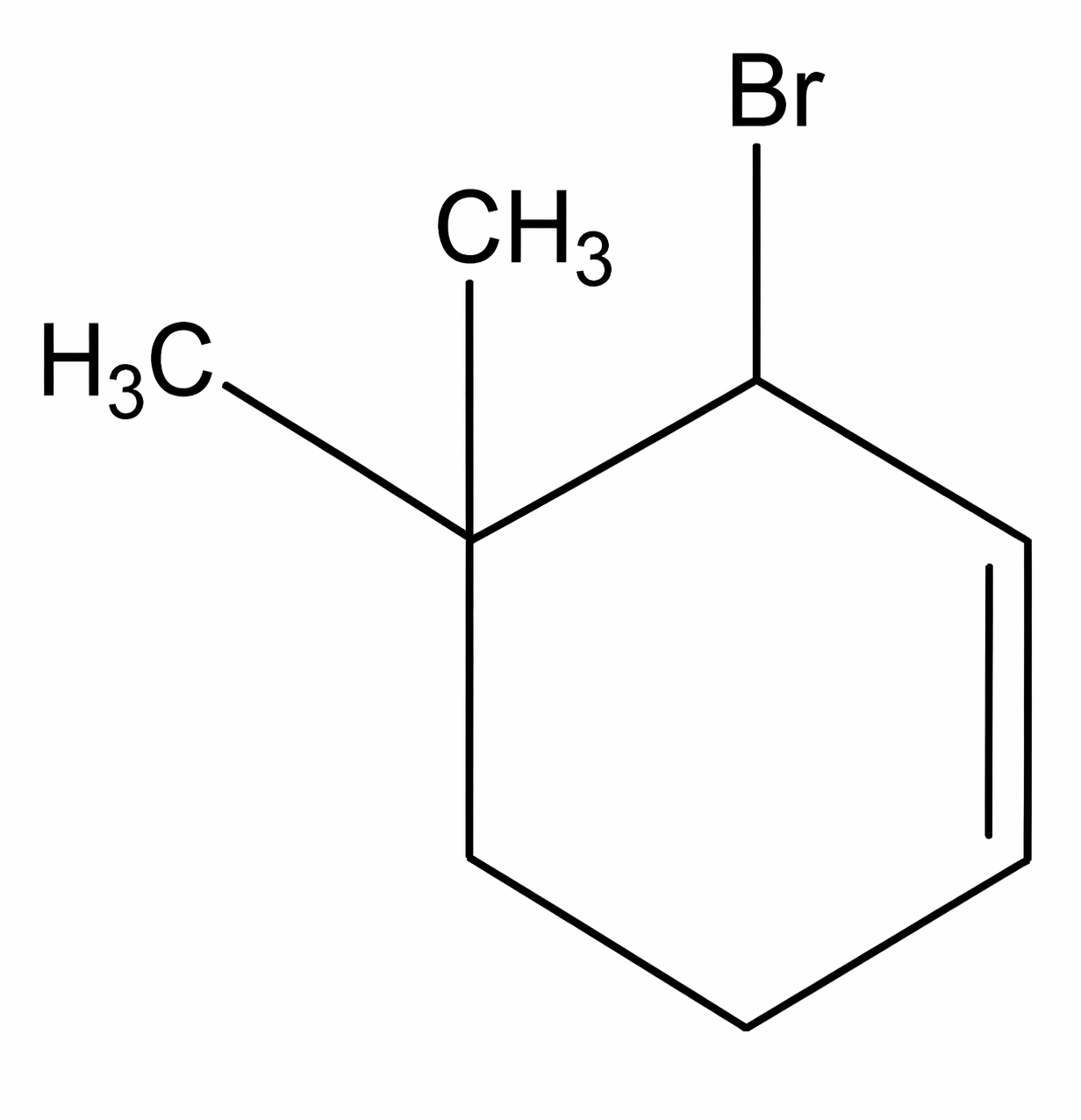 CUET 2025 Medium
 - The coordination number \(( CN )\) and oxidation state \(( OS )\) of Co in \(\left[ Co \left( C _2 O _4\right)_3\right]^{3-}\) is. \(\_\_\_\_\)CUET 2023 Hard
- The negatively charged sol among the following is:CUET 2023 Medium
- "Answer the question on basis of passage given below :
Carboxylic acids are weaker than mineral acids, but they are stronger acids than alcohols and many simple phenols (\(\text{pKa}\) is ~ 16 for ethanol and 10 for phenol). The higher acidity of carboxylic acids as compared to phenols can be understood similarly. The conjugate base of carboxylic acid, a carboxylate ion, is stabilised by two equivalent resonance structures in which the negative charge is at the more electronegative oxygen atom. The conjugate base of phenol, a phenoxide ion, has non-equivalent resonance structures in which the negative charge is at the less electronegative carbon atom. Further, the negative charge is delocalised over two electronegative oxygen atoms in carboxylate ion whereas it is less effectively delocalised over one oxygen atom and less electronegative carbon atoms in phenoxide ion. Thus, the carboxylate ion is more estabilised than phenoxide ion, so carboxylic acids are more acidic than phenols.
Effect of substituents on the acidity of carboxylic acids: substituents may affect the stabliity of the conjugate base and thus, also affect the acidity of the carboxylic acids. Electron withdrawing group increase the acidity of carboxylic acids by stabilising the conjugate base through delocalisation of the negative charge by inductive and/or resonance effects. Conversely, electron donating groups decrease the acidity by destabilising the conjugate base.
Arrange the following acids in order of their increasing \(\text{pKa}\) value:
(A) Benzoic acid
(B) 2-nitrobenzoic acid
(C) 4-nitrobenzoic acid
(D) 4-methoxybenzoic acid
Choose the correct answer from the options given below:"CUET 2023 Easy - Electrical disintegration or Bredig's Arc method involvesCUET 2023 Medium
More PYQs from CUET
- The system of equations
\(\begin{aligned} & x-3 y-8 z=-10 \\ & 2 x+5 y+\lambda z=13 \\ & 3 x+y-4 z=0\end{aligned}\)
has infinite number of solutions if the value of \(\lambda\) is equal to:CUET 2025 Easy - Let \(\Delta=\left|\begin{array}{ccc}a+b x & c+d x & p+q x \\ a x+b & c x+d & p x+q \\ u & v & w\end{array}\right|=\left(k-x^2\right)\left|\begin{array}{ccc}a & c & p \\ b & d & q \\ u & v & w\end{array}\right|\) then the value of k is:CUET 2023 Medium
- Match List-I with List-II (where \(c\) is an arbitrary constant)
Choose the correct answer from the options given below :List-I List-II (A) \(\int \tan x d x\) (I) \(\log |\sec x+\tan x|+c\) (B) \(\int \cot x d x\) (II) \(\log |\sec x|+c\) (C) \(\int \sec x d x\) (III) \(\log |\sin x|+c\) (D) \(\int \operatorname{cosec} x d x\) (IV) \(\log |\operatorname{cosec} x-\cot x|+c\) CUET 2025 Easy - Which of the following statements are correct?
(A) When light rays undergoes two internal reflections inside a raindrop, a secondary rainbow is formed.
(B) The angle between the emergent ray and angle of prism is called the angle of deviation.
(C) Light undergoes successive total internal reflections as it move through an optical fibre.
(D) A telescope provides angular magnification of distant objects.
(E) A simple magnifier is a diverging lens of small focal length.
Choose the correct answer from the options given below :CUET 2023 Hard - Match List-I with List-II for the band gap energy for different materials
List-I (Substances) List-II (Band gap Energy) (A) Germanium (I) 1.1 eV (B) Silicon (II) 0.7 eV (C) Insulator (III) Zero (D) metal (IV) 5 eV
Choose the correct answer from the options given below:CUET 2025 Easy - Which factor does not affect Hardy-Weinberg equilibrium?CUET 2023 Hard