


CUET · CHEMISTRY · PYQ PAPER 2023
Answer the question on the basis of passage given below:
Aldehydes are generally more reactive than ketones in nucleophilic addition reactions due to steric and electronic reasons. Sterically, the presence of two relatively large substituents in ketones hinders the approach of nucleophile to carbonyl carbon more than aldehydes having only one such substituent Electronically aldehydes are more reactive than ketones because two alkyl groups reduce the elctrophilicity of the carbonyl more effectively than in former.
Write the reaction sequence when phthalic acid reacts with ammonia.
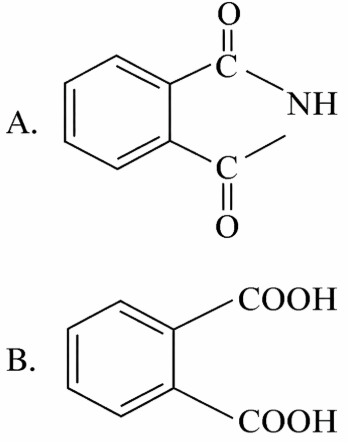
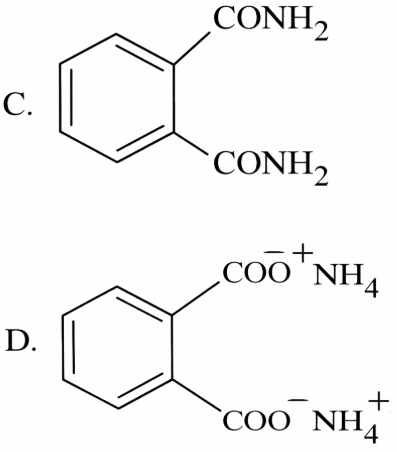
Choose the correct answer from the options given below:
- A \(B < D < C < A\)
- B \(B < C < D < A\)
- C \(B < A < D < C\)
- D \(B < C < A < D\)
Answer & Solution
Correct Answer
(D) \(B < C < A < D\)
Step-by-step Solution
Detailed explanation
\(C_6H_4(COOH)_2 + 2NH_3 \rightarrow C_6H_4(COONH_4)_2\) \(C_6H_4(COONH_4)_2 \xrightarrow{\Delta} C_6H_4(CONH_2)_2 + 2H_2O\) \(C_6H_4(CONH_2)_2 \xrightarrow{\text{Strong } \Delta} C_6H_4(CO)_2NH + NH_3\) \(B < D < C < A\)
See the Complete Solution
Get step-by-step explanations for this and 2.5 Lakh+ more JEE, NEET & CET questions.
- Unlock all solutions
- Practice the full chapter
- Track accuracy across PYQs
4.8 rated on Google Play · 14,000+ reviews
More questions from CHEMISTRY
- Match List-l with List-ll
Choose the correct answer from the options given below:List-l (Rate expression) List-II (Overall order of reaction) (A) \(r=k[A]^{0.2}[B]^{0.3}[C]\) (I) \(\frac{3}{10}\) (B) \(r=k[A]^{0.2}[B]^{-0.3}[C]\) (II) 1 (C) \(r=k[A][B]^{0.8}[C]^{-1}\) (III) \(3 / 2\) (D)\(r=k[A]^{0.2}[B]^{0.3}[C]^{0.5}\) (IV) \(9 / 10\) CUET 2025 Hard - Camphor in nitrogen gas is a type of solution:CUET 2024 Hard
- Answer the question on the basis of passage given below :
Aldehydes and ketones represent two essential classes of organic compounds
which are extensively used in the synthesis of a wide variety of other organic molecules.
Due to the inherent polarity of the central carbonyl group, these substances readily undergo nucleophilic addition reactions.
Broadly speaking, these addition reactions can be categorized into two types:
one in which simple addition of the nucleophilic reagent occurs across the \(> C = O\) bond, and the second type where the initial addition is subsequently followed by the elimination of a water molecule.
A variety of ammonia derivatives, including hydroxylamine, hydrazine, phenylhydrazine,
2, 4-dinitroplhenylhdrazine, and semicarbagide, all belong to this second category of reactions.
These specific derivatives are fundamentally used for the identification and definitive characterization of aldehydes and ketones. Significantly, both types of nucleophilic addition reactions are strongly influenced by both steric and electronic factors.
As a general rule, aliphatic aldehydes exhibit higher reactivity compared to aromatic aldehydes.
The aliphatic aldehydes demonstrate the ability to reduce both Fehling's solution and Tollen's reagent, whereas aromatic aldehydes are limited to reducing only Tollen's reagent.
In a similar manner to aldehydes, aromatic ketones are observed to be less reactive than aliphatic ketones towards all nucleophilic addition reactions.
In a separate context, phenols and carboxylic acids both exhibit acidic properties in nature.
Both classes of compounds readily dissolve in NaOH solution and cause blue litmus to turn red.
However, carboxylic acids stand out as much stronger acids than phenols and thus can decompose sodium bicarbonate \(\left( NaHCO _3\right)\) with the distinct evolution of \(CO _2\) gas, a reaction which phenols do not undergo.
It is important to note that both electron- donating and electron- withdrawing substituents significantly influence the acid strength of both aliphatic as well as aromatic carboxylic acids.
Furthermore, unlike all other common aliphatic acids, formic acid uniquely possesses reducing properties and simultaneously does not display the typical reactions characteristic of the alkyl group.
Fehling Solution A and B respectively, are :CUET 2023 Hard - Among the following compounds, which will not undergo oxidation reaction?CUET 2025 Easy
- Which of the following statement(s) is correct?
(A). Keratin is an example of fibrous protein.
(B). Fibrous proteins are water-soluble, while globular proteins are water-insoluble.
(C). Polypeptide chains in fibrous proteins run parallel and are held together by hydrogen and disulphide bonds.
(D). Insulin and albumins are common examples of globular proteins.
Choose the correct answer from the options given below :CUET 2023 Medium - What kind of behavior is shown in the Zwitter ionic form of amino acids?CUET 2025 Medium
More PYQs from CUET
- Answer the question on the basis of passage given below :
A colloid is a heterogeneous system in which a substance is dispersed (dispersed phase) as fine particles in another substance called dispersion medium.
Their particle size is intermediate between that of pure solutions (less than 1 nm) and suspensions (greater than 1000 nm).
They are known for interesting properties such as enormous surface area, Tyndall effect, Brownian motion etc.
They are widely used in industries and day to day life.
Some prominent uses of colloids are those in smoke precipitators, purification of water, medicines, cleansers etc.
Which of the following statements correctly explains the charge on hydrated ferric oxide sol, prepared by adding \(\text{FeCl}_3\) to hot water?CUET 2023 Hard - Observe the figures and answer the question.
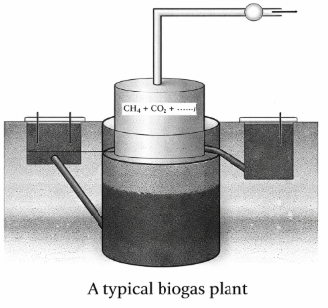
Which of the following material can not be used as slurry in bio-gas plants?CUET 2023 Medium - In a 200 m race, Rohan completes the race in 8 seconds and Vivan completes the race in 10 seconds. By how much distance Rohan beats Vivan?CUET 2025 Medium
- Fe shows extra stability as \(\text{Fe}^{3+}\) due to :CUET 2023 Hard
- Which of the following contribute to increase in population density?CUET 2023 Easy
- The straight line \(\frac{x+2}{3} = \frac{z-3}{-2}, y=2\) isCUET 2023 Medium