


CUET · CHEMISTRY · PYQ PAPER 2023
Answer the question on the basis of passage given below :
Formaldehyde is the first member of the aldehydic series. It is present in green leaves of plants where its presence is supposed to be due to the reaction of \(CO_2\) with water in the presence of sunlight and chlorophyll. Commercially, formaldehyde is obtained by the controlled oxidation of methane in the presence of molybdenum oxide (\(MoO\)) acting as a catalyst. Formaldehyde is a constituent of a number of polymers also called resins. These are non volatile solids or semi solids which are obtained directly from certain plants and can be synthesized in the laboratory.
Benzaldehyde is less reactive towards nucleophilic addition reaction than formaldehyde because of:
- A + R effect of \(>C=O\) group and steric factor due to phenyl group
- B - R effect of \(>C=O\) group and steric factor due to phenyl group
- C - I effect of \(>C=O\) group and steric factor due to phenyl group
- D + I effect of \(>C=O\) group and steric factor due to phenyl group
Answer & Solution
Correct Answer
(A) + R effect of \(>C=O\) group and steric factor due to phenyl group
Step-by-step Solution
Detailed explanation
Benzaldehyde is less reactive towards nucleophilic addition than formaldehyde due to the electron-donating resonance (+R) effect of the phenyl group, which decreases the electrophilicity of the carbonyl carbon, and the steric hindrance caused by the bulky phenyl group. The…
See the Complete Solution
Get step-by-step explanations for this and 2.5 Lakh+ more JEE, NEET & CET questions.
- Unlock all solutions
- Practice the full chapter
- Track accuracy across PYQs
4.8 rated on Google Play · 14,000+ reviews
More questions from CHEMISTRY
- What is the product of the following reaction?
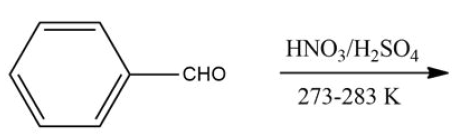 CUET 2025 Medium
 - All natural and artificial radioactive decay of unstable nuclei take place byCUET 2025 Medium
- The strongest oxidising and reducing agents respectively are :CUET 2023 Easy
- Read the passage carefully and answer the questions
The carbonyl group of aldehydes and ketones is highly polar. The positively charged carbon is readily attacked by electron-rich nucleophile and the negatively charged oxygen atom is attacked by an electro-deficient electrophile. Aldehydes and ketones undergo nucleophilic addition reactions in the presence of acid or a base. The mechanism involves attack of a nucleophile on the electron deficient carbonyl carbon to form a tetrahedral intermediate. A new bond is formed between the carbon and oxygen. Protonation of the anion furnished by the reaction medium yields neutral addition product. The addition product is same whether the reaction is catalyzed by acid or a base. For example in the presence of base aldehydes and ketones react with hydrogen cyanide to form cyanohydrin.
Which of the following compounds will undergo nucleophilic addition readily?CUET 2025 Easy - Read the passage carefully and answer the questions
The carbonyl group of aldehydes and ketones is highly polar. The positively charged carbon is readily attacked by electron-rich nucleophile and the negatively charged oxygen atom is attacked by an electro-deficient electrophile. Aldehydes and ketones undergo nucleophilic addition reactions in the presence of acid or a base. The mechanism involves attack of a nucleophile on the electron deficient carbonyl carbon to form a tetrahedral intermediate. A new bond is formed between the carbon and oxygen. Protonation of the anion furnished by the reaction medium yields a neutral addition product. The addition product is same whether the reaction is catalyzed by acid or a base. For example in the presence of base aldehydes and ketones react with hydrogen cyanide to form cyanohydrin.
The source of nucleophile in the base catalyzed cyanohydrin formation is:CUET 2025 Hard - Answer the question on the basis of passage given below :
Aldehydes and ketones represent two essential classes of organic compounds
which are extensively used in the synthesis of a wide variety of other organic molecules.
Due to the inherent polarity of the central carbonyl group, these substances readily undergo nucleophilic addition reactions.
Broadly speaking, these addition reactions can be categorized into two types:
one in which simple addition of the nucleophilic reagent occurs across the \(> C = O\) bond, and the second type where the initial addition is subsequently followed by the elimination of a water molecule.
A variety of ammonia derivatives, including hydroxylamine, hydrazine, phenylhydrazine,
2, 4-dinitroplhenylhdrazine, and semicarbagide, all belong to this second category of reactions.
These specific derivatives are fundamentally used for the identification and definitive characterization of aldehydes and ketones. Significantly, both types of nucleophilic addition reactions are strongly influenced by both steric and electronic factors.
As a general rule, aliphatic aldehydes exhibit higher reactivity compared to aromatic aldehydes.
The aliphatic aldehydes demonstrate the ability to reduce both Fehling's solution and Tollen's reagent, whereas aromatic aldehydes are limited to reducing only Tollen's reagent.
In a similar manner to aldehydes, aromatic ketones are observed to be less reactive than aliphatic ketones towards all nucleophilic addition reactions.
In a separate context, phenols and carboxylic acids both exhibit acidic properties in nature.
Both classes of compounds readily dissolve in NaOH solution and cause blue litmus to turn red.
However, carboxylic acids stand out as much stronger acids than phenols and thus can decompose sodium bicarbonate \(\left( NaHCO _3\right)\) with the distinct evolution of \(CO _2\) gas, a reaction which phenols do not undergo.
It is important to note that both electron- donating and electron- withdrawing substituents significantly influence the acid strength of both aliphatic as well as aromatic carboxylic acids.
Furthermore, unlike all other common aliphatic acids, formic acid uniquely possesses reducing properties and simultaneously does not display the typical reactions characteristic of the alkyl group.
Fehling Solution A and B respectively, are :CUET 2023 Hard
More PYQs from CUET
- In uniform electric field \( \vec{E} = 3 \times 10^3\hat{i} \text{ N/C} \), a square loop of side 10 cm is placed such that plane of square loop is parallel to the yz plane. The flux linked with the square loop will be:CUET 2023 Hard
- Transmission of HIV-Infection occurs by-
(A). Using infected needles by the health staff or by drug abusers
(B). Transfusion of contaminated blood and blood product
(C). Sexual contact with infected person
(D). Sharing food and sanitation facilities
Choose the correct answer from the options given below:CUET 2023 Hard - Match List-l with List-II
List-l (Genetic disorder) List-II (Characteristics) (A) Haemophilia (I) Mutation in HBB gene (B) Thalassemia (II) Sex-linked recessive disease (C) Phenylketonuria (III) Aneuploidy (D) Klinefelter's syndrome (IV) Mental retardation and reduced hair and skin pigmentation
Choose the correct answer from the options given below:CUET 2025 Easy - The amines which are soluble in water
(A) Methanamine
(B) Ethanamine
(C) Propanamine
(D) Benzylamine
Choose the correct answer from the options given below:CUET 2025 Easy - The degree of the differential equation \(\left(2+\left(\frac{d y}{d x}\right)^2\right)^{\frac{3}{2}}=a^2 \frac{d^2 y}{d x^2}\) is :CUET 2025 Easy
- A cistern can be filled by an inlet pipe in 20 hours and can be emptied by an outlet pipe in \(2 5\) hours. Both the pipes are opened. After \(1 0\) hours, the outlet pipe is closed, the total time to fill the tank is :CUET 2023 Easy