


CUET · CHEMISTRY · PYQ PAPER 2025
\(2 N_2 O _5 \rightarrow 4 NO _2+ O _2\)
At a given instant of time, the rate and rate constant are 1.02 \(\times\) 10\(^-\)\(\mathrm{4}\) mol L\(^-\)\(\mathrm{1}\) s\(^-\)\(\mathrm{1}\) and 3.4 \(\times\) 10\(^-\)\(\mathrm{5}\) s\(^-\)\(\mathrm{1}\), respectively.
The concentration of N\(_2\)\(\mathrm{O}\)_5 at that time will be:
- A \(3.0 \mathrm{~mol} \mathrm{~L}^{-1}\)
- B \(1.713 \mathrm{~mol} \mathrm{~L}^{-1}\)
- C \(1.02 \times 10^{-4} \mathrm{~mol} \mathrm{~L}^{-1}\)
- D \(3.4 \times 10^{-5} \mathrm{~mol} \mathrm{~L}^{-1}\)
Answer & Solution
Correct Answer
(A) \(3.0 \mathrm{~mol} \mathrm{~L}^{-1}\)
Step-by-step Solution
Detailed explanation
\( \text{Rate} = k[\text{N}_2\text{O}_5] \) \( [\text{N}_2\text{O}_5] = \frac{\text{Rate}}{k} \) \( [\text{N}_2\text{O}_5] = \frac{1.02 \times 10^{-4} \text{ mol L}^{-1}\text{ s}^{-1}}{3.4 \times 10^{-5} \text{ s}^{-1}} \) \( [\text{N}_2\text{O}_5] = 3.0 \text{ mol L}^{-1} \)
See the Complete Solution
Get step-by-step explanations for this and 2.5 Lakh+ more JEE, NEET & CET questions.
- Unlock all solutions
- Practice the full chapter
- Track accuracy across PYQs
4.8 rated on Google Play · 14,000+ reviews
More questions from CHEMISTRY
- Insulin is the example ofCUET 2023 Hard
- Answer the question on the basis of passage given below :
Adsorption is a surface phenomenon and it differs from absorption which occurs throughout the body of the substance that absorbs. In physiosorption the attractive forces are mainly van der Waal's forces while in chemisorption ionic/covalent bonds are formed between particles of adsorbent and adsorbate. The catalytic activity of finely divided iron in Haber's process of ammonia manufacture can be explained by adsorption theory. Adsorption being an exothermic process, the heat of adsorption is utilised in enhancing the rate of the reaction. Adsorption has many applications being used in gas masks, control of humidity, chromatograph separation, curing diseases etc.
Chromatography is based on:CUET 2023 Medium - Match List - I with List - II.
Choose the correct answer from the options given below :List - I (Polymer) List - II (Monomer) (A) Nylon 2-nylon 6 (I) Ethylene glycol and Benzene-1,2-dicarboxylic acidne (B) Neoprene (II) Glycine and Amino caproic acid (C) Glyptal (III) Adipic acid and Hexamethylene diam (D) Nylon 6, 6 (IV) 2-chlorobuta-1,3-diene CUET 2023 Hard - The number of moles of electrons produced in the oxidation of 67.2 L of H 2 at STP is:CUET 2024 Hard
- Low concentration of oxygen in the blood and tissues of people living at high altitude is due to :CUET 2023 Medium
- Williamson's synthesis for preparing dimethyl ether involvesCUET 2025 Easy
More PYQs from CUET
- A person invested ₹ 20000 in a mutual fund in year 2018. The value of the mutual fund increased to ₹ 32000 in year 2023. The compound annual growth rate of his investment is:
[Given that (1.6) \({ }^{\frac{1}{5}}=1.098\) ]CUET 2025 Easy - The radius of the first orbit in Bohr's hydrogen atom is 0.53\(\text{\AA}\). The radius of fourth orbit of this atom will be:CUET 2023 Medium
- Which of the following is not a limitation of valence bond theory (VBT)?CUET 2025 Hard
- Graphite is a good conductor of electricity due to the presence of -CUET 2023 Easy
- The correct IUPAC name for the following structure is:
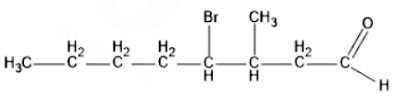 CUET 2025 Easy
 - How much charge is required for the reduction of 0.05 moles of \(MnO _4^{-}\) to \(MnO _2\)?CUET 2023 Medium