


CUET · BIOLOGY · PYQ PAPER 2025
The type of antibodies that produce the immune response in the presence of allergens like pollen, dust, animal dander etc. is _________
- A IgA
- B IgE
- C IgM
- D IgG
Answer & Solution
Correct Answer
(B) IgE
Step-by-step Solution
Detailed explanation
IgE
See the Complete Solution
Get step-by-step explanations for this and 2.5 Lakh+ more JEE, NEET & CET questions.
- Unlock all solutions
- Practice the full chapter
- Track accuracy across PYQs
4.8 rated on Google Play · 14,000+ reviews
More questions from BIOLOGY
- Read the following passage carefully and answer the given questions
The separated DNA fragments can be visualized only after staining the DNA with ethidium bromide followed by exposure to UV radiation. Bright orange colored bands of DNA in ethidium bromide stained gel exposed to UV light can be seen. The separated bands of DNA are cut out from the agarose gel and extracted from the gel piece. This step is known as elution. The DNA fragments purified in this way are used in constructing recombinant DNA by joining them with a cloning vector.
Which one of the following techniques is used to separate DNA fragments?CUET 2025 Hard - Match List - I with List - II.
Choose the correct answer from the options given below:List I (Name) List - II (Functions) (A) mRNA (I) amino acid carrier (B) rRNA (II) structural and catalytic role during translation (C) tRNA (IV) template for protein synthesis (D) cistron (III) gene CUET 2023 Medium - Bt toxin is expressed in plants to provide resistance to insects; hence used as a bio-pesticide. Select the correct examples of Bt plants:
(A). Bt Cotton
(B). Bt Rice
(C). Bt Peas
(D). Bt Corn
Choose the correct answer from the options given below:CUET 2025 Hard - The parturition is induced by a complex neuroendocrine mechanism. Which of the following hormone is not involved in this process?CUET 2023 Hard
- Match List-l with List-II
List-l (Evolutionary stages of human species) List-II (Time of existence/evolution) (A) Dryopithecus (I) 100,000-40,000 years ago (B) Australopithecines (II) About 1.5 million years ago (C) Homo erectus (III) About 2 million years ago (D) Neanderthal man (IV) About 15 million years ago
Choose the correct answer from the options given below:CUET 2025 Medium - Observe the given diagram representing global biodiversity and answer the question.
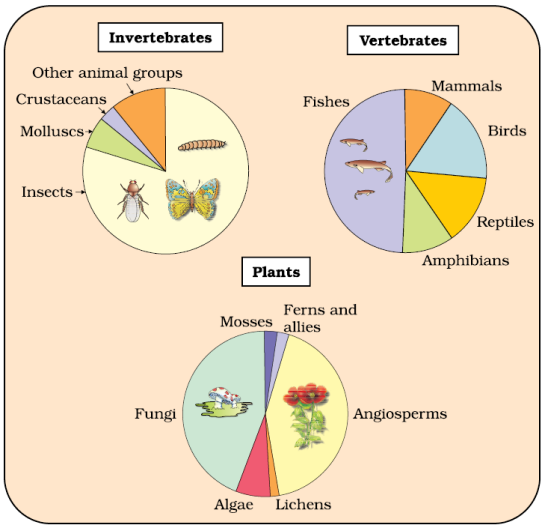
Global Bio-diversity
___________ occupy more than 2/3rd of Global Biodiversity.CUET 2023 Easy
More PYQs from CUET
- Which of the following statements are correct about the "Central Limit Theorem"?
(A) The sampling distribution of the sample mean approaches the normal distribution as the sample size gets larger.
(B) A sample size of 30 or more is considered to be sufficient to hold the "Central Limit Theorem".
(C) As the sample size becomes larger, the prediction of characteristics of the population becomes more accurate.
(D) The sampling distribution of the sample mean approaches bell shaped curveas the sample size gets larger.
Choose the correct answer from the options given below :CUET 2025 Hard - \(30\text{ mL}\) of \(\text{NiSO}_4\) is electrolysed using a current of \(360\text{mA}\) for \(30\text{ minutes}\).
How much of the metal would have been plated out if the current efficiency is only \(60\%\)? (\(\text{Ni} = 58.7\text{g/mol}\))CUET 2023 Easy - In n-type semiconductors, A are the majority charge carriers and B are the minority charge carriers. Here A and B are :CUET 2025 Medium
- Patients with diabetes have :CUET 2023 Medium
- For a bimolecular elementary reaction between A and B, the rate of reaction is expressed as rate \(=P \cdot Z_{A B} e^{-E_a / R T}\)
Identify the terms \(P, Z_{A B}\) and \(E_a\) involved in this expression, respectivelyCUET 2025 Hard - Which of the following is an example of homologous organs?CUET 2023 Easy