


CUET · BIOLOGY · PYQ PAPER 2025
Read the following passage carefully and answer the given questions.
Plasmodium, a tiny protozoan is responsible for the disease malaria. Different species of Plasmodium (P. vivax, P. malaria and P. falciparum) are responsible for different types of malaria. Of these, malignant malaria caused by Plasmodium falciparum is the most serious one and can even be fatal. Innate immunity consist of four types of barriers. These are – (i) Physical barriers- skin on our body is the main barrier which prevents entry of the micro-organisms. (ii) Physiological barriers- Acid in the stomach, saliva in the mouth, tears from eyes-all prevent microbial growth. (iii) Cellular barriers- Certain types of leukocytes (WBC) of our body like polymorpho-nuclear leukocytes (PMNL-neutrophils) and monocytes and natural killer (type of lymphocytes) in the blood as well as macrophages in tissues can phagocytose and destroy microbes. (iv) Cytokine barriers- virus-infected cells secrete proteins called interferons which protect non-infected cells from further viral infection. Allergy is due to the release of chemicals like histamine and serotonin from the mast cells. The use of drugs like anti-histamine, adrenalin and steroids quickly reduce the symptoms of allergy. Drugs like barbiturates, amphetamines, benzodiazepines, and other similar drugs, that are normally used as medicines to help patients cope with mental illnesses like depression and insomnia, are often abused.
Which one of the followings is not an example of physiological barriers?
- A Acid in the stomach
- B Interferons
- C Saliva in the mouth
- D Tears from eyes
Answer & Solution
Correct Answer
(B) Interferons
Step-by-step Solution
Detailed explanation
Interferons
See the Complete Solution
Get step-by-step explanations for this and 2.5 Lakh+ more JEE, NEET & CET questions.
- Unlock all solutions
- Practice the full chapter
- Track accuracy across PYQs
4.8 rated on Google Play · 14,000+ reviews
More questions from BIOLOGY
- The cutting of DNA at specific locations is done with help of:CUET 2023 Easy
- Which one of the given structures is not the secondary lymphoid organ?CUET 2025 Medium
- In some organisms, male has ZZ chromosomes and female has ZW chromosomes. This type of sex-determination is found in:CUET 2023 Easy
- In angiosperms, the outer wall of ovary develops into :CUET 2023 Hard
- Arrange the following steps regarding HIV infection in correct sequence
A. Viral RNA produced by the infected cell
B. Virus infects macrophages.
C. Viral DNA is produced by reverse transcriptase.
D. Viral RNA is introduced into the cell.
E. Viral DNA incorporates into the host genome.
Choose the correct answer from the options given below:CUET 2023 Easy - The key tools of recombinant DNA technology are:
(A) Ligases
(B) Restriction enzymes
(C) Polymerase enzymes
(D) Suitable vectors and host organisms
Choose the correct answer from the options given below:CUET 2025 Medium
More PYQs from CUET
- Identify the carbohydrate which is not a polysaccharideCUET 2025 Medium
- Increasing order of oxidation states of transition metal oxides will be :
(A) \(\text{TiO}_2\)
(B) \(\text{MnO}_4^-\)
(C) \(\text{VO}_2^+\)
(D) \(\text{CrO}_4^{2-}\)
(E) \(\text{Ni(CO)}_4\)
Choose the \textbf{correct} answer from the options given below :CUET 2023 Medium - The reaction of neutral \(M n O 4 ^{ \wedge }\) - and \(I ^{ \wedge }\) - givesCUET 2023 Easy
- In the given circuit, if the potential at A is 50 V, then potential at B is
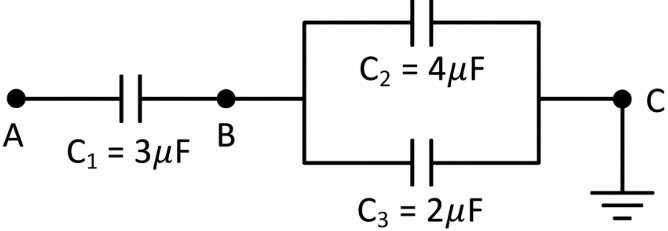 CUET 2025 Medium
 - In a potentiometer, a cell is balanced at 240 cm. On shunting the cell with 2 \(\Omega\) resistance, the balancing comes at 120 cm. What is the internal resistance of the cell ?CUET 2023 Medium
- Read the passage carefully and answer the questions
Replacement of a hydrogen atom in a hydrocarbon by an alkoxy or carboxyl group yields a class of compounds known as ethers. Ethers are classified as symmetrical or unsymmetrical on the basis of groups attached to the oxygen atoms. Diethyl ether, a symmetrical ether, has been widely used as an inhalation anesthetic. Ethers can be prepared by acid catalyzed intermolecular dehydration of alcohols and Williamson's synthesis. Acid catalyzed dehydration of alcohols is not generally preferred as it gives a mixture of elimination and substitution products. In Williamson's synthesis, an alkyl halide is allowed to react with sodium alkoxide. Ethers containing substituted Alkyl groups may also be prepared by this method. The C-O bond in ether is weakly polar and is cleaved under drastic conditions with excess of hydrogen halides. In electrophilic substitution, the alkoxy group deactivates the aromatic ring and directs the incoming group to ortho and para positions.
When ethanol is dehydrated in the presence of H2SO4, at 443 K and 413 K respectively, the products formed areCUET 2025 Medium