


CUET · BIOLOGY · PYQ PAPER 2023
Observe the given figures and answer the question
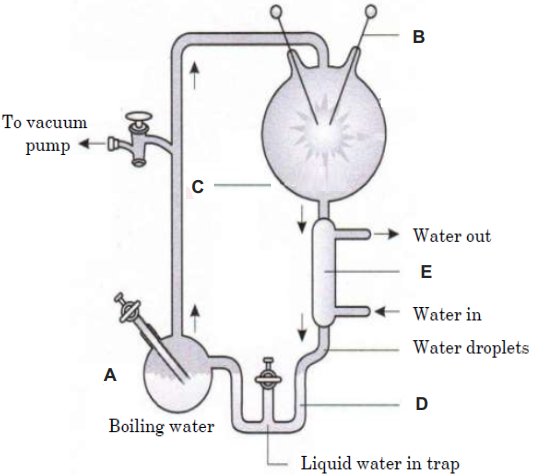
Identify the statements which hold true for Miller's experiment:
(A) He created an electric discharge in a closed flask containing CH4, N2, NH3 and water vapour at 1200°°C
(B) He created electric discharge in a closed flask containing CH4, N2, NH3 and water vapour at 800°C
(C) He observed the formation of amino acids only
(D) He observed the formation of amino acids, sugars and fats
Choose the correct answer from the options given below:
- A A) and (B) Only
- B (B) and (C) Only
- C (C) and (D) Only
- D (B) and (D) Only
Answer & Solution
Correct Answer
(D) (B) and (D) Only
Step-by-step Solution
Detailed explanation
(B) He created electric discharge in a closed flask containing CH4, N2, NH3 and water vapour at 800°C. (D) He observed the formation of amino acids, sugars and fats. The correct option is (B) and (D) Only.
See the Complete Solution
Get step-by-step explanations for this and 2.5 Lakh+ more JEE, NEET & CET questions.
- Unlock all solutions
- Practice the full chapter
- Track accuracy across PYQs
4.8 rated on Google Play · 14,000+ reviews
More questions from BIOLOGY
- The 'hilum' represents the junction between:CUET 2025 Medium
- Downstream processing method involves:CUET 2024 Medium
- The technology of biogas production was developed in India mainly due to the efforts of -CUET 2025 Medium
- The large holes in 'Swiss Cheese' are due to the production of a large amount of CO2 by a bacterium named asCUET 2023 Medium
- The number of phenotypes and genotypes obtained in F2 generation after crossing RRYY and rryy in pea plants are:CUET 2023 Medium
- STIs are reported to be very high among persons in which age group?CUET 2025 Medium
More PYQs from CUET
- The maximum slope of the curve \(y=-x^3+3 x^2+9 x-27\) is:CUET 2023 Hard
- In eukaryotes, RNA polymerase III transcribes:
(A) tRNA
(B) 5.8S rRNA
(C) 5srRNA
(D) snRNA
Choose the correct answer from the options given below:CUET 2025 Easy - The least non-negative remainder, when \(5^{61}\) is divided by 7 , isCUET 2025 Easy
- "Arrange the following in order of increasing boiling points
(A) 1,4-Dichlorobenzene
(B) 1,3-Dichlorobenzene
(C) 1,2-Dichlorobenzene
(D) Chlorobenzene
Choose the correct answer from the options given below:"CUET 2023 Medium - Read the passage carefully and answer the Questions
Molar conductivity \(\left( \Lambda _m\right)\) of a solution at a given concentration (c) is the conductance of volume, V of solution, containing one mole of electrolyte kept between the two electrodes with area of cross-section A and at a distance of unit length. It increases with the decrease in concentration and when the concentration approaches zero, the molar conductivity is called limiting molar conductivity \(\Lambda_m^0\). For a strong electrolyte, \(\left( \Lambda _m\right)\) increases linearly with dilution and is given by \(\Lambda_m=\Lambda_m^0-A c^{1 / 2}\).The value of the constant A for a given solvent depends on the type of electrolyte along with temperature. According to Kohlrausch law, the value of \(\Lambda_m^0\) for an electrolyte is \(\Lambda_m^0=\nu_{+} \lambda_{+}^0+\nu_{-} \lambda_{-}^0\), where \(\nu_{+}\)and \(\nu_{-}\) where v+ and v- are the number of cations and anions, respectively, per molecule of the electrolyte and \(\lambda_{+}^0\) and \(\lambda_{-}^0\) are limiting molar conductivities of cation and anion, respectively. Kohlrausch law
finds many applications, like determining the solubility of a sparingly soluble salt, determining the degree of dissociation \(\left(\Lambda_m / \Lambda_m^0\right)\), and the dissociation constant of a weak electrolyte.
Which one of the following has a different value of constant A in water?CUET 2025 Hard - Read the following paragraph and answer the given questions.
Repeated amplification is achieved by the use of a thermostable DNA polymerase (isolated from a bacterium, Thermus aquaticus), which remain active during the high temperature induced denaturation of double stranded DNA. The separated DNA fragments can be visualised only after staining the DNA with a compound known as ethidium bromide followed by exposure to UV radiation. The separated bands of DNA are cut out from the agarose gel and extracted from the gel piece. The convention for naming these enzymes is the first letter of the name comes from the genus and the second two letters come from the species of the prokaryotic cell from which they were isolated, e.g., EcoRI comes from Escherichia coli RY 13. In EcoRI, the letter 'R' is derived from the name of strain. Roman numbers following the names indicate the order in which the enzymes were isolated from that strain of bacteria. Stanley Cohen and Herbert Boyer accomplished this in 1972 by isolating the antibiotic resistance gene by cutting out a piece of DNA from a plasmid which was responsible for conferring antibiotic resistance. Since the DNA is enclosed within the membranes, we have to break the cell open to release DNA, RNA, protein, polysaccharides etc. The RNA can be removed by treatment with ribonuclease whereas proteins can be removed by treatment with protease. Other molecules can be removed by appropriate treatments and purified DNA ultimately precipitates out after the addition of chilled ethanol.
In the PCR, the thermostable DNA polymerase enzyme is obtained from:CUET 2025 Hard