


CUET · BIOLOGY · PYQ PAPER 2023
Arrange the steps of Polymerase chain reaction in proper sequence-
A. Selection of desired fragment of DNA
B. Annealing
C. Amplification
D. Extension
E. Denaturation
Choose the correct answer from the options given below
- A A, E, B, D, C
- B A, B, C, E, D
- C A, D, B, C, E
- D E, A, B, C, D
Answer & Solution
Correct Answer
(A) A, E, B, D, C
Step-by-step Solution
Detailed explanation
A, E, B, D, C
See the Complete Solution
Get step-by-step explanations for this and 2.5 Lakh+ more JEE, NEET & CET questions.
- Unlock all solutions
- Practice the full chapter
- Track accuracy across PYQs
4.8 rated on Google Play · 14,000+ reviews
More questions from BIOLOGY
- Match List I with List II
List - I List - II (A) Autogamy (I) Oxalis (B) Chasmogamo us flower (II) Pollination within same flower (C) Geitonogamy (III) Genetically different types of pollens fall on stigma of the flower (D) Xenogamy (IV) Transfer of pollen grains from the anther to the stigma of another flower of same plant
Choose the correct answer from the options given below:CUET 2023 Hard - Aphids and mosquitoes can be controlled by, respectively:CUET 2025 Hard
- Match List-I with List-II
Choose the correct answer from the options given below:List-I (Contraceptive methods) List-II (Examples) (A) Barrier method (I) LNG-20 (B) Oral method (II) Multiload 375 (C) Copper releasing IUDs (III) Vaults (D) Hormone releasing IUDs (IV) Saheli CUET 2025 Hard - The inner cell mass of the embryo contains some cells which can give rise to all the tissues and organs. They are known as:CUET 2025 Medium
- Which of the following option is correct for ammensalism?CUET 2023 Easy
- The brain size of Neanderthal man was :CUET 2023 Medium
More PYQs from CUET
- "Choose the reactions given by \(\text{Cr}_2\text{O}_7^{2-}\)
(A)\(\text{Cr}_2\text{O}_7^{2-} + 14\text{H}^+ + 6\text{Fe}^{2+} \rightarrow 2\text{Cr}^{3+} + 6\text{Fe}^{3+} + 7\text{H}_2\text{O}\)
(B) \(\text{Cr}_2\text{O}_7^{2-} + 14\text{H}^+ + 3\text{H}_2\text{S} \rightarrow 2\text{Cr}^{3+} + 3\text{SO}_4^{2-} + 7\text{H}_2\text{O}\)
(C) \(\text{Cr}_2\text{O}_7^{2-} + 14\text{H}^+ + 3\text{Sn}^{2+} \rightarrow 2\text{Cr}^{3+} + 3\text{Sn}^{4+} + 7\text{H}_2\text{O}\)
(D) \(\text{Cr}_2\text{O}_7^{2-} + 14\text{H}^+ \rightarrow 3\text{Cr}^{3+} + 2\text{H}_2\text{O}\)
(E) \(\text{Cr}_2\text{O}_7^{2-} + 2\text{OH}^- \rightarrow 2\text{CrO}_4^{2-} + \text{H}_2\text{O}\)
Choose the correct answer from the options given below:"CUET 2023 Hard - From the following diagram, determine the direction of propagation of an electromagnetic wave.
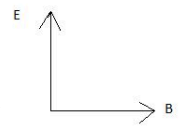 CUET 2025 Easy
 - The condition where one species is harmed whereas the other is unaffected is called.CUET 2023 Medium
- Phenol can be distinguished from ethanol by the following reagent :CUET 2023 Hard
- Answer the question on the basis of passage given below:
Proteins are the polymers of about twenty different a-amino acids which are linked by peptide bonds. Proteins perform various structural and dynamic functions in the organisms. Proteins which contain only a-amino acids are called simple proteins. The secondary or tertiary structure of proteins get disturbed on change of pH or temperature and they are not able to perform their functions. This is called denaturation of proteins. Enzymes are biocatalysts which speed up the reactions in biosystems. Vitamins are accessory food factors required in the diet. They are classified as fat soluble (A, D, E and K) and water soluble (B group and C). Deficiency of vitamins leads to many diseases. Nucleic acids are the polymers of nucleotides which in turn consist of a base, a pentose sugar and phosphate moiety. Nucleic acids are responsible for the transfer of characters from parents to offsprings. There are two types of nucleic acids DNA and RNA. DNA contains a five carbon sugar molecule called 2-deoxyribose whereas RNA contains ribose.
Which of the following is an essential amino acid?CUET 2023 Easy - Read the following paragraph carefully and answer the given questions.
In the year 1963 the two enzymes responsible for restricting the growth of bacteriophage in E. coli were isolated. The first restriction endonuclease - Hind II, whose functioning depended on a specific DNA nucleotide sequence was characterized five years later. It was found that Hind II always cut DNA molecules at a particular point by recognizing a specific sequence of six base pairs. This specific base sequence is known as the recognition sequence for Hind II. Besides Hind II, today we know more than 900 restriction enzymes that have been isolated from over 230 strains of bacteria, each of which recognize different recognition sequences.
In EcoR I the latter 'R' is derived from the -CUET 2023 Easy